Table of Contents
Best BITSAT Attempt Strategy to Avoid Negative Marking and Maximize Score (2026)
Pratham Jiwnani
5/16/2026
If you are preparing for BITSAT 2026, one question keeps most students up at night: should you attempt more questions to score higher, or play it safe to avoid negative marking? The answer is neither extreme. It is about knowing exactly when to push forward and when to hold back — and making that call correctly under exam pressure is what separates a 260 from a 320.
This guide breaks down the complete BITSAT attempt strategy for 2026, covering how negative marking works, how many questions to attempt at each score target, when guessing helps versus hurts, and what top scorers actually do differently.
BITSAT 2026 Exam Overview
BITSAT (Birla Institute of Technology and Science Admission Test) is the entrance exam for B.E., B.Pharm., and integrated M.Sc. programmes at BITS Pilani campuses in Pilani, Goa, and Hyderabad. It is conducted entirely online, and unlike JEE, it has no sectional time limits — 130 questions in 3 hours, all in one continuous window.
Here is a quick reference for BITSAT 2026:
| Detail | Information |
|---|---|
| Conducting Body | BITS Pilani |
| Exam Mode | Computer-Based Test |
| Total Questions | 130 + 12 optional bonus |
| Duration | 3 Hours |
| Marking Scheme | +3 Correct, –1 Wrong, 0 Skipped |
| Session 1 Dates | 15–16 April 2026 |
| Session 2 Dates | 24–26 May 2026 |
| Session 2 Application Deadline | 5 May 2026 |
Always verify the latest dates and eligibility details on the official BITS Pilani admissions portal, as schedules can be updated. For subject-wise preparation, CrackIT's BITSAT Formula Sheets offer a free, exam-ready resource built by BITSians.
How Negative Marking Works in BITSAT — And Why It Changes Everything
Understanding the marking system is not optional — it is the foundation of your entire exam strategy. Every correct answer earns you +3 marks. Every incorrect answer costs –1 mark. Unattempted questions carry zero marks and do not penalise you in any way.
Here is where many students go wrong: they assume that attempting more questions always leads to a higher score. The math says otherwise. Consider two realistic scenarios.
In the first scenario, you attempt 20 uncertain questions, get 8 right (+24) and 12 wrong (–12), for a net gain of +12. Acceptable. In the second scenario, same 20 questions, but you only get 4 right (+12) and 16 wrong (–16), for a net loss of –4. You have actually hurt your score by attempting those questions.
This is why the BITSAT negative marking strategy is not about avoiding guessing entirely. It is about guessing only when you have a genuine reasoning advantage — not out of anxiety or habit.
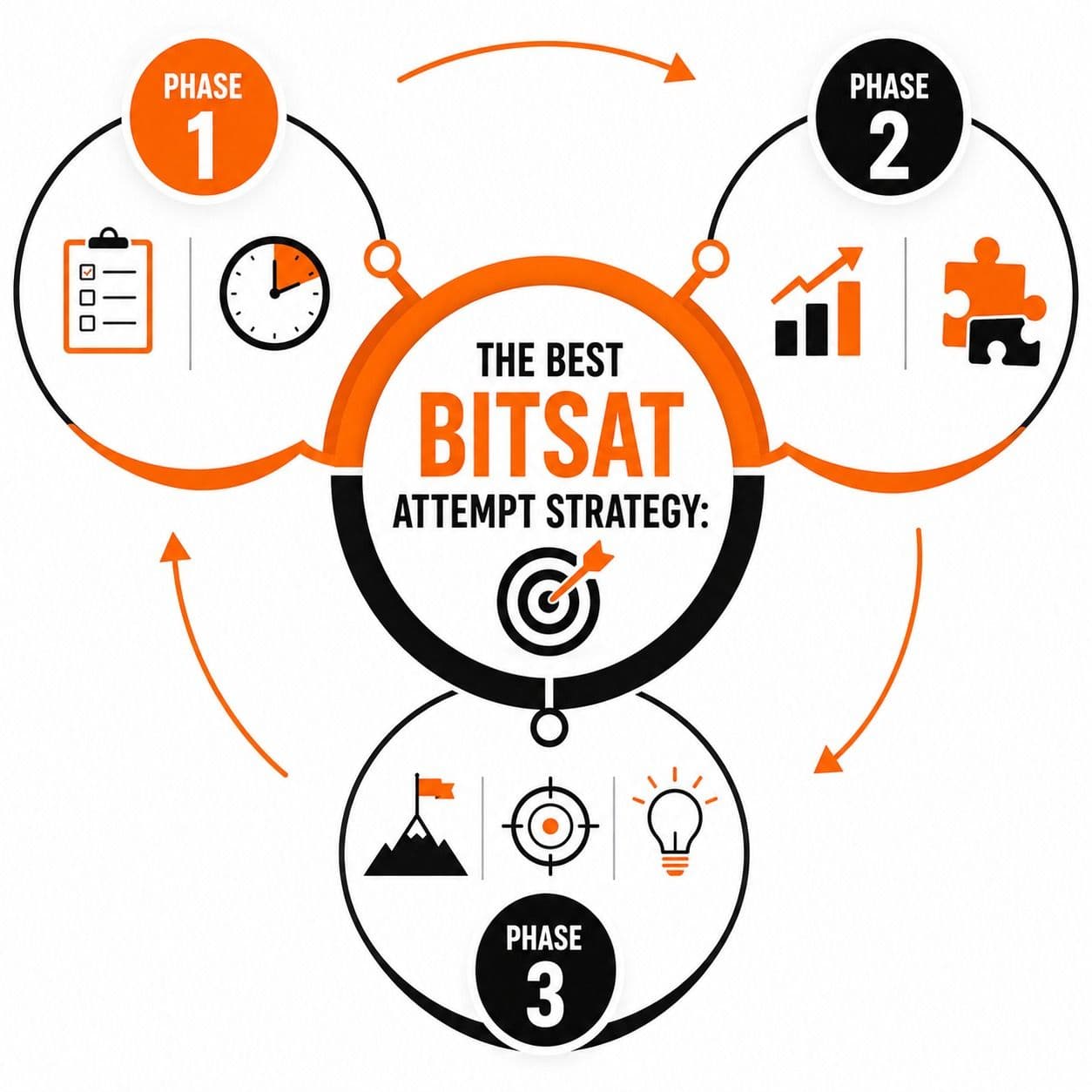
The Best BITSAT Attempt Strategy: A 3-Phase Approach
Top scorers do not tackle all 130 questions in order and hope for the best. They work in deliberate phases, each with a clear goal and a clear stopping condition.
Phase 1 — First 60 to 75 Minutes: Build Your Score Foundation
Start with what you know cold. Direct Chemistry questions, straightforward Physics, English vocabulary, and Logical Reasoning are your early momentum-builders. Avoid lengthy calculations or multi-step derivations in this opening phase. Your target is 45 to 55 questions answered with high confidence. This is not the time to prove yourself on hard problems — it is the time to put runs on the board and build a cushion.
Phase 2 — Next 75 Minutes: Controlled Expansion
Now you move into moderate-difficulty territory — calculation-based PCM problems, questions where elimination is possible, and topics you know reasonably well but need more than 30 seconds to solve. The rule here is straightforward. If you cannot see a clear path to the answer within 60 to 90 seconds, skip it and move on. Your accuracy strategy depends on discipline, not stubbornness.
Phase 3 — Final 30 to 40 Minutes: Strategic Risk-Taking
This phase decides whether you score 280 or 310. Revisit skipped questions and apply educated guessing where applicable — but only when you have eliminated at least two options, partially recall a relevant formula, or can narrow the answer through logic. Never make a random attempt purely because time is running out. A panicked wrong answer in this phase can undo three correct ones.
Students who train with CrackIT's BITSAT Test Series regularly practise this 3-phase approach under timed conditions. Mock analysis — not mock count — is what sharpens your transitions between phases.
How Many Questions Should You Attempt in BITSAT?
This is one of the most searched questions about BITSAT, and there is no single universal answer. The right number depends entirely on your accuracy level, which you should already know from your mock test performance.
| Score Target | Suggested Attempts | Accuracy Needed |
|---|---|---|
| 220 – 250 | 85 –100 | Moderate (75–80%) |
| 250–280 | 95–110 | Good (82–87%) |
| 300+ | 105–118 | High (88–92%) |
| 330+ | 115+ | Very High (93%+) |
These are benchmarks, not rules. A student who attempts 95 questions with 90% accuracy will outscore someone who attempts 120 recklessly. Raw attempt count means nothing — your final score does.
How to Score 300+ in BITSAT: The Maths Behind the Milestone
Scoring 300 in BITSAT sounds intimidating, but the numbers are more achievable than most students realise. You do not need to attempt every question. You need to attempt the right ones.
A simple calculation: 105 correct answers multiplied by 3 equals 315. Minus 15 wrong answers at 1 mark each equals –15. Final score: 300 exactly. That is 105 out of 130 questions — roughly 80% of the paper — with a reasonable 15-question error margin.
A realistic 300+ breakdown by section looks like this: Physics (22–25 correct), Chemistry (24–27 correct), English and Logical Reasoning (20–25 correct), and Mathematics (35–40 correct). Mathematics and Chemistry typically offer the highest scoring opportunities for well-prepared students.
If you are currently scoring in the 240–290 range and want a personalised roadmap, CrackIT's mentorship programme pairs you with BITSians who have cracked the exact score you are targeting and can identify precisely where you are losing marks.
Should You Guess the BITSAT? Yes — But Only Smartly
Smart guessing is a skill, not a risk. When you have absolutely no idea what the answer is, skipping is correct. But when you have eliminated two options, recall a partial formula, or can reason about the question conceptually — that is not a guess, it is an educated inference, and the expected value is positive.
A simple decision framework for exam day:
Attempt the question if you have eliminated at least two options, you can recall a relevant concept or formula, or your reasoning — backed by logic rather than anxiety — points toward a particular answer.
Skip the question if all four options look equally plausible, you have no conceptual anchor for the question, or you are considering an attempt purely because time pressure is making you anxious.
Practising this decision under timed conditions is the only way to truly internalise it. That is one of the core benefits of taking full-length BITSAT mock tests that replicate real exam pressure. Explore the CrackIT Test Series to get started with mocks designed by BITSians.
Can You Skip Questions in BITSAT?
Absolutely — and you should. There is a persistent myth among students that skipping questions signals weakness or poor preparation. It does not. It is a deliberate strategic choice that top scorers make repeatedly throughout the exam.
Spending four minutes on a single stubborn question while skipping five questions you could have solved in that same time is one of the most common BITSAT score killers. The rule of thumb: if a question has not given you a clear path to the answer within 75 to 90 seconds, mark it for review and move on. You can return to it later. You cannot recover the time lost staring at a problem that is actively draining your confidence.
BITSAT Bonus Questions: A Reward, Not a Rescue
After completing all 130 main questions, BITSAT offers 12 optional bonus questions. This sounds like a free score boost, but there is a critical catch — once you move to the bonus section, you cannot return to the main paper. Any doubts, review flags, or questions you wanted to revisit are locked in permanently.
Attempt the bonus questions only when you have completed the main paper with genuine confidence, have very few questionable answers, and have sufficient time remaining. If you rushed through the main paper or made several uncertain guesses, use that remaining time to review flagged answers instead of chasing bonus marks. The best BITSAT bonus question strategy is simple — treat it as a reward for strong preparation, not a lifeline.
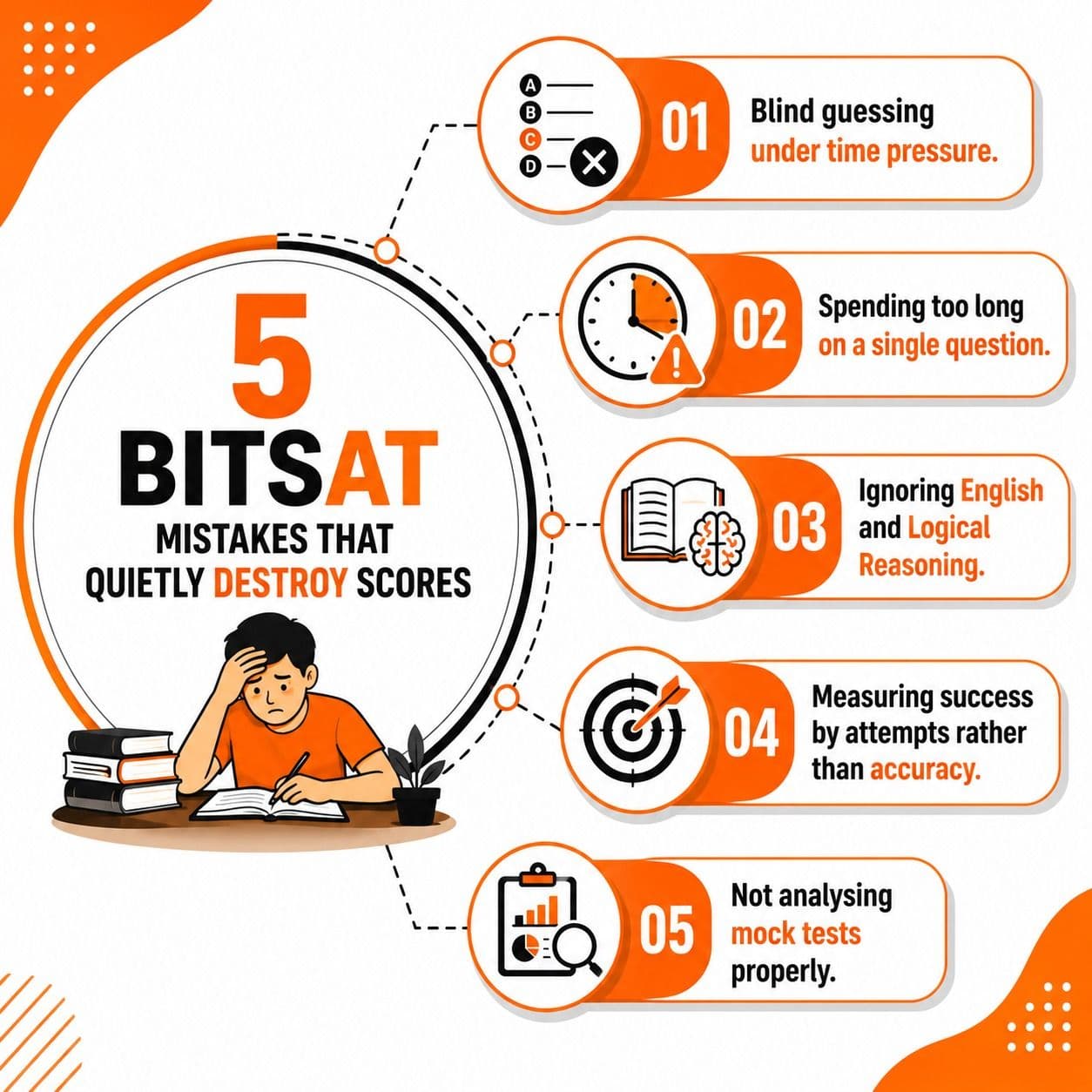
5 BITSAT Mistakes That Quietly Destroy Scores
Blind guessing under time pressure. This is the most costly mistake in BITSAT. Even one bad guessing streak in the final 20 minutes can wipe out significant gains from the first half of the paper.
Spending too long on a single question. BITSAT rewards speed and smart distribution of effort. No single question is worth four minutes of your time.
Ignoring English and Logical Reasoning. These two sections can be completed quickly with high accuracy and are routinely undertrained. Students who obsess over Physics derivations but skip LR practice are leaving easy marks on the table.
Measuring success by attempts rather than accuracy. Your score is the only number that matters on results day. Attempting 125 questions with 70% accuracy is worse than attempting 100 with 88% accuracy.
Not analysing mock tests properly. Taking 20 mocks without reviewing why you got questions wrong teaches you very little. Mock analysis is where real improvement happens. Read what students who have been through this process say on the CrackIT Reviews page.
BITSAT Time Management: A Suggested Section Split
With no sectional time limits, you are free to allocate time however you choose — which is both a freedom and a trap. Without a plan, most students drift toward their comfort zones and run short on time in their stronger sections.
| Section | Suggested Time |
|---|---|
| Physics + Chemistry | 90 minutes |
| English + Logical Reasoning | 25 minutes |
| Mathematics | 60 minutes |
| Review Buffer | 5–10 minutes |
This is a starting point, not a rigid rule. Your ideal split will emerge from your mock test data. Track your section-wise timing in every mock and adjust accordingly. If you are unsure how to interpret your performance data, a CrackIT mentor can walk you through it in a single session.
Final Preparation Checklist for BITSAT 2026
Strong preparation is the foundation that makes every strategy above actually work. Without the underlying knowledge, no attempt formula compensates.
Revise formula sheets daily, especially Physics mechanics, Organic Chemistry reactions, and Mathematics shortcuts — all available for free on CrackIT's Formula Sheets page. Solve two to three full timed mock tests per week and spend as much time on analysis as you did on the test itself. Practise the skip-and-return habit actively — do not wait until exam day to discover you cannot let a question go. Read the CrackIT blog regularly for subject-specific strategies and exam updates. And if you are unsure whether your current score is enough for your preferred campus and branch, use the CrackIT BITSAT College Predictor to get a data-backed estimate before exam day.
Frequently Asked Questions
How does negative marking work in BITSAT?
Every correct answer gives +3 marks, every incorrect answer deducts –1 mark, and skipped questions carry 0 marks. This structure makes accuracy significantly more important than raw volume of attempts.
How many questions should I attempt in BITSAT for 300+?
Most students targeting 300+ attempt between 105 and 118 questions with high accuracy. For example, 105 correct answers minus 15 wrong answers gives exactly 300 marks.
Should I attempt all 130 questions in BITSAT?
Not unless your mock accuracy is consistently above 90%. Attempting all questions with lower accuracy will reduce your score because negative marks accumulate faster than most students expect.
Is guessing worth it in BITSAT?
Yes, but only educated guessing. If you can eliminate two or more options using partial knowledge or logic, guessing improves your expected score. Blind guessing without any conceptual basis typically hurts your final tally.
Can I skip questions in BITSAT?
Yes. Skipping is a strategic tool, not a failure. If a question takes more than 90 seconds without a clear solution path, skip it, move on, and return if time allows.
Should I attempt the bonus questions in BITSAT?
Only after confidently completing all 130 main questions with minimal uncertain answers and enough time remaining. Once you enter the bonus section, you cannot return to the main paper.
What is a good BITSAT score for BITS Pilani CSE? B
ITS Pilani CSE typically requires 340+ for the Pilani campus, 330+ for Goa, and slightly lower for Hyderabad, though cutoffs vary each year. Use the CrackIT College Predictor for an estimate based on recent trends.
What is the total marks in BITSAT 2026?
The total marks in BITSAT is 390, calculated as 130 questions multiplied by 3 marks each. With the optional 12 bonus questions, the maximum possible score is 426, though bonus attempts carry the same +3/–1 scheme.
Which section is easiest to score in BITSAT?
English and Logical Reasoning are widely considered the fastest sections to score in because questions are direct, require no complex calculation, and can be completed in under 25 minutes with good preparation. Many students underinvest in these sections and leave guaranteed marks unclaimed.
How should I use BITSAT mock tests effectively?
Attempt every mock under strict exam conditions — no breaks, no phones, full 3-hour window. Immediately after, analyse every wrong answer and every skipped question. Track your accuracy percentage, section-wise timing, and guess success rate across mocks. This data tells you your real attempt ceiling far more reliably than intuition. CrackIT's Test Series includes detailed performance analytics built specifically for this kind of analysis.
Does BITSAT have sectional cutoffs?
No. BITSAT does not have sectional minimum marks. Your total score across all sections is what determines admission eligibility. However, to hit competitive totals, you need to perform consistently across all four sections — neglecting any one section creates a ceiling on your overall score.
How is BITSAT different from JEE in terms of exam strategy?
The key strategic differences are speed and flexibility. BITSAT has no sectional time limits, so you manage your own time across the full paper. The +3/–1 marking scheme is identical to JEE Advanced for MCQs, but BITSAT's 130-question volume in 3 hours means the average time per question is under 90 seconds. JEE allows more time per question and has a wider variety of question types. BITSAT rewards faster recall, smart skipping, and efficient time allocation more than deep analytical thinking per question.
Conclusion
The best BITSAT attempt strategy for 2026 is not about attempting everything — it is about attempting the right questions at the right time with the right level of confidence behind you. Prioritise accuracy, skip without hesitation when needed, guess only when logic supports it, and treat the bonus section as a reward for solid preparation rather than a safety net.
Build your personal attempt benchmark through consistent mock testing, track your numbers honestly, and refine your approach every single week leading up to the exam. That is what 300+ scorers consistently do.
For expert-designed mocks, personalised feedback, and guidance from students who have cracked BITSAT at the highest levels, explore CrackIT's BITSAT Test Series and mentorship programme — built by BITSians, for future BITSians.
Categories
Join the Discussion
0 comments