Table of Contents
Exam Review BITSAT 2025 Shift 1 (24 June Morning): Analysis, Difficulty & Student Feedback
Pratham Jiwnani
6/24/2025
Exam Review BITSAT 2025 Shift 1 (24 June Morning): Analysis, Difficulty & Student Feedback
June 24, 2025, marked Day 1 of BITSAT 2025, and the morning shift (Shift 1) brought a mix of relief, challenges, and surprises for aspirants across the country. For many, the paper was a test of perseverance with its long, tricky sections that pushed mental sharpness to the limit.
If you're prepping for the upcoming BITSAT shifts or curious about what the first batch of examinees faced, you're in the right place. Here's a subject-wise analysis, insights from students, and tips to help strategize for better results.
Key Insights at a Glance
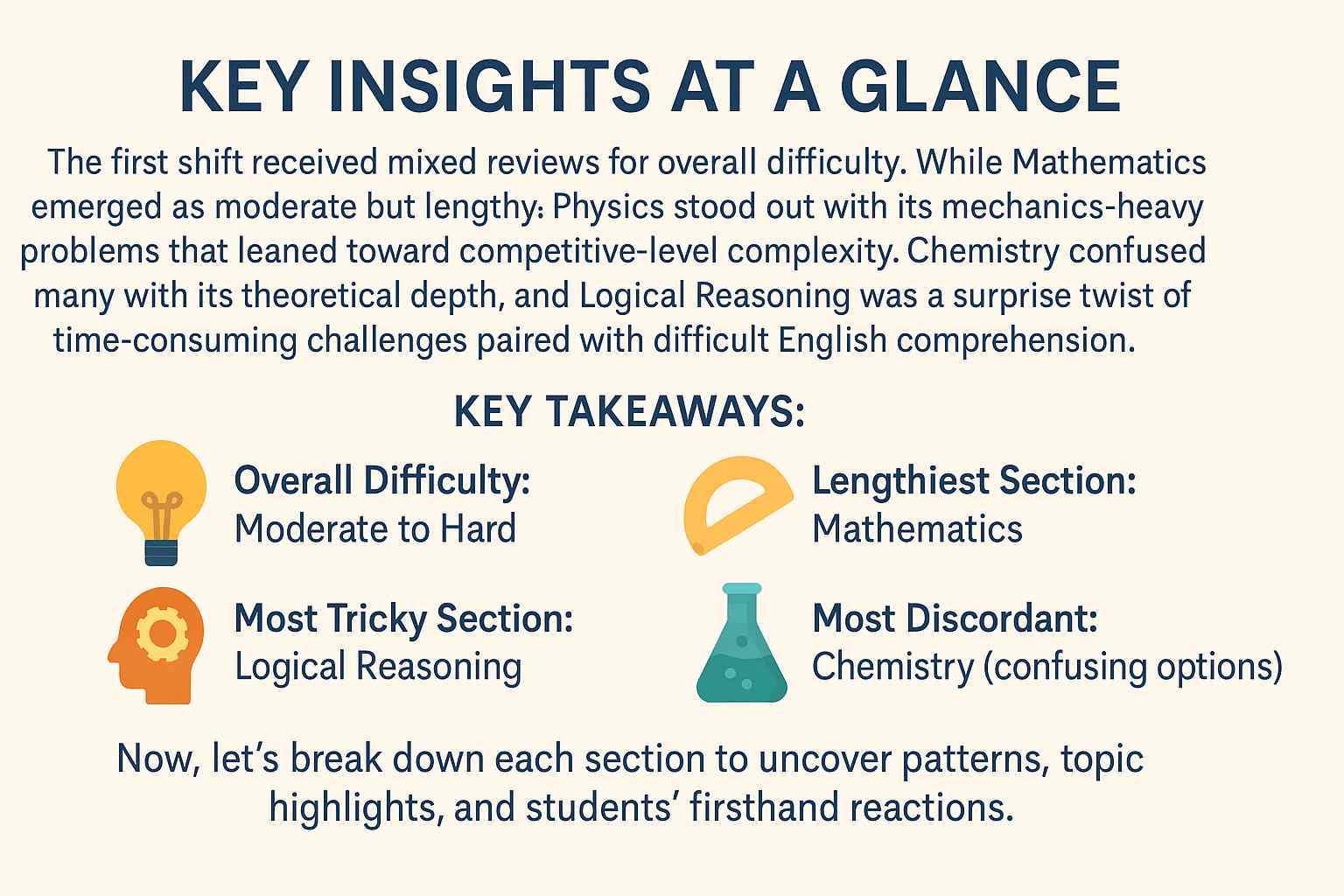
The first shift received mixed reviews for overall difficulty. While Mathematics emerged as moderate but lengthy, Physics stood out with its mechanics-heavy problems that leaned toward competitive-level complexity. Chemistry confused many with its theoretical depth, and Logical Reasoning was a surprise twist of time-consuming challenges paired with difficult English comprehension.
Key takeaways:
- Overall Difficulty: Moderate to Hard
- Lengthiest Section: Mathematics
- Most Tricky Section: Logical Reasoning
- Most Discordant: Chemistry (confusing options)
Now, let's break down each section to uncover patterns, topic highlights, and students' firsthand reactions.
Subject-wise Paper Analysis (BITSAT 2025, Shift 1)
Mathematics – Lengthy and Time-Consuming
Mathematics posed no extraordinary surprises but remained true to BITSAT's reputation for lengthy calculations. Dominated by multi-step logical problems, cracking this section required efficiency and time management.
Key Highlights:
- Probability alone featured 5–6 questions, with a mix of Bayes' Theorem and conditional probability.
- Vectors & 3D Geometry led the charge, asking about coplanar conditions and vector identities.
- Differential Equations was significant but manageable, with IF-based and problem-solving variations in 2–3 questions.
- Topics like Integration focused on Indefinite parts, avoiding definite integration questions altogether.
- Miscellaneous areas like Conics, Cramer’s Rule, and Trigonometry each had 2–4 straightforward questions.
Student Feedback
“The questions weren’t too tough, but every single one took more time than expected. I had to skip problems in the last 10 minutes.”
Physics – Moderate to Hard, Mechanics Stands Out
A mechanics-heavy paper, the Physics section leaned closer to JEE-level. Questions demanded core conceptual knowledge, especially in NLM, Rotational Motion, and Simple Harmonic Motion (SHM).
Key Highlights:
- The majority of the section revolved around Mechanics, including:
- Newton's Laws of Motion (NLM)
- SHM and wave motion (2–3 direct problem statements).
- Projectile motion and rotational conditions.
- Electrostatics & Magnetism explored niche areas:
- Force calculation over cones, point charges, etc.
- Several 1–2 mark formula-driven problems, including:
- KE of ejected electrons, c = 1/√εμ.
Student Feedback
“Physics felt relentless. Mechanics has always been okay for me, but some solved concepts appeared totally fresh or indirect.”
Chemistry – Tricky and Mentally Exhausting
Chemistry leaned more toward theoretical challenges. Students described the section as moderate but confusing due to overwhelming theory and mental fatigue induced by ambiguous options.
Key Highlights:
- Physical Chemistry:
- Focused on formulas and concepts tied to reactions and equilibrium factors.
- Clear favorite picks were Kinetics, Electrochemistry, and Equilibrium.
- Organic Chemistry:
- Fewer tricky questions here, but still packed with in-depth frame requests:
- E.g., unusual flame test finds and product predictions.
- Fewer tricky questions here, but still packed with in-depth frame requests:
- General & Theoretical:
- No focus on Biology chapters.
English & Logical Reasoning
English:
- The section had mixed difficulty. While some found a couple of questions manageable, comprehension passages were mostly moderate to tough.
- Vocabulary-based questions and inference-based questions required careful reading and understanding.
Key Tip: Don’t get stuck on individual words. Focus on the overall meaning of the sentence, and look for keywords like "however" or "despite" to understand contrasts or shifts in tone. Practice skimming while identifying key details to improve comprehension speed and accuracy.
Logical Reasoning:
- This section was time-consuming and challenging.
- Many students struggled to complete all the questions due to time constraints.
Key Tip: Time management is crucial. Attempt shorter, straightforward questions first and mark lengthy or confusing ones to revisit later. Consistent practice with mock tests can help build speed and accuracy.
Memory-Based Questions Asked in BITSAT 2025 Shift 1 (24 June Morning)
Chemistry
- Identify the incorrect statement about Xenon compounds.
- Oxidation number of Fe³⁺ in EDTA complex.
- Second ionization energy trend among V, Cr, and Mn.
- SI unit of radioactivity.
- SI unit of permeability in a medium.
- The product formed when potassium (K) reacts with excess O₂.
Physics
- Dimensional analysis of the expression ℎ𝑐/𝑓, where ℎ is Planck’s constant, 𝑐 is the speed of light, and 𝑓 is frequency.
- SI unit of permeability.
- SI unit of radioactivity.
- A dipole-based SHM question with two negative charges and a positive charge oscillating between them.
- Force on a cylinder when a bullet rebounds at 45°.
- Vector identity problem: If 𝑎⃗ × 𝑏⃗ = 𝑏⃗ × 𝑐⃗ = 𝑐⃗ × 𝑎⃗, what is 𝑎⃗ + 𝑏⃗ + 𝑐⃗?
Mathematics
- Which conic section does not have two parallel tangents?
- Evaluate the logarithmic series: ln(7) − ln(49)/2 + ln(343)/3 − ⋯
- Given the equation of a tangent and a radius of 20, find the equation of the circle.
- From a pair of straight lines and a normal-like equation, find the orthocenter.
- Solve a system using Cramer’s Rule.
Summary Table
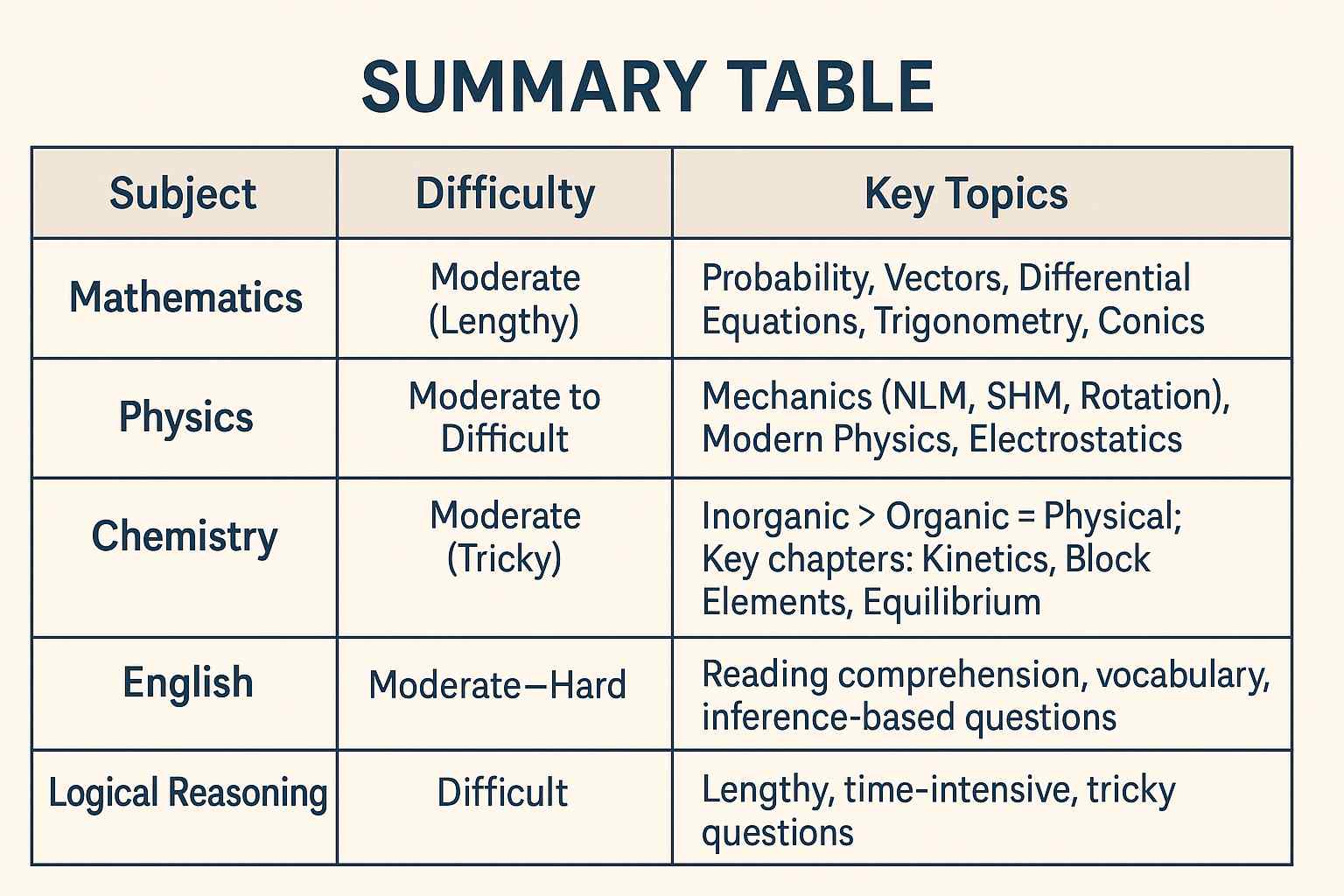
| Subject | Difficulty | Key Topics |
|---|---|---|
| Mathematics | Moderate (Lengthy) | Probability, Vectors, Differential Equations, Trigonometry, Conics |
| Physics | Moderate to Difficult | Mechanics (NLM, SHM, Rotation), Modern Physics, Electrostatics |
| Chemistry | Moderate (Tricky) | Inorganic > Organic = Physical; Key chapters: Kinetics, Block Elements, Equilibrium |
| English | Moderate–Hard | Reading comprehension, vocabulary, inference-based questions |
| Logical Reasoning | Difficult | Lengthy, time-intensive, tricky questions |
Student Reactions at a Glance:
- “The paper felt tough overall—Chemistry and LR took a lot of time.”
- “Maths was okay, but lengthy; Mechanics in Physics was tough.”
- “I wasted time studying deleted Chemistry chapters… they didn’t show up.”
- “Bayes theorem, VCM, and DE integration came up—definitely JEE-like.”
Tips for Upcoming Shifts:
- Physics: Strengthen your Mechanics concepts and memorize essential formulas.
- Mathematics: Focus on Probability, Differential Equations, and Conics.
- Chemistry: Don’t skip Block Chemistry, Electrochemistry, and key theory in Inorganic.
- Logical Reasoning: Skip lengthy problems if stuck and return later. Practice time-bound LR mocks.
- English: Practice reading between the lines and recognizing tone/intent for tricky comprehension questions.
Conclusion:
BITSAT 2025 Shift 1 was a test of speed, precision, and patience. While no section was overwhelmingly difficult, the combined length and mental load created pressure. The key to cracking upcoming shifts lies in consistent practice, topic prioritization, and mock test strategy.
BITSAT papers can feel unpredictable, but consistent practice and a clear strategy can make all the difference. Focus on high-weightage topics, stay calm, and manage your time wisely. Remember, even tricky papers are manageable with preparation and patience. If you’re preparing for the next shift, review your weak points and tackle them head-on.
Stay focused. You've got this!
Categories
Join the Discussion
0 comments