Table of Contents
BITSAT 30 Day Crash Plan for 330 Score
Pratham Jiwnani
5/16/2026

So you've been giving BITSAT mocks, and the score is stuck somewhere around 240–260. The exam is a month away. And every time you sit down to study, there's this voice in the back of your head asking — "Is 330 even possible now?"
Here's the honest answer: yes, it is. But not by doing what you've been doing.
Most students in this position make the same mistake — they panic, download three new study plans, buy another test series, and start "studying harder." That rarely works. What actually works in the last 30 days is very different from what worked in the first six months. This BITSAT 30 day crash plan for 330 score breaks down exactly what you need to do — day by day. And if you're looking for quality mocks to practice with, check out CrackIT's BITSAT Mock Test Series built specifically to mirror the real exam pattern.
Quick Answer (For Students Who Need It Now)
- Yes, 250 → 330+ is possible in one month — but only with focused mock analysis, not more studying
- Attempt 15–20 full-length mocks in the last 30 days
- Spend 2–3x more time on analysis than on the test itself
- Prioritize NCERT Chemistry + formula revision + LR speed
- Do NOT start new books or resources — fix what's already broken
- Track progress over 5-day averages, not daily scores
BITSAT Exam Pattern
Before diving into the plan, here's what you're actually dealing with:
| Feature | Details |
|---|---|
| Mode | Online (Computer-Based Test) |
| Duration | 3 Hours |
| Total Questions | 130 + 12 Bonus Questions |
| Subjects | Physics, Chemistry, Maths, English & LR |
| Marking Scheme | +3 Correct / –1 Wrong |
| Target for 330+ | ~110–120 questions at 85–90% accuracy |
BITSAT is not a knowledge exam — it's a speed and accuracy exam. The questions aren't designed to stump you with deep theory; they test how quickly and correctly you can apply what you already know. That distinction changes everything about how you should prepare in the final month.
BITSAT Exam Important Dates (2025)
| Event | Expected Timeline |
|---|---|
| BITSAT Session 1 | May 2025 |
| BITSAT Session 2 | June 2025 |
| Admit Card Release | 7–10 days before exam |
| Slot Booking | 10–15 days before exam |
Section-Wise Scoring Strategy
Here's something most students don't think about — not all sections are equal. Before your BITSAT final 30 days strategy kicks in, understand where the easy marks are:
| Subject | Effort Level | Score Potential | Time to Spend |
|---|---|---|---|
| Chemistry | Low | Very High | 30–35 mins |
| English + LR | Low | High | 20–25 mins |
| Physics | Medium | High | 40–45 mins ( 15min for Bonus) |
| Mathematics | High | Very High | 50–55 mins |
Chemistry and LR together can give you 50–60 marks with relatively low effort. If you're ignoring these two sections, you're literally leaving marks on the table.
BITSAT 30 Day Crash Plan: The 3-Phase Strategy
This is the core of your BITSAT one month study plan with daily targets and mock test strategy. Think of the next 30 days in three distinct blocks — each one builds on the previous.
Phase 1 (Days 1–10): Stop the Bleeding
Goal: Figure out exactly why you're scoring 250 — not 310
This sounds obvious, but most students skip this step entirely. They just keep giving mocks without understanding what's actually going wrong. That's why scores don't move.
In these first 10 days, attempt one mock every two days. But here's the crucial part — spend more time on the analysis than on the test itself. If the test takes 3 hours, spend 4–5 hours going through:
- Every question you got wrong
- Every question you skipped
- Every question you got right but guessed on
Categorize every mistake into one of three buckets:
- Conceptual gaps — you genuinely didn't know the concept
- Silly mistakes — you knew it but made a calculation or reading error
- Time pressure errors — you knew it, but rushed and got it wrong
Most students who do this honestly realize that 60–70% of their lost marks come from silly mistakes and poor question selection — not from lack of knowledge. That's the good news. The marks are already there. You just need to stop throwing them away.
Subject focus in Phase 1:
- Physics: Go through your formula sheet every morning. Skip theory unless there's a real conceptual gap
- Chemistry: NCERT — especially Inorganic. Read it like a story, not a textbook
- Maths: Pick the 5–6 highest-weightage topics and drill only those
Not sure which topics carry the most weight? Go through the complete BITSAT syllabus and topic-wise weightage breakdown to prioritize smarter.
Phase 2 (Days 11–20): Build the Engine
Goal: Push from 250 to 285–295
By now you know your weak spots. This phase of your BITSAT intensive revision plan for last 30 days is about fixing them systematically while building your test-taking habit.
Give mocks every alternate day. The jump from 250 to 290 happens when three things click together:
1. Better question selection In BITSAT, not every question deserves your time. Within the first 20–30 seconds of reading a question, train yourself to judge: is this a quick win, a medium-effort question, or a time sink? Skip the time sinks in the first pass. Come back if time allows.
2. Fixing silly mistakes with an Error Notebook Start maintaining a dedicated error notebook. Every silly mistake — wrong sign, misread question, forgotten unit — gets written down. Before every mock from this point, spend 15 minutes reading through that notebook. The improvement in accuracy is noticeable within a week.
3. Time management per section If you're spending too long in one section, you're attempting questions you shouldn't be. Practice the habit of moving on — it's a skill BITSAT rewards heavily.
Phase 3 (Days 21–30): The Final Push to 330+
Goal: Peak performance on exam day
This is where you shift from fixing problems to peaking at the right time. Your BITSAT last month preparation roadmap for a high score above 300 comes down to three things:
Mental stamina: BITSAT is 3 hours long. Cognitive fatigue hits hardest in the last 30–40 questions. Fix this by always giving mocks in real exam conditions — same time of day, no phone, no breaks, full 3 hours.
The bonus questions: If you finish before time, BITSAT gives you 12 extra questions. This is a massive opportunity that most students don't train for. Practice finishing the main 130 questions in under 2 hours 45 minutes consistently.
Daily formula revision: Spend 30–45 minutes every morning just reading formulas — Physics and Maths. Not solving problems. Just reading. It keeps them fresh and cuts down calculation time in the actual exam.
Subject-Wise Strategy for BITSAT Last 30 Days
Physics
Stop reading theory. If a concept isn't clear by now, deep theory isn't the answer in 30 days. Focus entirely on formula application and speed. High-priority topics: Mechanics, Electrostatics, Optics, and Modern Physics.
Chemistry
This is where you gain the most marks the fastest. NCERT Chemistry, read carefully, is genuinely enough to score very well. For Organic — named reactions and mechanisms. For Inorganic — one-page cheat sheets per chapter, pure memorization. For Physical Chemistry — formulas and calculation drills.
Mathematics
Coordinate Geometry, Calculus, and Algebra make up the bulk of the section. Don't try to cover everything. Master these three and you're in a strong position. Avoid problems that take more than 3–4 minutes — they're not worth it under exam pressure.
English & Logical Reasoning
This section is criminally underused by most students. It's 25 questions, many of them straightforward, and it takes far less time than Physics or Maths. Spend 20–30 minutes daily on LR patterns and vocabulary. In the exam, do this section quickly and redirect that saved time to Maths or Physics.
How to Improve BITSAT Mock Test Score in Last 4 Weeks
If you're stuck at 250, your mock analysis process is what's broken — not your preparation. Here's the method that actually works:
After every mock:
- Categorize every wrong answer (conceptual / silly / time pressure)
- Reattempt all wrong questions without looking at solutions first
- Only then check solutions — understand the approach, not just the answer
- Log every silly mistake in your error notebook
- Identify which section is costing you the most time
Do this consistently for 4 weeks and you will see a score improvement. It's not dramatic or exciting - it's just the process that works. Alongside mocks, solving BITSAT previous year papers is one of the best ways to get familiar with real question patterns and difficulty levels.
A Realistic Daily Study Structure
Here's what a solid day looks like during this BITSAT 30 days study plan with mock test schedule:
| Time Block | Activity |
|---|---|
| Morning (1 hour) | Formula revision + error notebook review |
| Mid-morning to afternoon (3 hours) | Full mock test or section-wise practice |
| Afternoon (3–4 hours) | Mock analysis + targeted weak area revision |
| Evening (1–2 hours) | NCERT Chemistry / LR practice / light formula drilling |
| Night | Wind down — don't study right before bed |
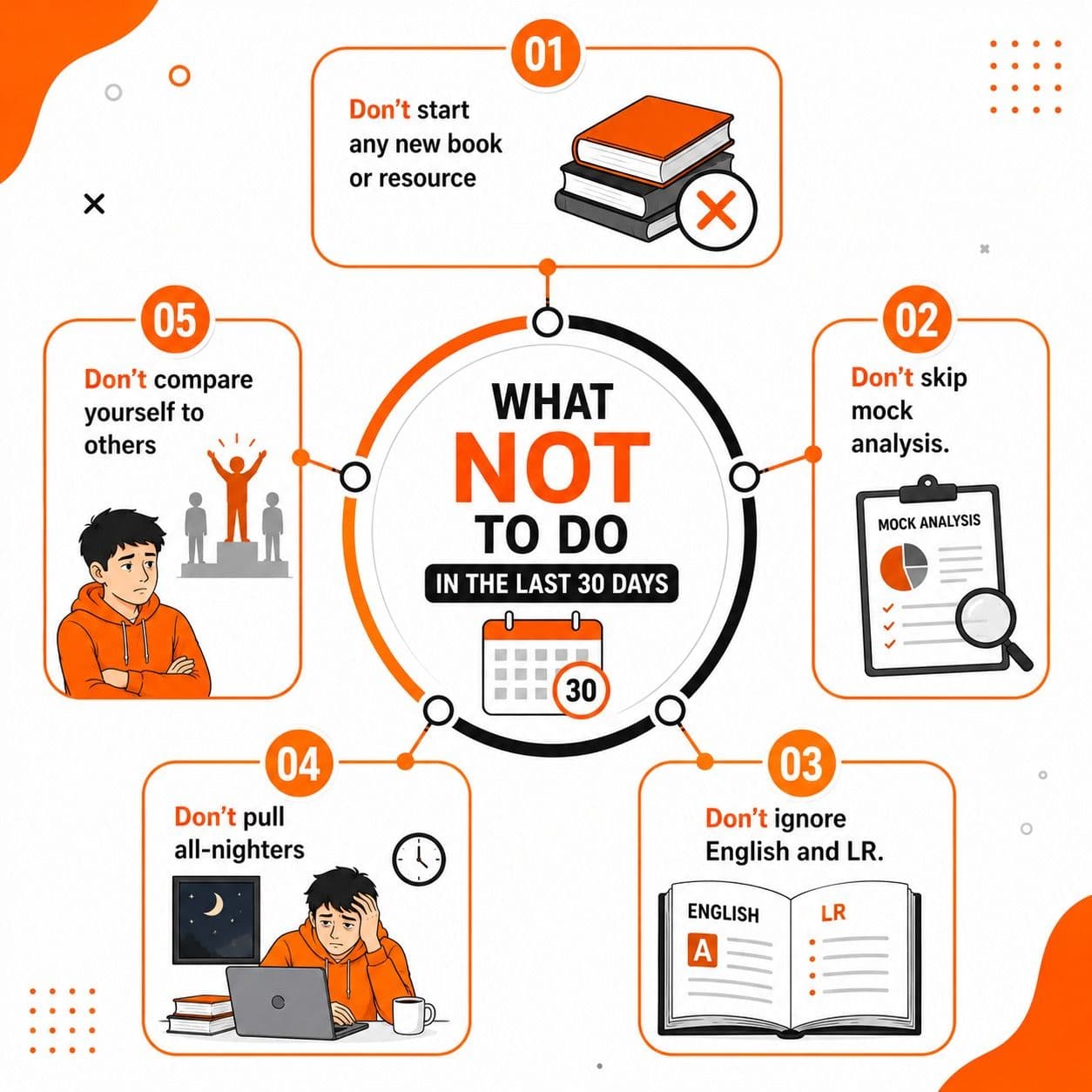
What NOT to Do in the Last 30 Days
Just as important as what you should do:
Don't start any new book or resource. You don't need new material. You need to squeeze more out of what you already have.
Don't skip mock analysis. Giving a mock without analyzing it is like doing a workout with the wrong form — effort with no results.
Don't ignore English and LR. These are free marks. Treating them as unimportant is one of the most expensive mistakes students make in BITSAT.
Don't pull all-nighters. Sleep is when your brain consolidates learning. A tired brain scores worse, makes more silly mistakes, and collapses under pressure. Sleep 7–8 hours, especially in the final week.
Don't compare yourself to others. Someone in your class claims to give 3 mocks a day and score 350. Cool. That's not your story. Stick to your plan.
The Mindset Piece (Yes, This Actually Matters)
Going from 250 to 330 in a month is a significant jump. There will be days when a mock goes badly — you score 220 and feel like the whole plan is falling apart. That's completely normal. Don't change your strategy based on one bad day.
What you're building is a system, not a feeling. Track your progress over 5-day averages, not daily scores. If the trend is moving upward — even slowly — you're doing exactly what you need to. You can also use the CrackIT BITSAT Score Predictor to estimate your target score based on your current mock performance.
The students who make the biggest score jumps in the final month aren't the ones who study the most hours. They're the ones who study the most deliberately.
How CrackIT Helps You Get to 330 Faster
Strategy alone can only take you so far. What separates students who actually hit 330 from those who plateau at 280 is guided analysis.
Advanced Mock Analysis + Video Solutions — Understand exactly why you got a question wrong, not just that you did. Structured breakdowns help you improve faster than reviewing on your own.
Personalized Mentorship — Weekly strategy calls, performance tracking, and a customized plan built around your specific score profile and weak areas. Explore CrackIT's BITSAT Mentorship Program to see how students are guided from 250 to 330+.
BITS College Predictor — Know your chances at Pilani, Goa, and Hyderabad campuses based on your current mock performance. Use the CrackIT BITS College Predictor to set realistic targets and make informed decisions early.
Explore CrackIT's BITSAT Mock Series and Mentorship
Quick Summary
- Attempt 15–20 full mocks in the last 30 days
- Spend more time analyzing than attempting
- Fix silly mistakes through an error notebook
- Prioritize Chemistry and LR for the fastest score gains
- Don't touch new resources — optimize what you already have
- Sleep well, take rest days, and trust the process
330 is within reach. The plan is right here. Now it's about execution.
Frequently Asked Questions
1. Can I really go from 250 to 330 in BITSAT in one month?
Yes — it's genuinely possible if you focus on mock analysis, accuracy improvement, and targeted revision. Most big score jumps happen when students stop learning new content and start fixing recurring mistakes instead.
2. What is the best BITSAT last 30 days preparation strategy?
The most effective strategy is: give regular full-length mocks, analyze every mistake deeply, revise formulas daily, and prioritize high-scoring sections like Chemistry and Logical Reasoning. Avoid switching resources at this stage.
3. How many mocks should I attempt in the last 30 days?
Aim for 15–20 full-length mocks. But the number matters less than the quality of your post-mock analysis. One well-analyzed mock is worth more than three mocks you gave without reviewing.
4. How do I improve my BITSAT mock score quickly in one month?
Focus entirely on accuracy, not attempt count. Maintain an error notebook, revise key topics daily, and analyze every mock test. The fastest improvement comes from fixing the same mistakes you keep repeating — not from solving new problems.
5. Is NCERT enough for BITSAT Chemistry preparation in the last 30 days?
Yes - especially for Chemistry. NCERT covers the bulk of what BITSAT tests, and reading it multiple times in the final 30 days is one of the highest-ROI activities you can do at this stage.
6. What role does mock analysis play in score improvement?
Mock analysis is the single most important factor in the final month. It identifies weak areas, reduces repeated mistakes, and teaches you how to select questions better — all of which directly and immediately affect your score.
7. How should I manage time in the BITSAT exam to score 330+?
Allocate roughly 30–35 minutes to Chemistry, 20–25 minutes to English and LR, and about 50–55 minutes each to Physics and Maths. Always attempt easy questions first in each section and skip time sinks on the first pass.
Categories
Join the Discussion
0 comments