Table of Contents
Mastering BITSAT English – Vocabulary, Grammar & Reading Tips
Pratham Jiwnani
9/18/2025
Many students underestimate BITSAT English. They think, “It’s only 10 questions, I’ll manage.” The truth is, those 10 questions can make or break your final score. They are often the easiest marks to grab if you know what to expect, but the hardest to forgive if you lose them to careless errors. Let’s talk about how to prepare like a pro.
BITSAT English at a Glance
- Section placement: English Proficiency is part of Part III, which has 10 English + 20 Logical Reasoning questions. Total = 30 questions in this section.
- Marking scheme: +3 for correct, 1 for wrong answers.
- Total exam: 130 questions + 12 bonus questions if you finish early. Duration: 3 hours.
- Impact: English is quick and can free up time for tougher Physics, Chemistry, and Math.
Official links: BITS Pilani BITSAT page • BITSAT 2025 brochure PDF
Also read: BITSAT English syllabus (internal) • Prepare Logical Reasoning for BITSAT (internal)
Official Syllabus Snapshot
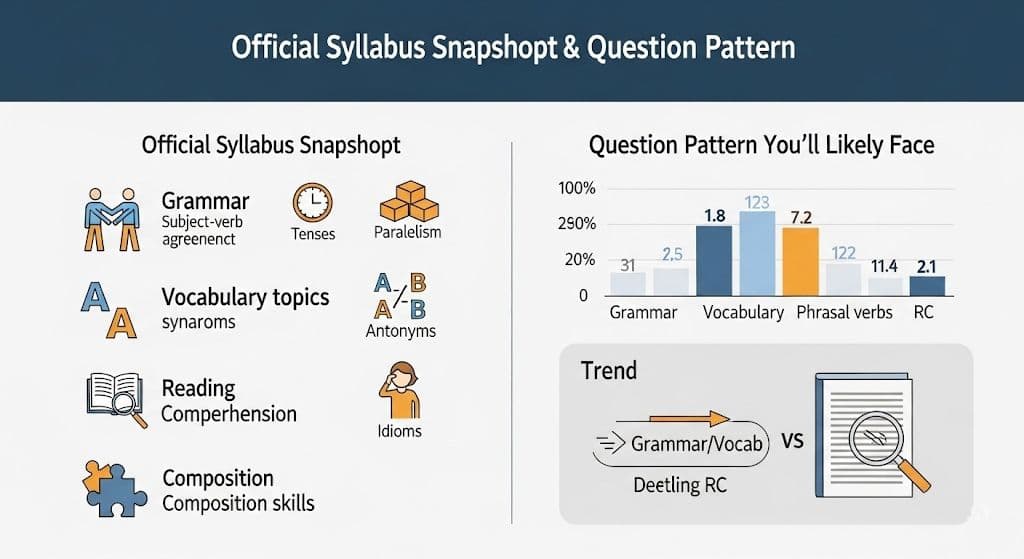
Grammar topics: Determiners, prepositions, modals, adjectives, relative pronouns, subject–verb agreement, tenses, parallel construction, voice and transformation, question tags, relative clauses.
Vocabulary topics: Synonyms, antonyms, contextual meaning, odd word out, one-word substitutions, spelling/word formation, homophones, collocations, phrasal verbs, idioms, analogies.
Reading comprehension: Short passages with questions on main idea, inference, tone, fact vs opinion, vocabulary-in-context, connectives.
Composition skills: Sentence rearrangement, paragraph unity, linkers, logical connectors. Source: Official BITSAT 2025 brochure
Question Pattern You’ll Likely Face
- 3–4 grammar error spotting or sentence correction.
- 2–3 vocabulary (synonyms, antonyms, idioms, or one-word substitutions).
- 1–2 phrasal verbs or collocations.
- 1 RC passage (around 4–6 questions).Trend: Grammar and vocab are short, RC takes more time but is straightforward.
Grammar: Clean Rules and Quick Examples
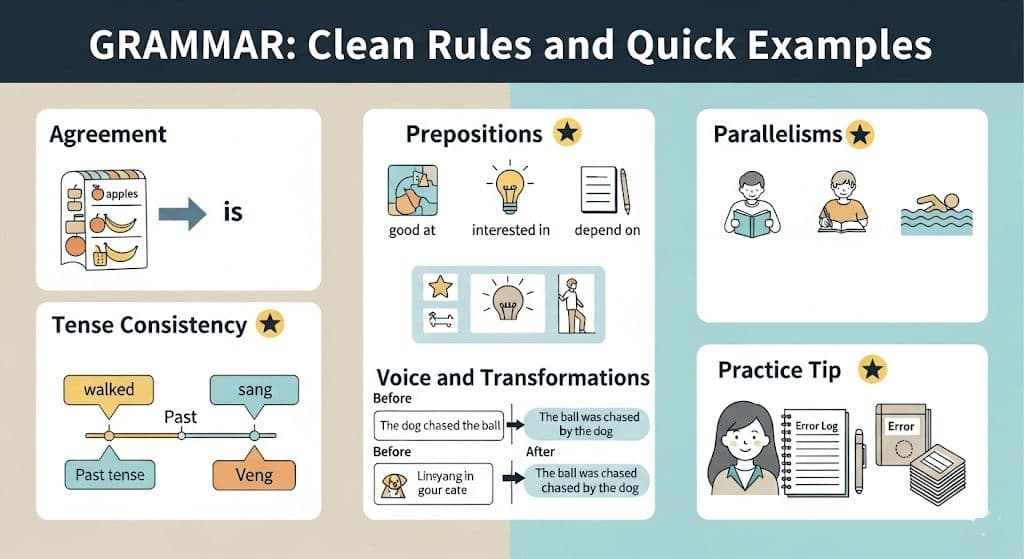
- Agreement: Subject and verb must match. Example: “The list of items is long,” not “are long.” Many fall for this because “items” is closer to the verb, but the subject is “list.”
- Tense consistency: Stick to one timeline. “She said she was tired,” not “she said she is tired.” Reported speech is a favorite area where BITSAT slips into tense traps.
- Prepositions: English has fixed pairs—good at, interested in, and depend on. Don’t guess. Learn the common ones by heart.
- Parallelism: Items in a series should be in the same form. “He likes reading, writing, and swimming,” not “reading, writing, and swimming.”
- Voice and transformation: Be able to switch active ↔ passive and direct ↔ indirect speech. These combine grammar and tense knowledge.
Practice tip: Do 15–20 error-spotting or correction questions daily. Don’t just check answers—write down the rule you missed. Build a one-line rulebook of your mistakes and revise it before mocks. This helps avoid repeating errors.
Vocabulary: Context Is Everything
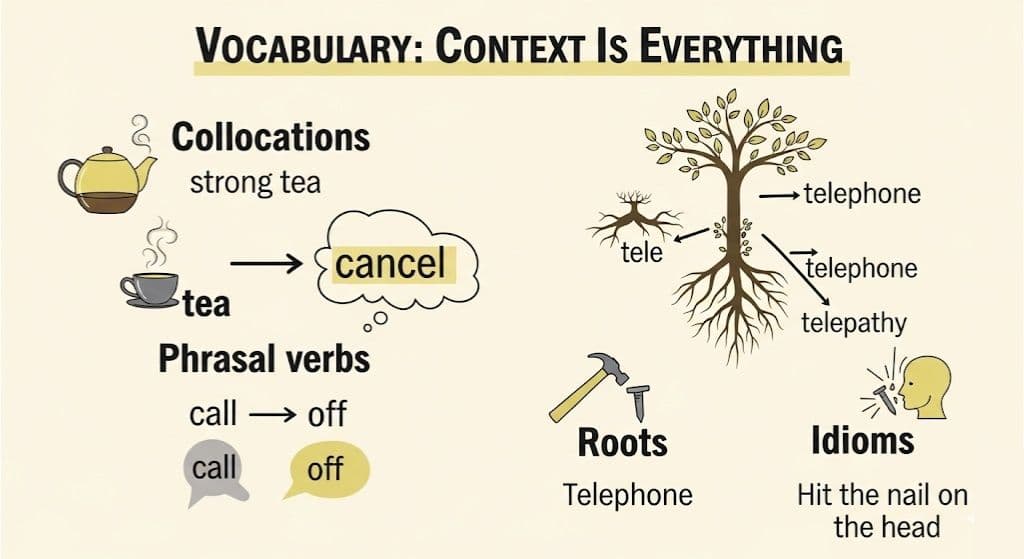
Why context matters: Memorizing random words won’t help much. You need to know how they work in sentences.
Methods:
- Collocations: Learn natural word pairings. Example: “Strong tea,” not “powerful tea.”
- Phrasal verbs: Pick 5–10 a day. Example: “Carry out” = conduct, “Call off” = cancel.
- Roots: Learn prefixes and suffixes. Example: “Tele” = distance → telephone, telepathy.
- Idioms: Focus on high-frequency ones. Example: “Hit the nail on the head” = to be accurate.
Plan:
- 14 days, 20 words a day (with sentences).
- Revise Day 1 words on Days 3, 7, and 14.
- Use flashcards (apps like Anki or Quizlet).
Reading Comprehension: Speed and Accuracy
Steps:
Look at the questions first. Know what to focus on.
Skim passage for structure: topic, tone, purpose.
Scan for keywords. Don’t over-read.
For inference, ask: “If the author believes this, what does it imply?”
Example practice: If a passage argues for renewable energy, and the question asks, “What can be inferred?” – an answer like “The author supports sustainable solutions” is correct, not “The author rejects all non-renewables.”
Routine: Practice 2 short passages daily. Write down the type of mistake you made (misread, rushed, vocabulary issue). Fix the cause, not just the answer.
Section Strategy: How to Attempt
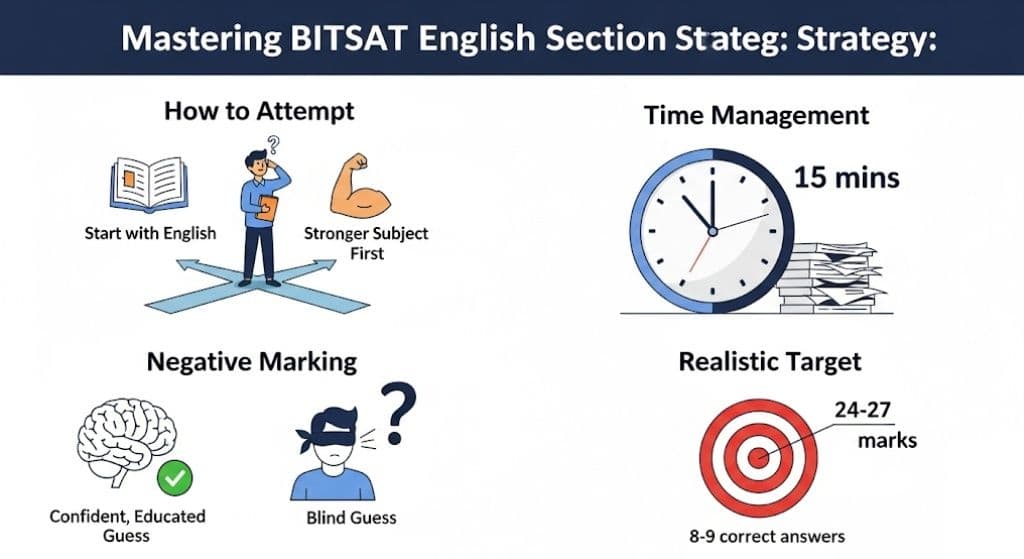
Think about how you want to use English in the flow of your paper. Some students like to start with it because it gives a quick confidence boost. Others prefer to finish a stronger subject first and then come to English when their momentum is steady. Either way works, but you should be clear on your order before the exam day.
Keep this section tight on time. Around 15 minutes is enough to attempt all 10 questions without eating into Physics, Chemistry, or Math. If you spend too much time, you risk losing marks where the bulk of the points are.
Be careful with negative marking. Don’t take blind guesses—one or two wrong answers can cancel out the effort of the correct ones. Instead, make educated attempts only when you’re at least 70% sure.
A realistic target is 8–9 correct answers. That translates into 24–27 marks, which is a solid addition to your overall score and achievable with steady practice.
Mocks and PYQs
- Do one English-only practice set three times a week.
- Maintain a mistake log with categories (Grammar–Agreement, Vocab–Idiom, Reading Comprehension–Inference).
- Revisit your log before full tests.
- For full tests, use BITSAT Test Series (internal). For doubts, use AI Doubt Resolver (internal).
7-Day Plan
- Daily (30–40 minutes): 10 error spotting, 10 vocab, 1 Reading Comprehension passage.
- Days 4 and 7: Take a timed English and Language Reading (LR) mock.
14-Day Plan
- Odd days: Grammar + drills.
- Even days: Vocabulary + Reading Comprehension.
- Last 3 days: Two full mocks, revise mistake log, finalize attempt order.
Pitfalls to Avoid
- Spending hours on obscure word lists. Stick to common vocabulary.
- Over-reading passages. Most answers are direct.
- Forgetting the time limit. Don’t let Reading Comprehension eat 20 minutes.
- Blind guessing. Remember the 1 penalty.
Quick Reference Cheat Sheet
- Collocations: take a risk, make progress, draw a conclusion, commit a crime.
- Idioms: once in a blue moon, bite the bullet, on the fence, jump the gun.
- Grammar traps: either/or (verb agrees with nearer subject), not only… but also (parallel form), none (can be singular or plural based on context).
FAQs
How many English questions are there in BITSAT 2025?
10 English + 20 Logical Reasoning in Part III. Source: BITSAT 2025 brochure
Are idioms and phrasal verbs asked?
Yes. They are officially part of the syllabus.
What’s the best way to prepare in 2 weeks?
Do daily grammar drills, 20 vocab words, and 2 RCs. Take 2 full mocks in the second week.
Is English tough in BITSAT?
It’s moderate. If you keep grammar clean and practice vocab/RC daily, it’s your scoring edge.
Where can I find the official syllabus?
On the BITS Pilani site or directly in the brochure.
Final Takeaway
BITSAT English isn’t about mugging up thousands of words or memorizing obscure grammar. It’s about consistent practice, learning in context, and being exam-smart. If you can bank these 10 questions quickly and accurately, you buy yourself confidence and time for the heavy subjects.
Next steps:
Categories
Join the Discussion
0 comments