Table of Contents
Can I Crack JEE Main 2026 in One Month? Practical Tips & Study Plan
Pratham Jiwnani
12/27/2025
Can I crack JEE Main 2026 in one month?
This is one of the most searched and most stressful questions among aspirants as the exam date approaches. The honest answer is: yes, you can significantly improve your score and even qualify with a strong percentile, provided your preparation in the last month is strategic, focused, and exam-oriented.
This final month is not about covering the entire syllabus again. It is about optimising what you already know, eliminating mistakes, improving accuracy, and maximising score per hour.
This article presents a realistic, practical, and structured JEE Main 2026 last month strategy, based on proven preparation patterns, previous year trends, mock-test analysis, and expert guidance designed exactly for students who are short on time but serious about results.
Understanding the Final Month Reality
Before starting intense preparation, it’s important to set the right expectations.
What the last one month is NOT for
- Learning the entire syllabus from scratch
- Starting completely new chapters randomly
- Reading bulky books without practice
What the last one month IS for
- Revising high-yield and scoring chapters
- Practising high-frequency question types
- Taking focused mock tests
- Solving JEE Mains previous year question papers
- Improving speed, accuracy, and question selection
Your focus should always be on what actually converts into marks in the exam, not what feels important theoretically.
Who Should NOT Follow This One-Month Plan
This plan is not suitable for students who are starting JEE Main preparation from absolute zero or have not studied core concepts of Physics, Chemistry, and Mathematics at all.If your fundamentals are completely weak, a longer, structured preparation timeline is required instead of last-month optimization.
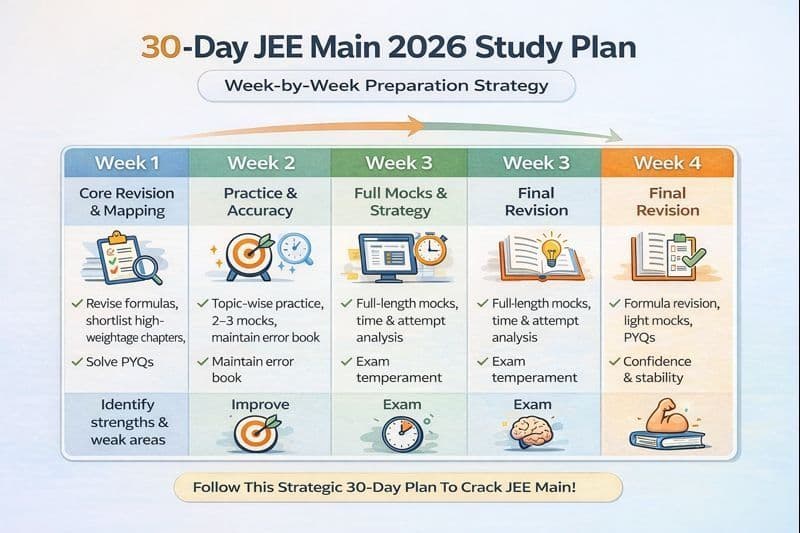
30-Day JEE Main 2026 Study Plan (Week-Wise)
The most effective way to prepare in one month is by dividing time into clear weekly goals.
30-Day JEE Main 2026 Preparation Breakdown
| Week | Focus Area | What to do | Outcome |
|---|---|---|---|
| Week 1 | Core Revision & Mapping | Revise formulas, shortlist high-weightage chapters, solve PYQs | Identify strengths & weak areas |
| Week 2 | Week 2 Practice & Accuracy | Topic-wise practice, 2–3 mocks, maintain error book | Improve accuracy |
| Week 3 | Full Mocks & Strategy | Full-length mocks, time & attempt analysis | Exam temperament |
| Week 4 | Final Revision | Formula revision, light mocks, PYQs | Confidence & stability |
Week 1: Core Revision & Syllabus Mapping
Goal: Refresh fundamentals and identify strengths and weaknesses.
What to do
- Create a shortlist of high-weightage chapters
- Revise core formulas, concepts, and shortcuts
- Start solving chapter-wise JEE mains previous year question papers
- Revisit NCERT basics, especially for Chemistry
Daily Pattern
- Morning: Physics concepts + numericals
- Afternoon: Chemistry NCERT + PYQs
- Evening: Mathematics problem practice + formula revision
Week 2: Targeted Question Practice & Mock Tests
Goal: Improve familiarity and fix mistakes.
What to do
- Solve topic-wise questions from scoring chapters
- Take 2–3 mock tests this week
- Maintain an Error Book (write every mistake + correct logic)
Core Focus Areas
- Physics: Mechanics, Electrostatics, Current Electricity
- Chemistry: Inorganic & Physical basics, stoichiometry
- Maths: Algebra, Coordinate Geometry, Calculus
Remember: Mocks are useful only when you analyse them deeply.
Week 3: Full-Length Mocks & Time Management
Goal: Convert knowledge into exam performance.
What to do
- Take full-length mock tests daily or on alternate days
- Analyse each test for:
- Accuracy
- Time spent per subject
- Attempt vs correct ratio
Important
- Set safe attempt targets per subject
- Attempt only questions you are confident about
- Refine your section order and time distribution
Week 4: Final Revision & Confidence Building
Goal: Stabilize preparation and reduce stress.
What to do
- Avoid learning new topics
- Revise short notes, formulas, and PYQs
- Take 1–2 light mocks only
- Focus on calm, confident execution
Last 3 Days
- Light revision only (formulas, flashcards)
- No heavy problem-solving
- Sleep well and stay relaxed
Subject-Wise Last Month Strategy
Physics
- Priorities conceptual clarity
- Solve application-based problems
- Revise formulas and understand usage
High-ROI Chapters
- Mechanics
- Heat & Thermodynamics
- Electrostatics
- Current Electricity
Tips
- Create short formula sheets
- Practise data-based questions regularly
Chemistry
Chemistry can be the highest-scoring subject in the last month.
Strategy
- Inorganic: NCERT facts, trends, exceptions
- Organic: Reaction mechanisms you already know
- Physical: Formula-based numerical practice
Key Tip: Use flashcards for reactions and revise them repeatedly.
Mathematics
Maths demands practice + confidence.
Focus On
- Algebra
- Coordinate Geometry
- Calculus
- Probability
Tips
- Solve mixed problem sets
- Take sectional tests
- Time yourself strictly
Even a few correct questions in Maths can fetch valuable marks.
Mock Tests — Your Most Valuable Tool
Mocks are not just tests; they are performance mirrors.
Why mock tests matter
- Simulate real exam pressure
- Reveal weak topics
- Improve accuracy under stress
- Train time management
Best Practice
- Take mocks in actual exam timing
- Spend twice the test duration on analysis
- Focus on why mistakes happened
Mentorship guidance helps validate your study plan and reduce last-minute confusion.
Last-Month Focus: What to Do vs What to Avoid
| Do This | Avoid This |
|---|---|
| Revise high-weightage chapters | Starting new chapters |
| Solve PYQs daily | Random question practice |
| Analyse every mock | Taking mocks without review |
| Focus on accuracy | Blind guessing |
Smart Revision Techniques
Top performers consistently:
- Use flashcards for formulas & reactions
- Maintain short notes
- Revisit mistake areas daily
- Solve PYQs repeatedly
- Follow a mock → analyse → improve cycle
These techniques improve retention and recall on exam day.
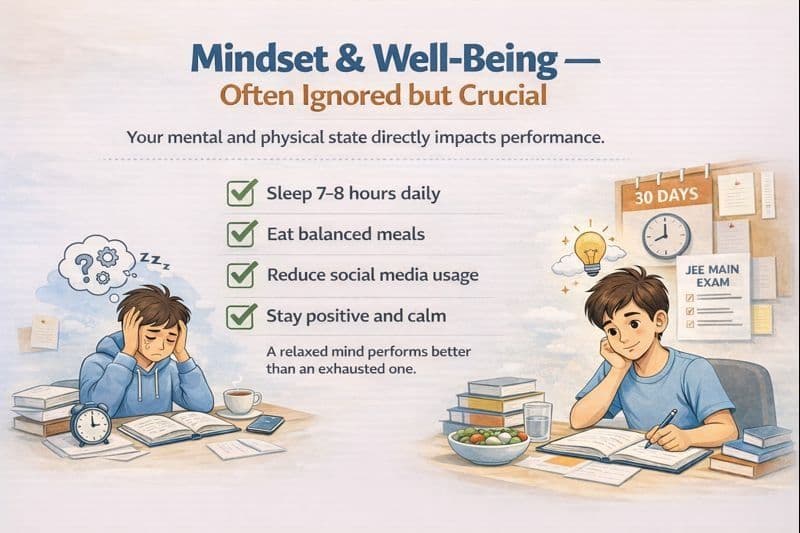
Mindset & Well-Being — Often Ignored but Crucial
Your mental and physical state directly impacts performance.
Sleep 7– 8 hours daily Eat balanced meals Reduce social media usage Stay positive and calm
A relaxed mind performs better than an exhausted one.
Exam Day Strategy
On exam day:
- Reach the centre early
- Start with your strongest subject
- Avoid blind guessing
- Stick to your time plan
Smart execution can easily create a 10–20 mark difference.
Can You Really Crack JEE Main 2026 in One Month?
Yes - you can significantly improve your score and secure a good rank if:
- You focus on scoring chapters
- You use mock tests strategically
- You revise smartly
- You control accuracy and time management
This is not a miracle shortcut, it is a logical, exam-centric strategy that many successful students follow every year.
Yes, you can crack JEE Main 2026 in one month by focusing on high-weightage chapters, practising previous year questions, analysing mock tests properly, and prioritising accuracy over syllabus completion.
FAQs
1. Can I crack JEE Main 2026 in one month if my syllabus is incomplete?
Yes. Focus on high-weightage chapters, PYQs, and accuracy instead of full syllabus coverage.
2. How many mock tests should I take in the last month?
Ideally 10–15 mocks with deep analysis after each test.
3. Should I start new chapters in the final 7 days?
No. Use this time only for revision and strengthening known topics.
4. Are previous year question papers enough for last-month preparation?
They are essential and should be solved multiple times for pattern recognition.
5. Is self-study enough in the final month?
Yes, if supported by structured revision, mock tests, and consistent analysis.
Categories
Join the Discussion
0 comments