Table of Contents
CS & Electronics Prep Guide for JEE Aspirants – Time Management + Resources
Pratham Jiwnani
9/12/2025
If you’re preparing for JEE, chances are your plate is already full with Physics, Chemistry, and Mathematics. But here’s something worth thinking about: Computer Science (CS) and Electronics can give you an extra edge.
Not only can they strengthen your logical reasoning and practical knowledge, but they also prepare you for the kind of work you’ll do once you enter engineering.
The key challenge? Managing your time so that these subjects add value instead of becoming distractions. In this guide, we’ll walk through why CS and Electronics matter, how to balance them with JEE prep, and the best resources to learn from.
1. Why CS & Electronics Matter for JEE Aspirants
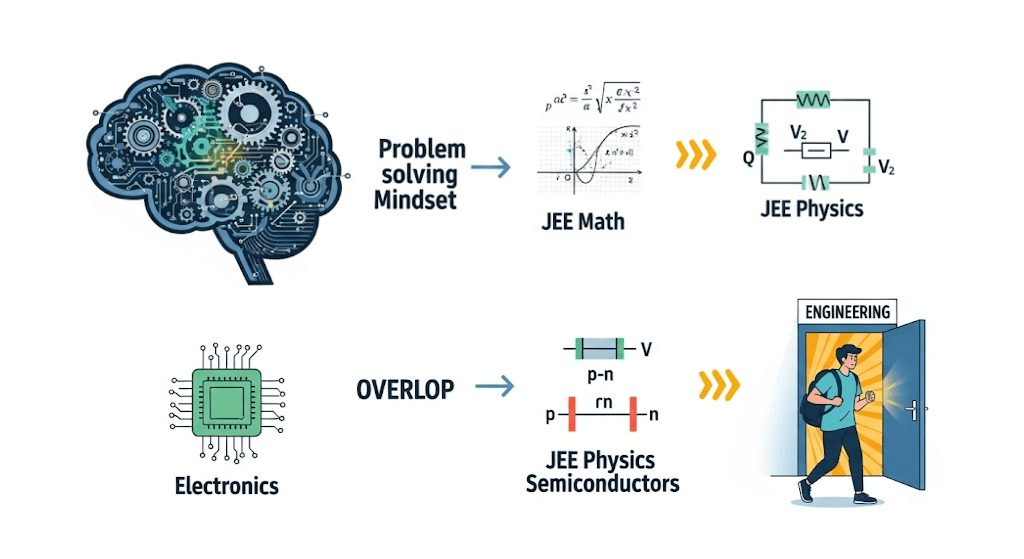
JEE doesn’t test you directly on CS or Electronics. But these subjects build the kind of problem-solving mindset you need for JEE. Programming sharpens logic, algorithms, and speed of thought—all of which reflect in Math and Physics. Electronics overlaps with JEE Physics topics like semiconductors and communication systems, making it easier to score in those areas.
In the bigger picture, most top engineering branches revolve around CS, IT, or Electronics. A head start in these subjects means you won’t just clear an exam—you’ll step into engineering with confidence.
2. Balancing JEE Core Subjects with CS & Electronics
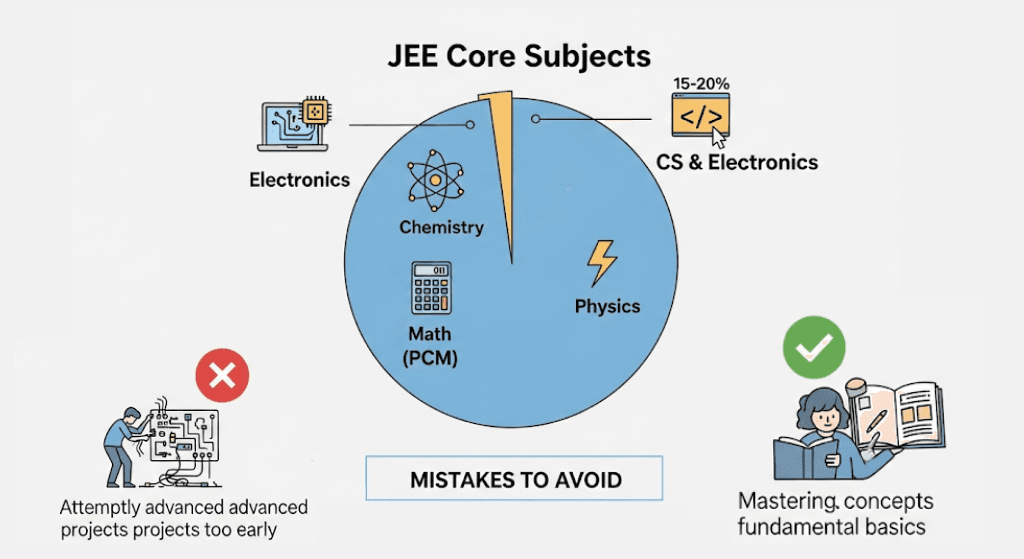
It’s easy to get carried away with coding or circuit projects and forget that your real test is JEE. Always keep PCM at the center of your plan—CS and Electronics should feel like side dishes, not the main course. If you treat them as add-ons, they’ll help you without draining your energy from JEE.
- PCM Focus: Dedicate about 80–85% of your study time to Physics, Chemistry, and Math.
- CS & Electronics: 15–20% of your weekly hours are enough to build basics and avoid distractions.
- Mistakes to Avoid: Don’t dive into advanced coding projects or complex hardware builds now. Stick to fundamentals, revise overlapping JEE concepts, and always check: Is this adding to my JEE prep? For building a strong JEE base, read Early PYQ Practice to Boost JEE Rank.
3. CS Preparation for JEE + Engineering Foundation
Think of CS as training your brain to think step by step. This logical approach is exactly what JEE demands.
- Focus Topics: Programming basics, loops, arrays, functions, and simple algorithms. Avoid advanced frameworks for now.
- Languages: Start with Python if you’re new—it’s simple and rewarding. If you want a long-term edge for competitive coding, go with C++.
- How It Helps JEE: Debugging a program builds patience. Writing algorithms trains you to think systematically. Both skills make solving Math and Physics problems faster and less stressful.
Practical Tip: Code 2–3 small exercises a week—like checking prime numbers or sorting an array. Over time, these small practices add up to big improvements in your JEE-style logical thinking.
4. Electronics Preparation for JEE + Engineering Foundation
Electronics feels like an extension of JEE Physics—especially chapters like semiconductors and communication systems.
- Key Topics: Basics of circuits, semiconductors, diodes, transistors, logic gates, amplifiers, and communication techniques.
- Why This Matters for JEE: These topics appear frequently as scoring questions. Understanding how a diode works or how signals are modulated gives you more confidence than rote memorization.
- Beyond JEE: Electronics is a first-year engineering subject. If you cover the basics now, you’ll find those classes smoother and easier.
Use simulation apps like Tinkercad or YouTube explainers to visualize concepts. This way, when JEE gives you a semiconductor graph, you’ll actually understand it. For Physics overlap, also check Why NCERT Alone Isn’t Enough.
5. Time Management Strategies
Time is always tight during JEE prep, so the trick is to treat CS and Electronics as refreshing add-ons.
- Daily Plan: Keep them for lighter study slots—like evenings.
- Weekly Plan: Two 1–2 hour sessions are enough to cover the basics without stress.
- Methods: Use Pomodoro (25–30 minutes focused study + 5-minute breaks). On weekends, block a larger chunk to practice without pressure.
- Integration: Connect CS/Electronics with JEE topics. Revise semiconductors while practicing Electronics basics. Break Math problems like algorithms. This double-use of time makes learning more efficient.
6. Recommended Resources
For CS:
- Coding platforms: HackerRank or Codeforces (beginner sections).
- Courses: Python/C++ beginner playlists on YouTube.
- Why it matters: Coding builds structure, persistence, and problem-solving patience.
For Electronics:
- NPTEL courses for circuits and semiconductors.
- NCERT + Reference books for semiconductors and communication.
- Simulation apps like Tinkercad for virtual circuits.
- Why it matters: Visual learning cements abstract concepts and builds intuition.
For JEE foundation:
7. Integrating CS & Electronics into JEE Prep Smartly
- Don’t Overdo It: Treat them as supplements, not the main course.
- Slot Smartly: Use them as breaks after heavy PCM sessions.
- First-Year Advantage: You’ll be ahead of peers when CS and Electronics show up in college. That saves stress later and boosts confidence early.
FAQs on CS & Electronics Prep Guide for JEE Aspirants
Q1. Should I learn coding before cracking JEE?
Yes, but keep it limited to basics. Focus on understanding loops, conditions, and small problem-solving programs like factorial or prime number checks. These build logical thinking without taking away time from PCM.
Q2. Is Electronics important for JEE?
Directly, yes—mainly for semiconductors and communication chapters in Physics. Indirectly, learning basics like diodes and transistors gives you intuition and can make those questions easier to solve rather than memorize.
Q3. How much time should I spend on CS/Electronics per week?
Around 2–4 hours is good enough. A couple of short sessions during the week will build a foundation. PCM should remain your top priority, but using CS/Electronics as lighter sessions can also refresh your mind.
Q4. Won’t this reduce my JEE score?
Not if you manage it well. Stick to the 80–20 rule: about 80% of your study time for PCM and 20% for CS/Electronics. This way, you won’t compromise your JEE prep, and the extra learning actually supports it.
Q5. Which language should I choose for coding?
If you’re new, Python is simpler and faster to pick up. If you see yourself doing competitive coding or want an advantage for engineering courses, C++ is the better long-term choice. Both are good, so choose based on your comfort level.
Q6. Do these subjects really help beyond JEE?
Yes. In college, you’ll have programming and electronics from the very first year. Students who already know the basics often find it much easier to score well. Later on, skills in coding and electronics directly help in internships, projects, and placements.
9. Final Takeaways & Action Plan
If you’re a JEE aspirant, focus on PCM. But adding CS and Electronics in small, consistent doses gives you an edge: sharper logic, better Physics understanding, and smoother entry into engineering.
Action Plan:
- Fix two CS/Electronics slots weekly.
- Pick one coding language (Python or C++).
- Use Electronics to strengthen JEE Physics.
- Connect CS/Electronics with JEE-style problem-solving.
In the end, JEE isn’t just about scoring high—it’s about preparing yourself for the engineering journey ahead. With a balanced approach, CS and Electronics can make that journey easier, smarter, and more rewarding.
Categories
Join the Discussion
0 comments