Table of Contents
JEE Main 2026 First Attempt vs Second Attempt – Pros, Cons & Strategy
Pratham Jiwnani
12/17/2025
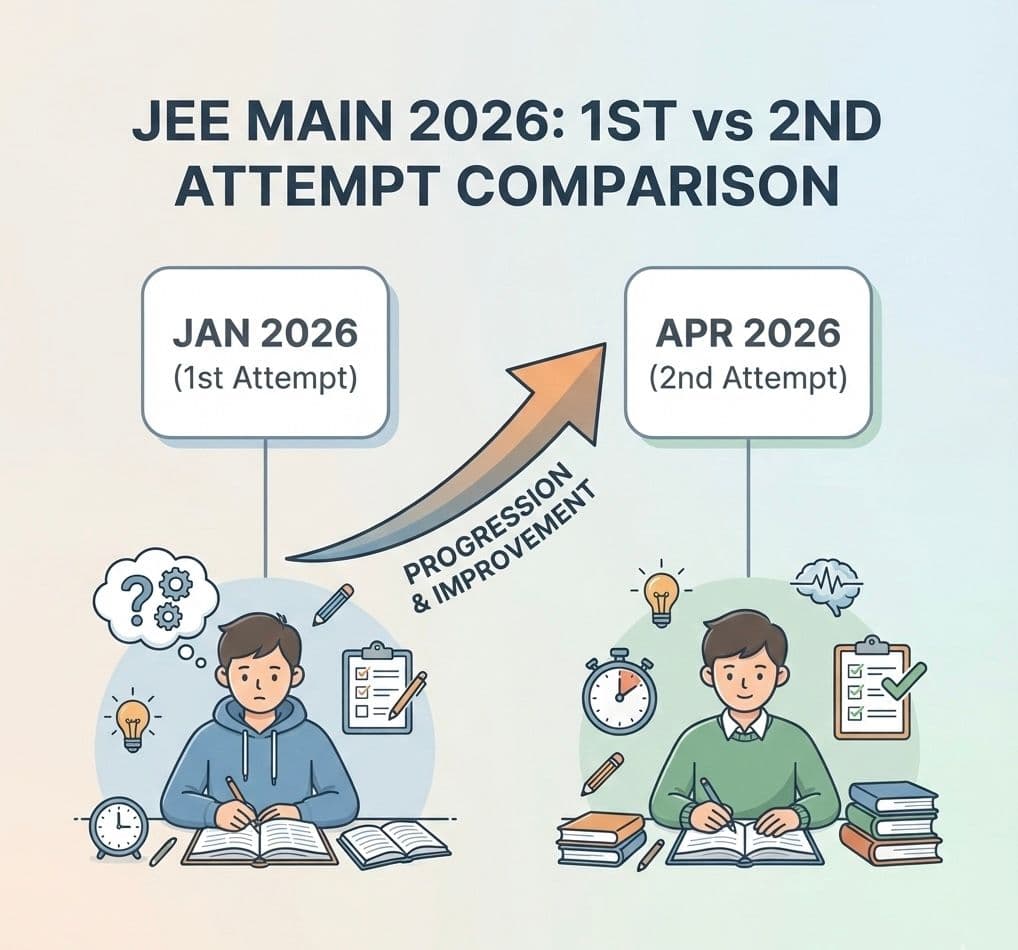
Preparing for the JEE Main entrance exam is one of the most challenging phases in a student’s academic journey. Months of preparation, endless problem-solving, mock tests, and revisions often lead to one major question: First Attempt vs Second Attempt: which JEE Main 2026 attempt should you focus on?
Many students feel confused about whether they should give their best shot in January or treat it as a practice run and aim to peak in April. This confusion, if not addressed early, can lead to poor planning, burnout, and missed opportunities.
Smart preparation today is not about studying harder alone. It’s about planning strategically, analysing performance data, and making informed decisions at the right time. Understanding how both attempts work and how to use them to your advantage can significantly improve your confidence, accuracy, and final rank.
First Attempt vs Second Attempt
For most students, attempting both sessions of JEE Main 2026 is the best strategy because the best score out of the two is considered for ranking. The first attempt helps evaluate preparation and identify weaknesses, while the second attempt allows improvement through focused revision and performance analysis. However, the ideal approach depends on your preparation level, school exam schedule, and learning pace.

What Are the Two Attempts of JEE Main 2026?
The National Testing Agency (NTA) conducts JEE Main in two sessions every year:
- Session 1: January 2026
- Session 2: April 2026
Both sessions follow:
- The same syllabus
- Identical exam pattern
- Similar marking scheme
- Normalization to ensure fairness
The key difference is not the paper, but the student’s level of preparedness at the time of attempting the exam.
From a strategic standpoint:
- Session 1 offers real exam exposure and clarity on gaps
Session 2 allows optimisation based on feedback and analysis
| Aspect | Session 1 (January) | Session 2 (April) |
|---|---|---|
| Preparation stage | Often mid-preparation | More revised & refined |
| Mental readiness | Higher anxiety | Better exam temperament |
| Purpose | Benchmark attempt | Improvement attempt |
| Competition | Broad mix of readiness | More serious aspirants |
By April, most students have:
- Practiced more JEE Main previous year question papers
- Analysed mock test performance
- Improved speed, accuracy, and confidence
Is the JEE Main Second Attempt Harder Than the First Attempt?
This is one of the most common doubts among aspirants.
Difficulty Level vs Perceived Difficulty
Technically, both attempts have similar difficulty levels, and NTA’s normalisation process ensures fairness across sessions. However, the second attempt often feels harder due to:
- Higher expectations from self and parents
- Pressure to improve percentile
- Awareness of competition
Interestingly, students who properly analyse the JEE Main answer key and mock test data after January often find the April attempt easier because they are better prepared mentally and strategically.
Pro Tip: Stop worrying about which attempt is harder. Focus on reducing mistakes and improving accuracy, not predicting paper difficulty.
Based on trends observed from previous JEE Main sessions and student performance patterns, most aspirants show measurable improvement in the second attempt after structured analysis of mock tests, answer keys, and recurring mistakes.
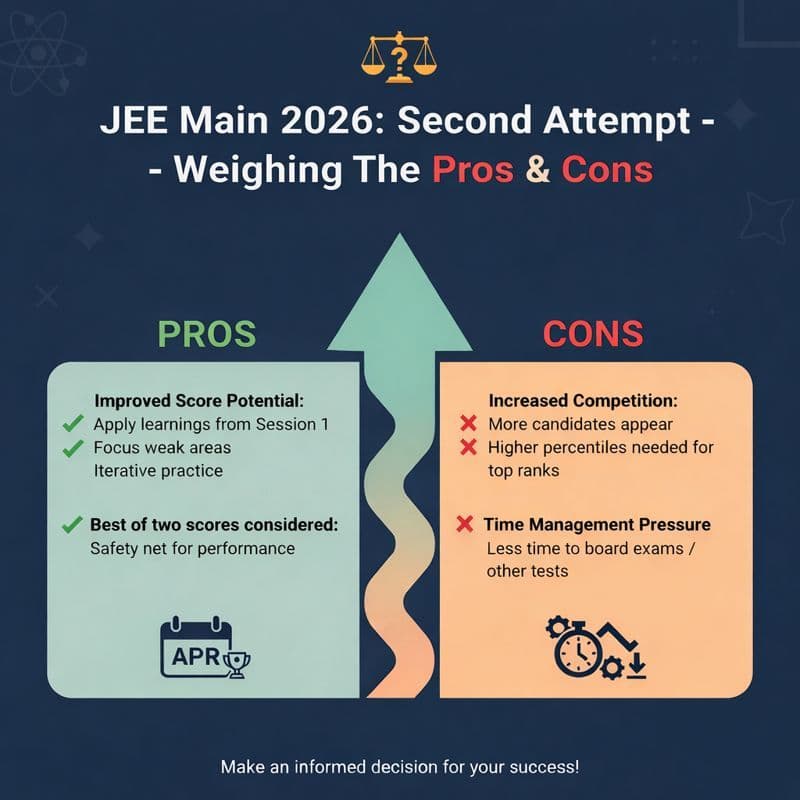
Pros and Cons of the First Attempt of JEE Main 2026
Advantages of the First Attempt
- Helps assess real exam readiness
- Identifies weak chapters and concepts
- Improves time management awareness
- Reduces pressure for the second attempt if score is good
Limitations of the First Attempt
- Syllabus may not be fully completed
- Exam anxiety can affect performance
- Students may overthink minor mistakes
Real Insight: Many students who underperform in January improve significantly in April simply by correcting recurring errors and refining strategy.
Pros and Cons of the Second Attempt of JEE Main 2026
Advantages of the Second Attempt
- Opportunity to correct January mistakes
- More revision and conceptual clarity
- Better accuracy and exam temperament
- Higher chances of improving JEE Main rank
Risks of the Second Attempt
- Increased pressure to perform
- Risk of burnout if preparation isn’t balanced
- Possible clash with JEE Advanced preparation
Pro Tip: Treat the second attempt as a refinement phase, not a last-minute rescue mission.
Is It Necessary to Give a Second Attempt in JEE Main?
There is no one-size-fits-all answer, but most students benefit from attempting both sessions.
Who Should Attempt Both Attempts?
- Students with inconsistent mock scores
- Aspirants targeting top NITs, IIITs, or GFTIs
- Students aiming to improve accuracy and percentile
When Skipping the Second Attempt Makes Sense
- You score an exceptionally high percentile in January
- You want to focus entirely on JEE Advanced preparation
Pro Tip: Make this decision after analysing your first attempt result, not emotionally or under pressure.
Why Many Students Fail to Improve Despite Multiple Attempts
Giving multiple attempts does not automatically guarantee improvement.
Common Reasons for Stagnation
- Lack of structured performance analysis
- Ignoring mock test mistakes
- Repeating the same preparation mistakes
- Focusing on quantity over quality
Pro Tip: Maintain an error log and review recurring mistakes weekly. This single habit often leads to measurable score improvement.
How to Use Online Preparation Tools Effectively
Modern digital platforms can significantly enhance preparation when used correctly.
Planning and Self-Evaluation
- Set weekly targets
- Track accuracy trends
- Compare performance with JEE Main previous year question papers
Continuous Improvement Cycle
Practice → Analyse → Adjust → Repeat
Students who follow this cycle consistently often see 15–20 percentile improvement between attempts.
Final Verdict: First Attempt vs Second Attempt
The smartest approach is not choosing one attempt over the other, but using both strategically. The first attempt provides clarity and feedback, while the second attempt allows improvement and optimisation.
Success in the JEE Main entrance exam depends on:
- Consistent practice
- Insight-driven analysis
- Calm decision-making
- Structured preparation
Pro Tip: Plan, analyse, and refine after every test. Smart preparation always beats last-minute effort.
Frequently Asked Questions
1. Which is better: JEE Main first attempt or second attempt?
Both attempts are equally important. The first attempt helps assess readiness, while the second attempt allows improvement. Since the best score is considered, attempting both is usually beneficial.
2. Is the JEE Main second attempt harder than the first attempt?
No. Both sessions follow the same syllabus and exam pattern. The perceived difficulty may feel higher in April due to pressure, not because the paper is tougher.
3. Can I give only the second attempt of JEE Main 2026?
Yes, you can appear only for the second attempt. However, skipping the first attempt means losing valuable exam experience and performance feedback.
4. Does attempting both sessions improve JEE Main rank?
Yes. Many students improve their percentile in the second attempt by analyzing mistakes, improving accuracy, and managing time better after the first attempt.
5. Should I focus on JEE Advanced after a good first attempt score?
If you score very high in the first attempt, you may shift focus to JEE Advanced while maintaining light revision for the second attempt to retain performance consistency.
Categories
Join the Discussion
0 comments