Table of Contents
From JEE to BITSAT: Strategy Deep-Dive for Smarter Prep
Pratham Jiwnani
9/25/2025
Here’s a more detailed version of each section. I’ll assume you’ve done some JEE prep already and are now considering or preparing for BITSAT. I’ll also point out when to use tools like CrackIt’s features to boost effectiveness.
The Silent Trap
You’ve pushed through tough JEE problems, understood derivations, and solved past Advanced papers. That gives you an advantage. But when you switch or add BITSAT, many students assume: “I’ve done JEE prep, so this is just more of the same.” That’s not the case.
- JEE rewards depth, often sacrificing speed.
- BITSAT demands both speed and breadth: more questions, some new content (English, Reasoning), tight time per question.
So this guide will help you adapt what you've already built, rather than start over. I’ll show you what to keep, what to tweak.
Section 1: Snapshot of Differences
Here’s what really differs, beyond just “different colleges”.
| Feature | What do you know from JEE prep | What changes in BITSAT you must plan for |
|---|---|---|
| Total Questions & Time | JEE Main gives you ~75-90 questions in 3 hours; you may spend 2-3 mins per hard one. | BITSAT gives ~130 MCQs in 3 hours + possible bonus questions. That’s ~1.3 mins/question if you're fast. Need fast decision making. |
| Sections | PCM: Physics, Chemistry, Maths. Depth, sometimes lengthy problem solving. | Adds English Proficiency and Logical Reasoning. You need to factor these into prep. Don’t leave them for “later.” |
| Marking scheme & Guessing risk | JEE: +4 for correct, –1 for wrong (Main). Some sections numeric answer no negative. Depth matters. | BITSAT: +3 for correct, –1 for wrong. Because more questions, wrong attempts can hurt you more proportionally. |
| Syllabus Overlap | Almost entirely NCERT + JEE reference books. You are used to exceptions, tricky proofs, in-depth concept testing. | Syllabus is mostly overlapping (PCM), but speed, fact recall, quicker problem types matter. And new areas (English, Reasoning) require revision. |
What this means for you: Don’t change everything, but adjust priorities. If something took you 5 mins under JEE, in BITSAT, treat it as maybe 1-2 minutes, zero if you can’t with high confidence.
Section 2: Syllabus Overlap, What to Keep, What to Add
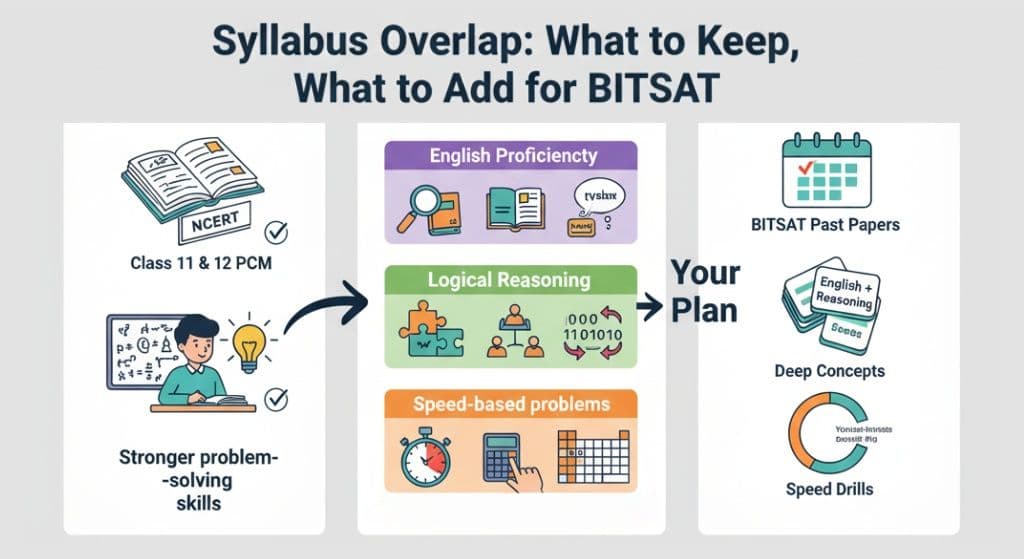
Since you’ve already done JEE prep, you’ve covered most of the PCM topics. But some parts need special attention for BITSAT.
What you already have
- NCERT in full for Class 11 & Class 12 in PCM. That’s foundational.
- Stronger problem-solving skills from JEE: solving tricky numericals, multiple modes of thinking.
What to add or sharpen
- English Proficiency: Comprehension passages, grammar (error spotting, fill in the blanks), vocabulary. Many JEE students consider this non-core, but in BITSAT, missing easy marks here hurts rank.
- Logical Reasoning: Seating arrangement, coding-decoding, puzzles. Practice is key. Often it's new content for many.
- Speed-based problems: Even in PCM, problems that are direct, shorter, or tricked via multiple options. For example, elimination method, approximate calculations.
- NCERT tables, common organic reactions, periodic table: things that can be memorized and recalled fast.
Strategy to map what to focus on
Take a year’s worth of BITSAT past papers (or mock) and see which PCM topics show up often.
Build flashcards / cheat sheets for English + Reasoning tasks.
Maintain your deep concept work for tough JEE problems, but allocate time blocks to speed drills.
Section 3: Exam Pattern & Timing, Why Speed Matters
You need to shift how you think about time. Under JEE, it’s tolerable to spend more time on some questions. In BITSAT, not so much.
Key differences in timing & approach
- Questions per section: More in BITSAT, though each is typically more direct. (iQuanta)
- Choice & skipping: BITSAT may let you skip and return, but time is so tight that you need confidence in when to skip.
- Negative marking: Mistakes hurt, but unanswered questions are safer if you’re unsure.
What to do in your prep
- Use timed drills: small sets of 5-10 questions, 2 mins or less per question. Push yourself.
- Simulate realistic test pace early , don’t wait until late in prep.
- Track your error types: conceptual mistakes, calculation errors, misreading, and running out of time.
- Use tools like CrackIt’s AI Doubt Resolver when you’re stuck on mistakes repeatedly, so that you can correct misconceptions quickly. (See: CrackIt AI Doubt Resolver)
Section 4: Subject-Wise Tactical Changes
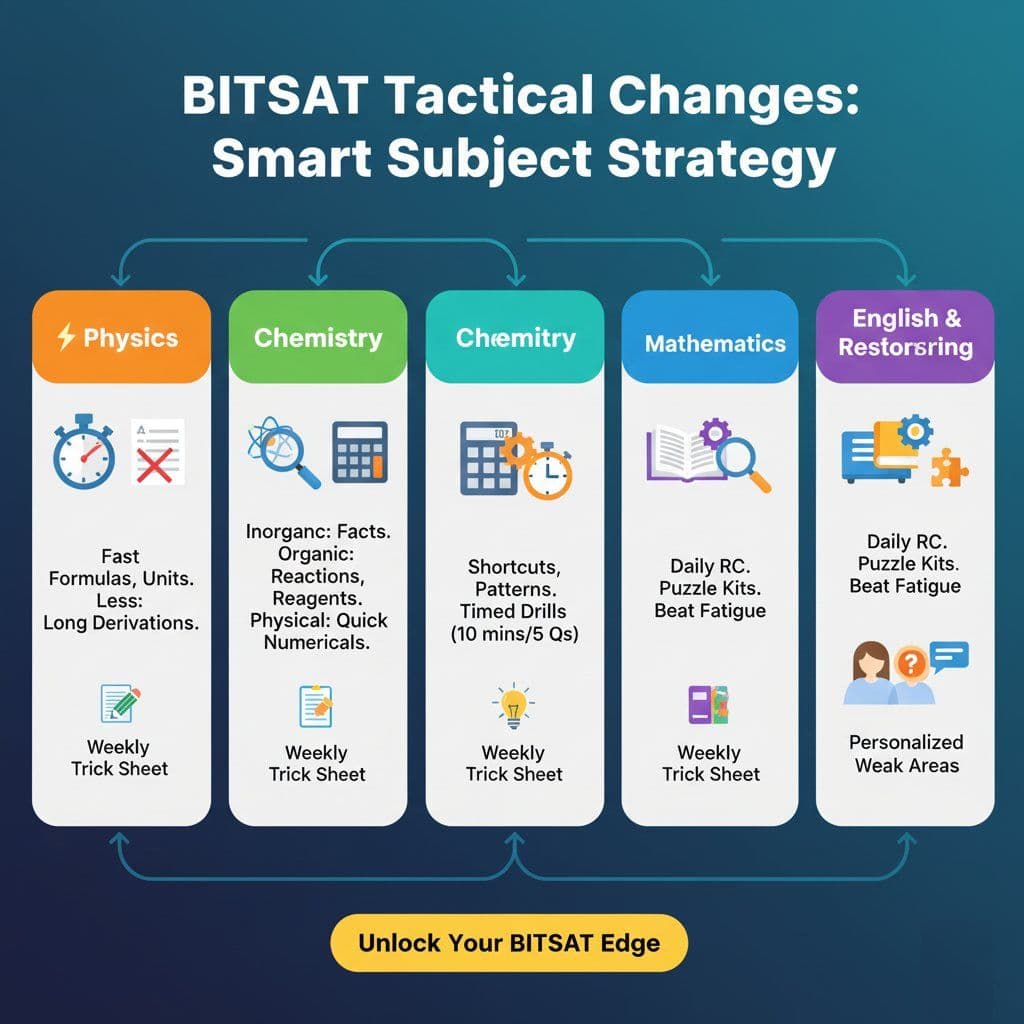
Let’s break down how your approach in each subject must shift or adapt. I’ll assume you already do good work in JEE in these, but now focus on tweaking:
Physics
- For JEE, you may have done a few deeply known problem types (e.g., electromagnetism derivations, complex wave properties). Keep that, but cut practice time on super-long derivations unless they frequently appear in BITSAT past papers.
- Focus more on quick formula recall, unit conversions, and working out mechanics problems fast.
- Maintain a small “formula & trick sheet” you review every week.
Chemistry
- Inorganic: be fluent in the periodic table, common oxidation states, and coordination compounds. These tend to show up in simpler, direct form in BITSAT.
- Organic: reaction mechanism may be tested lightly, but what matters is reaction names, reagents, and product identification fast.
- Physical & Physical Chemistry parts: you may encounter direct application or numerical questions. Be accurate in numerical estimation.
Mathematics
- Reserve deep JEE-type integrals and proofs, but make sure you also solve the straightforward ones fast.
- Learn “shortcut” methods: pattern recognition, elimination, approximate values, and avoid rewriting complicated steps each time.
- Practice sections under stricter time constraints, e.g., 10 mins for 5 questions.
English & Logical Reasoning
- Do not assume these will “give you time off.” They often come in mid or later parts of the test, when fatigue sets in. If you haven’t practiced, you’ll slow down.
- Build reading habits: work on reading comprehension daily, 2-3 passages per week, early.
- Do puzzle kits for reasoning: try seating arrangement, cause & effect, syllogisms.
- Use CrackIt’s Mentorship feature if you find yourself consistently weak in English or Reasoning: personalized guidance helps reduce wasted effort. (See: CrackIt Mentorship)
Section 5: Mock Tests and Adaptive Practice
Mocks aren’t just “practice exams.” They are where strategy meets execution.
When & how many mocks
- If BITSAT is several months away, begin with 1 mock every 10–14 days.
- Once you’re in the last 6-8 weeks, move to 2-3 mocks per week.
- In the final 2-3 weeks: daily mocks or mock + sectional drills.
What to analyze
After each mock:
- Which questions took you too long, or did you skip? Why? Was it concept, or hesitation?
- Which sections had you more wrong answers: PCM vs English/Reasoning?
- Where did you lose marks because of negative marking? Perhaps guessing more than you should.
- Time spent per question: keep logs.
Tools & tech
- Use platforms that provide detailed analysis, not just scores.
- CrackIt Predictor can help you estimate what your mock test scores imply in terms of cutoffs/rank. (See: CrackIt Predictor)
- For doubts, use AI Doubt Resolver so small mistakes don’t keep recurring.
Section 6: Study Plan Templates (How to Convert what you’ve done for JEE into BITSAT-ready)
Given you have JEE prep, here’s how to pivot:
| Template | Timeline | Key Focus Areas |
|---|---|---|
| 30-Day Crash Plan (if you're late switching) | Last 1 month | Heavy mocks, every mistake fixed, English/Reasoning every other day. Skip long derivations unless they’re quick-win. Daily target: 2 mocks + 2 speed drills. |
| 60-Day Balanced Plan | ~2 months | First month to build adjustments: speed in PCM, regular English+Reasoning. Next month, heavy mocks + analyzing weak areas. |
| 3-Month Plan (ideal) | 3 months | First month: firm up NCERT + core PCM. Second month: add English/Reasoning + speed drills. Third month: mocks + revision + time-pressure work. |
Sample Weekly Layout (60-day plan)
| Day | Activity |
|---|---|
| Mon–Fri | 2 hours PCM (mix deep & fast problems) + 1 hour English/Reasoning + short timed drills |
| Sat | Full mock test + analysis |
| Sun | Revision of weaker topics + rest or light mock depending on condition |
Using CrackIt Tools in the Plan
- Slot in CrackIt’s Online Platforms to get quality video lectures / problem libraries. (See: Top Online Platforms for JEE 2026 Preparation). Many platforms have BITSAT-style practice too.
- When stuck, lean on AI Doubt Resolver rather than letting doubts pile up.
- Use CrackIt Mentorship to personalise the study plan if you feel off track.
Section 7: Resource List
You probably already have many books for JEE. Here are ones you should keep, adjust, or add, plus useful tools.
Books / Reference Materials
- NCERT (non-negotiable).
- For English & Reasoning: books specific to BITSAT.
- PCM reference: keep your JEE-oriented books, but supplement with ones having faster problem sets.
Mock Test Series & Platforms
- Platforms that mimic the BITSAT environment (CBT, 130 MCQs).
- CrackIt’s test series + predictor tools.
Tools from CrackIt to Use
- AI Doubt Resolver: for fast resolution of concept or calculation doubts.
- Predictor: helps you understand whether your mock scores are good enough for target campuses.
Section 8: Exam Day Tactics
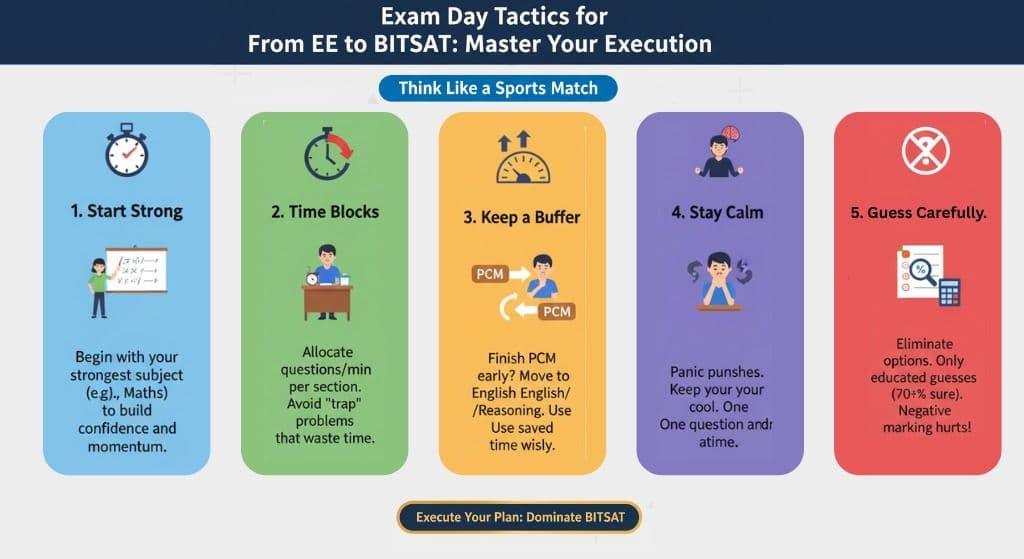
Treat exam day as you would a sports match. Preparation matters, but day-of execution decides.
- Start with your strongest subject to build confidence. If you’re faster in Maths, begin there.
- Time blocks: Plan in advance how many questions/min per section. Don’t get drawn into a trap problem early.
- Keep a small buffer: If you finish PCM early, move to English/Reasoning.
- Stay calm: exams like BITSAT punish panic.
- Guess carefully: only after eliminating options reasonably. Negative marking still hurts.
Section 9: Case Studies & What They Teach
Looking at students who made this shift can help you see what works and what missteps cost.
- Focus on consistent small gains: someone who added just 15 mins/day English + reasoning gained 25-40 marks over a few mocks.
- Mock analysis is non-optional: missed concepts + repeated mistakes = time waste.
- Smart resource use: those who used tools (predictors, doubt resolver, mentors), even if imperfect, outperformed those who had bigger confidence but less feedback.
Section 10: Common Pitfalls & How to Avoid Them
Here are mistakes I see often and how you can sidestep them:
| Mistake | Consequence | Fix |
|---|---|---|
| Ignoring English & Reasoning until last week | Big loss in marks, low comfort during exam timing | Integrate English/Reasoning early (say 1 hour/week to start) |
| Overemphasis on super-hard JEE problems | Slow pace, low completion in mocks | Trim practice: focus on deep problems once or twice a week; prioritize speed overall |
| Guessing wildly | Negative marks eat into the score | Use educated guessing only; better to leave blank than guess when not sure |
| Not reviewing mocks | Repeat mistakes | After every mock, list three major weakness areas; use CrackIt’s doubt resolver/mentorship here |
Section 11: Summary & Actionable Next Steps
You already have a solid foundation from your JEE work. What you need now is to adjust, sharpen, and accelerate.
Key takeaways:
- Prioritize speed & accuracy nearly as much as concept depth.
- Don’t skip English and Logical Reasoning; they give you free marks that other students ignore.
- Use mocks early and often. Analyze them.
- Use tools like CrackIt Predictor, CrackIt AI Doubt Resolver, and CrackIt Mentorship to get feedback and stay on track.
What you can do today:
- Take a recent BITSAT mock test, log your time per question and section.
- Identify 2 weak topics (could be English or Reasoning) and schedule daily micro-practice (15 mins) for a week.
- Set up a 60-day plan using the template above. Fit in mock tests and feedback tools.
If you stick to this, you’ll walk into BITSAT not beside, but ahead of many students who think JEE prep is enough without adaptation.
Conclusion: Shaping Two Strategies Without Losing Focus
Preparing for JEE and BITSAT together often feels like balancing two different sports; you’re playing the same game (competitive exams) but with slightly different rules. JEE pushes you into problem-solving depth, while BITSAT rewards speed, accuracy, and consistency. If you understand the shift in strategy, focusing on conceptual mastery for JEE and quick application for BITSAT, you can prepare effectively for both without burning out.
What matters most is personalization. Not every student will struggle with the same parts. Some may need stronger fundamentals, while others may need to practice faster decision-making. That’s why tools like mentorship and AI-driven aids such as the AI Doubt Resolver can help you stay on track with tailored guidance instead of generic advice.
And don’t forget, confidence is key. If you’ve ever felt unsure about alternatives beyond JEE, our breakdown on engineering exam options will help you keep perspective. Ultimately, the goal isn’t to pick JEE or BITSAT; it’s to stay exam-ready for both.
FAQs: From JEE to BITSAT Strategy Shift
1. Can I prepare for JEE and BITSAT together, or do I need separate study plans?
Yes, you can prepare for both together because the syllabus overlaps heavily. The difference is in the approach:
- JEE = fewer but tougher questions, requiring deep problem-solving.
- BITSAT = more questions, lighter per question, but strict time pressure. Use JEE prep as your foundation, and closer to BITSAT, shift gears towards speed practice and mock tests.
Check out why NCERT alone isn’t enough to see how you can expand your base resources for both exams.
2. Which exam is harder: JEE or BITSAT?
- JEE Main/Advanced is considered harder conceptually because it digs into problem-solving at a deeper level.
- BITSAT is more about stamina and speed; answering 130+ questions in just 3 hours is mentally draining.
So “harder” depends on your skill set: if you’re strong in concepts but slower, JEE might suit you better; if you’re quick but prefer lighter questions, BITSAT feels more manageable.
3. Should I take BITSAT seriously if I am already focused on JEE?
Absolutely. Many students underestimate BITSAT and regret it later. BITS Pilani and its campuses are among the top private engineering institutions in India, with placements and peer groups on par with IITs in many cases. Preparing for BITSAT also gives you a safety net and reduces pressure on JEE.
If you’re feeling shaky about “alternatives,” this article on engineering exam back-ups will help you see why BITSAT is a strong choice.
4. How should I manage time between JEE and BITSAT prep?
Here’s a practical split:
- Until JEE Main/Advanced → Focus on JEE syllabus, concepts, and PYQs.
- After JEE → Switch gears to BITSAT mocks, NCERT refreshers, and speed-building drills.
Also, try online platforms built for dual prep; our list of top online prep tools can help you choose the right ones.
5. Are BITSAT mock tests really that important?
Yes. In fact, BITSAT success is heavily dependent on mock performance. Time management, speed, and accuracy only sharpen with practice. A smart way to track readiness is by using predictor tools that simulate real exam scenarios and predict your chances of clearing cutoffs.
6. What if I can’t clear JEE but perform well in BITSAT?
That’s completely fine. Many successful engineers, entrepreneurs, and researchers have come from BITS. The exam path is different, but the destination is still top-tier education. Don’t measure your worth by a single exam.
For perspective on this, read: Not confident about JEE? Alternative exams explained.
Final Takeaway: Build your JEE prep as the core, and layer BITSAT strategy on top with mocks, speed drills, and accuracy training. Don’t split your energy too early, but also don’t leave BITSAT for the last minute. With the right mix of concept depth and time management, you’ll walk into both exams prepared.
Categories
Join the Discussion
0 comments