Table of Contents
How to Build a JEE Formula Sheet for Physics, Chemistry, and Math in One Weekend
Pratham Jiwnani
10/1/2025
Creating a complete and usable formula sheet in just one weekend is possible - if you plan smartly.
\This guide will walk you through exactly how to collect, organize, and use formulas in a way that helps you during mock tests, revision, and the final exam. Stick with me; by Monday, you’ll have “your sheet” ready to review every day.
Why a Formula Sheet Is More Than Just Notes
You might think, “I already have notebooks full of formulas and solved problems, why build a separate sheet?” Fair point. But when you’re under exam pressure with 3 hours to finish ~75–90 tough problems, your brain doesn’t want to flip between notebooks. It requires a compact, high-signal sheet that you can glance at and recall easily.
Here’s why this weekend exercise is worth it:
- Faster recall: You save seconds on every question when you don’t pause to search for the right formula.
- Reduced errors: With a clean, well-reviewed sheet, you’re less likely to misremember signs or units.
- Confidence boost: Knowing your formula sheet is solid frees up mental space to focus on problem logic.
- Revision engine: In the last few weeks, your formula sheet will become a daily 10-minute ritual.
An ideal formula sheet isn’t just a dump of everything you know; it’s the distilled essentials you’ll actually use.
The Smart Approach: How to Do This Weekend Well
Don’t just sit and scribble. This weekend has to be smart work, not frantic work. Follow these guiding principles:
- Select, don’t collect. You don’t need every obscure formula. Focus on high-yield formulas (ones you see repeatedly in past JEE exams).
- Clarity over completeness. A messy sheet defeats the purpose. Better to have 1 page clean and readable than 3 pages full but unreadable.
- Organize by subject → topic → formula. Linear structure helps mental retrieval.
- Use what you already have. Your class notes, coaching sheets, solved examples, NCERT, and past papers all contain formulas worth transferring.
- Prepare to revise it daily. The weekend is just set up. The real value lies in using it.
You can also use CrackIt’s AI Doubt Resolver whenever you’re unsure about a formula or derivation. (See: https://www.crackit.co.in/ai-doubt-resolver)
If you feel stuck or your direction feels unfocused, CrackIt Mentorship can help tailor which formulas to prioritize. (See: https://www.crackit.co.in/mentorship)
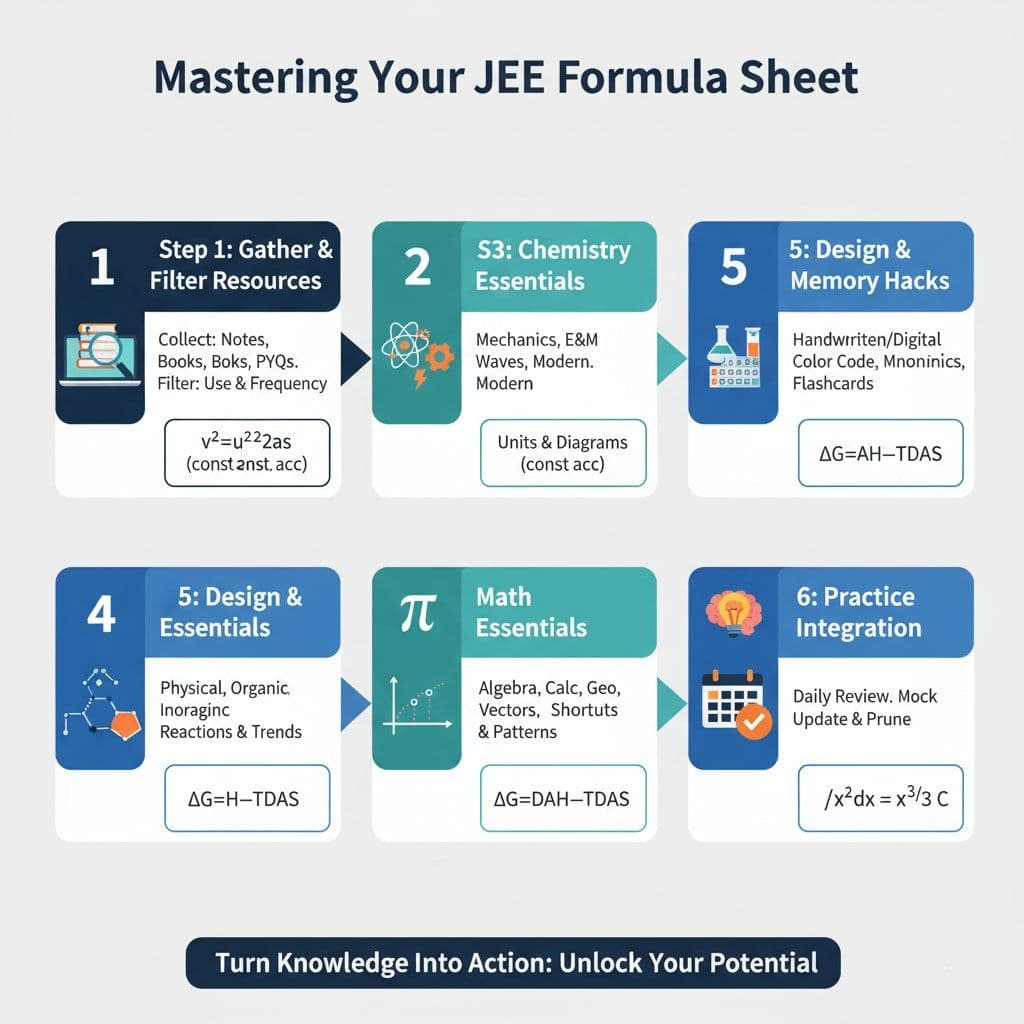
Step 1: Gather & Filter Resources
What to Collect
- Your class/coaching notes
- High-quality reference books (e.g., for JEE)
- Past year papers and formula compilations
- NCERT for baseline correctness
- Online guides/formula compilations (as a cross-check)
How to Filter
Ask for each formula:
- Have I seen this used repeatedly in past exams or mocks?
- Is this variant or special case essential or rare?
- Does it have an easy-to-remember structure or pattern?
If the answer is “rarely” or “complex variant,” skip it for now. You can add later if you have space.
Also, use your early PYQ practice insights to see which formulas appear often in past exams, and prioritize those.
Step 2: Physics Formula Sheet Essentials
Here’s how to structure your Physics section. Keep it logical, with sub-categories, units, and caveats.
Major Subtopics & Formula Categories
- Mechanics & Kinematics: Equations of motion, work-energy, rotational formulas, collisions, center of mass
- Electricity & Magnetism Ohm’s law, Kirchhoff’s laws, fields & potentials, displacement current, circuits
- Waves, Optics & Thermodynamics: Wave speed, interference, lens/mirror formulas, first / second law, heat capacity relations
- Modern Physics / Semiconductors: Photoelectric effect, nuclear processes, energy levels
Tips for Physics Section
- Always write units/dimensions next to each formula
- Underline or box versions with sign conventions (like sign of q, direction, etc.)
- Small diagrams (e.g. ray diagram for a mirror/lens) help recall
Example (Snippets)
| Topic | Formula | Notes / Condition |
|---|---|---|
| Kinematics | v2=u2+2asv^2 = u^2 + 2as | Only when the acceleration constant |
| Work-Energy | W=F⋅dcosθW = F \cdot d \cos\theta | Use the vector dot product |
| Lens formula | 1f=1v−1u\frac{1}{f} = \frac{1}{v} - \frac{1}{u} | Sign conventions matter |
You can reference guides like the IITIANGUIDE formula sheet for inspiration. (BestOnline IIT JEE Coaching)
Step 3: Chemistry Formula Sheet Essentials
Chemistry often rewards memorization, so your sheet here is going to be both formulaic and conceptual.
Subdivisions
- Physical Chemistry: Gas laws, thermodynamics (ΔG, ΔH, ΔS), equilibrium constants, kinetics, electrochemistry
- Organic Chemistry Reaction mechanisms, rearrangements, named reactions, reagents → products
- Inorganic Chemistry: Periodic trends, coordination number formula, oxidation states, and clarity about constants
Tips for Chemistry Section
- Use one-line reaction maps instead of full mechanistic steps
- Color code inorganic groups / periodic patterns
- For electrolytes/redox reactions, write standard potentials, Nernst equation variants
Example (Snippets)
- ΔG=ΔH−TΔS\Delta G = \Delta H - T\Delta S
- E=E∘−0.059nlogQE = E^\circ - \frac{0.059}{n} \log Q (for redox)
- Reaction shorthand: “Alk → Alkene (P Br₂ / Δ)” rather than full mechanism
Step 4: Math Formula Sheet Essentials
Math is formula + pattern recognition. Your sheet should help you see which formula fits.
Subtopics & Core Formula Types
- Algebra & Sequences / Series: Quadratic formula, arithmetic/geometric series sum formulas, binomial identities
- Trigonometry Identities, transformations, addition/subtraction formulas
- Calculus: Differentiation rules, standard integrals, mean value theorem, area formulas
- Coordinate & 3D Geometry: Line equations, plane equations, distance formulas, direction cosines
- Vectors: Dot/cross products, projection formula, triple product
Tips for the Math Section
- Use compact notation (e.g., Σ, Δ) where possible
- Highlight “go-to” identities (e.g., sin²+cos² = 1)
- Mark connections: e.g., derivative/integral pairs
Example (Snippets)
- Algebra: x=−b±b2−4ac2ax = \frac{-b \pm \sqrt{b^2 - 4ac}}{2a}
- Trig: sin(A+B)=sinAcosB+cosAsinB\sin(A + B) = \sin A \cos B + \cos A \sin B
- Geometry: Distance between (x₁, y₁, z₁) and (x₂, y₂, z₂) = (x2−x1)2+…\sqrt{(x₂ - x₁)^2 + \ldots}
You’ll find good references in 3D geometry formula collections. (PW Gulf)
Step 5: Design & Memory Hacks
You might have the formulas, but what makes them stick, or accessible under pressure, is design + mental anchoring.
Handwritten vs Digital
- Handwriting helps memory (muscle memory)
- Digital is flexible, clean, and can be printed or shared
- Many top students use both: handwrite a first pass, then digitize the final version
Visual Design Tips
- Use color codes (e.g., blue for Physics, green for Chem, red for Math)
- Use boxes, charts, and arrows to show dependencies
- Keep some blank margins - you may add formulas later
Memory Hacks & Mnemonics
- Use first-letter mnemonics (e.g. SOH CAH TOA)
- Group formulas by the same structure (so recalling one triggers others)
- Daily “flash review” (5–7 min scanning)
- After each mock, annotate your sheet with formulas you forgot or misused
And don’t forget: you can validate your tricky formula memories using CrackIt’s AI Doubt Resolver when in doubt.
Step 6: Practice Integration - Turn Your Sheet Into Action
A formula sheet is useless unless you use it daily.
- Daily revision: spend the first 5–10 mins scanning your sheet before practice
- Mock test pairing: after a mock, check which formulas you failed to recall
- Recall drills: cover parts of your sheet and try to regenerate them
- Update & prune: remove formulas you never use, add ones you missed
- Track your progress using CrackIt Predictor, it shows you whether your formula mastery correlates with improved mock scores (https://www.crackit.co.in/predictor)
Use as many mock tests as possible (linked from guides like When to Start JEE Mock Tests 2026.
Common Mistakes Students Make with Formula Sheets
- Too bulky/cluttered → you can’t read it under pressure
- Copy-paste mode → no personal logic or mnemonics
- No revision → sheet becomes decorative, not functional
- Including rare formulas too early
- No linking to application → you don’t test your recall under pressure
Avoid these by keeping your sheet lean, reviewing every day, and iterating as you use it.
Case Study: How a Student Fortified Their Mock Scores in 2 Days
Let me walk you through “Arjun’s experiment” (based on many real trends):
- Arjun had scattered notes. On Saturday morning, he listed the top 30 formulas per subject (Physics, Chemistry, Math) from his mocks.
- He typed them neatly in a table and printed a one-page version by Sunday evening.
- For three days, he carried that sheet everywhere, reviewed 10 minutes before practice, and annotated formulas he forgot.
- In his next mock, he improved by 10–12 marks just because he reduced the time wasted in formula recall.
- Over the week, the sheet also revealed weak areas (formulas he kept forgetting), so he prioritized those.
Key lesson: drafting doesn’t build the sheet; using and refining does.
Conclusion: Your Sheet as an Exam-Day Shield
By the end of the weekend, you’ll have:
- A well-ordered, legible, high-yield formula sheet
- A routine to review it daily
- A dynamic tool: add, remove, revise formulas based on your mocks
In the final days before JEE, this sheet becomes your quick-scan booster, your “cold-start engine” to awaken memory before every session.
Don’t treat this as “extra work”; it’s an investment. The time you spend this weekend chooses whether you pause and look up formulas in the exam hall, or move fluidly through questions with confidence.
FAQs
Q: Can I really build a comprehensive formula sheet in just one weekend?
Yes, if you filter smartly and focus on essentials. You don’t need every formula; just the ones you’ll repeatedly use. The goal is not completeness but utility. After the weekend, you’ll refine, not build from scratch.
Q: Should I make one sheet per subject or combine Physics, Chem & Math?
Depends on your preference and manageability. Many students prefer three separate sheets (one per subject) to avoid clutter; others use one master sheet divided into sections. The important part is clarity and quick navigation.
Q: Is handwritten better than digital?
Handwriting helps with muscle memory and retention. Digital gives flexibility for editing and printing. Ideally, begin handwritten, then digitize for a clean final version (and print as backup).
Q: How often should I revise my formula sheet?
Daily short scans (5–10 mins) are most effective. Also, at least once after every mock test, cross-check which formulas you missed and update your sheet accordingly.
Q: Can a formula sheet replace detailed concept notes or revision?
No, it complements them. The formula sheet helps with recall, not understanding. You still need concept clarity, problem-solving practice, and applications. But the sheet helps reduce cognitive load when solving.
Categories
Join the Discussion
0 comments