Table of Contents
From JEE to MHT-CET: How Strategy Changes for Each Exam
Pratham Jiwnani
10/1/2025
Why Comparing JEE & MHT-CET Matters
You’ve probably heard many students say, “If I prepare for JEE, I’ll automatically do well in state CETs like MHT-CET.” That sounds logical - after all, there’s a lot of overlap in the syllabus.
But in practice, exam dynamics shift. What you prioritized for JEE (deep problem solving, tricky integrals) might not serve you best in MHT-CET, where speed, precision, and state syllabus alignment are equally critical.
If you’re someone preparing for JEE but also planning to write MHT-CET, this article is for you. I’ll walk you through how strategy needs to change—what to keep, what to sharpen, and what to drop. By the end, you'll have a clearer roadmap for excelling at both—with less wasted effort.
JEE vs MHT-CET: Exam Pattern Breakdown
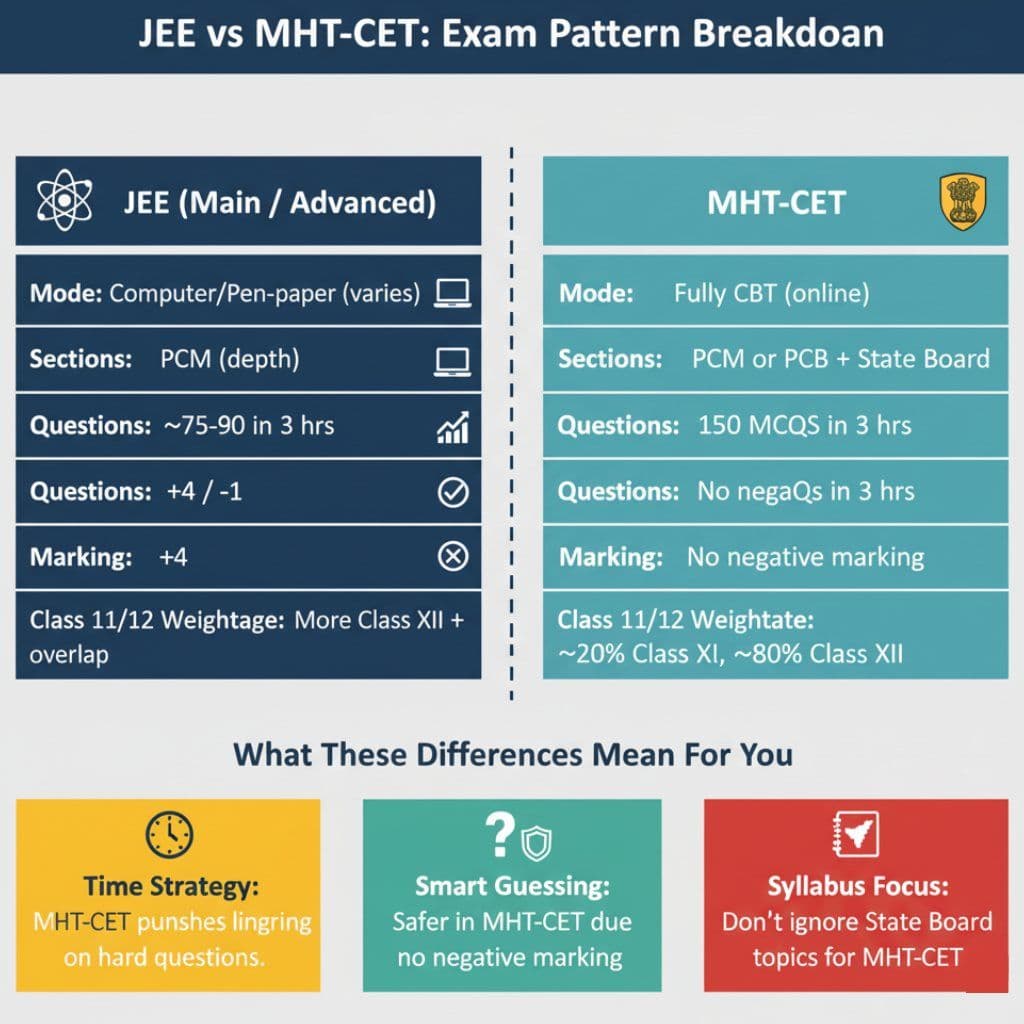
Before overhauling the strategy, understand how these two exams differ structurally. That difference is where your planning changes.
Key Aspects Where They Differ
| Feature | JEE (Main / Advanced) | MHT-CET |
|---|---|---|
| Mode | Computer-based / Pen-paper (varies) | Fully CBT |
| Sections / Subjects | Physics, Chemistry, Maths (strict depth) | PCM (for Engineering) or PCB (for Pharmacy) + state board syllabus alignment |
| Number of Questions / Duration | ~75–90 questions in 3 hours (varies) | 150 MCQs in 3 hours for PCM (50 each in Physics, Chemistry, Maths) |
| Marking / Negative Marking | +4 / –1 (Main) or other schemes in Advanced | No negative marking in MHT-CET |
| Weightage of Class XI vs XII | Often more weight to class XII, but JEE includes conceptual overlap from both years | ~20% questions from Class XI, ~80% from Class XII syllabus |
What These Differences Mean For You
- In JEE, sacrificing time on one hard question might pay off. In MHT-CET, you can’t afford to linger too long.
- Because there’s no negative marking in MHT-CET, guessing (when done smartly) is safer than in JEE.
- The alignment to the state board syllabus in MHT-CET means topics students often skip under JEE prep may rear their heads—don’t ignore them.
Syllabus Overlap and Key Differences
Your JEE study has covered a large chunk of what MHT-CET demands. But not all overlap is equal—some topics get more weight in CET, some get sidelined.
What’s Common / Safe to Carry Forward
- Core Physics, Chemistry, Maths from Class XII, and many parts of Class XI
- A problem-solving mindset: you’ll need it everywhere
- Practice with MCQs and objective-style questions
What You Must Adjust or Add
- Focus more on board-style problems and application-based questions in the state syllabus (MHT-CET leans heavily here) (cetcell.mahacet.org)
- Don’t neglect topics that many JEE aspirants avoid (especially from the board syllabus)
- Because MHT-CET has no negative marking, strengthen your elimination strategies and educated guessing
Problem-Solving Approach: Depth vs Speed
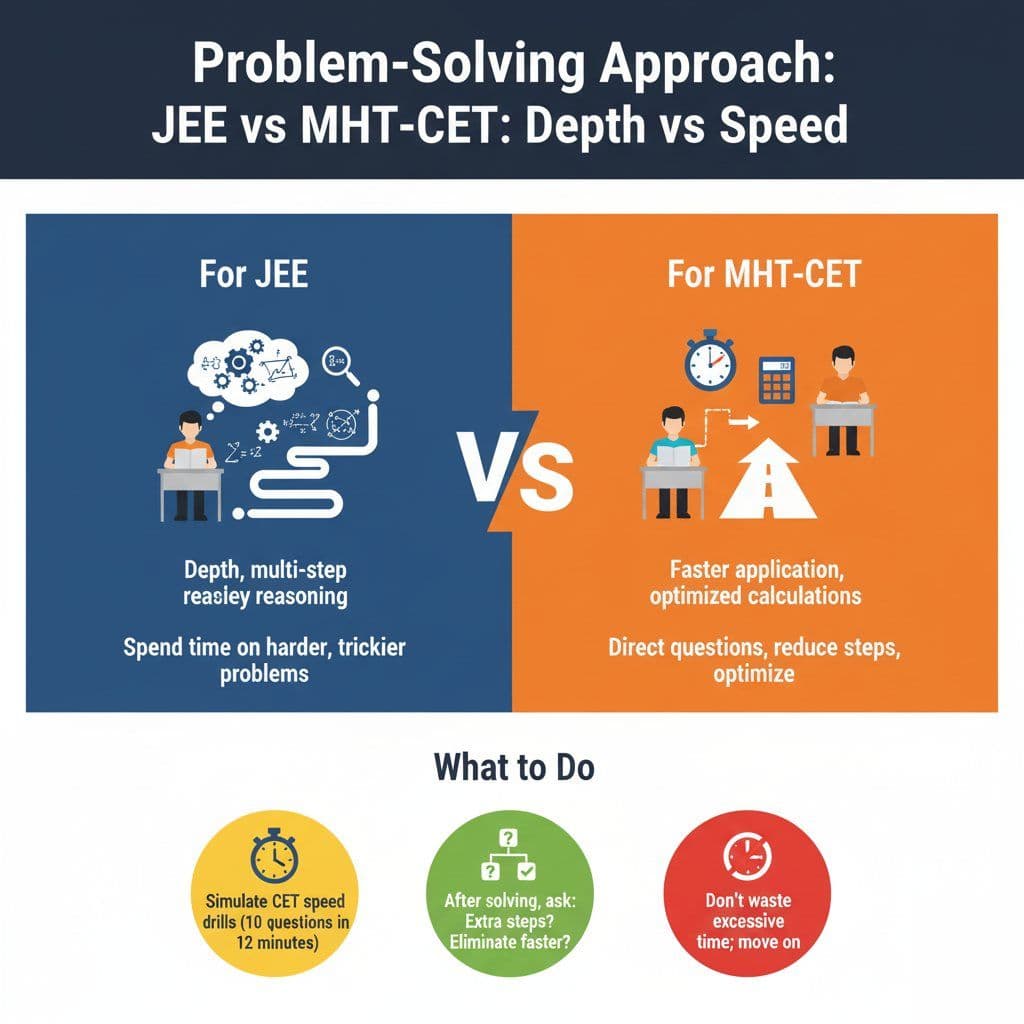
This is where your mindset needs to pivot.
For JEE
- You can afford to spend time thinking through harder or trickier problems
- Depth, multi-step reasoning, elegant proofs, and conceptual traps are your strength areas
For MHT-CET
- Questions tend to be more direct and require faster application
- You need to reduce needless steps, optimize calculations, and skip distractions
- Time per question is lower in practice; you must internalize pattern recognition
What to Do
- In your practice, simulate CET speed drills (e.g., 10 questions in 12 minutes)
- After solving, always ask: Did I take extra steps? Could I have eliminated options faster?
- Don’t waste excessive time on one question; move on and come back if time permits
Time Management Tactics
Even a strong student can lose half their marks if they mismanage time. Both JEE and MHT-CET require discipline in time allocation, but the approach is not identical.
The 3-Hour Challenge
- JEE: With fewer questions but higher difficulty, you can afford to spend more time per question. Time management here means deciding when to give up on a question.
- MHT-CET: With 150 questions in 180 minutes, you get just over 1 minute per question. That means time management here is about speed and prioritization.
Pro Tip: Build a buffer of 15–20 minutes by finishing easier sections quickly. This time can be invested in revisiting flagged questions.
Section-Wise Strategy
- Start Strong: Begin with your strongest subject (say Maths) to gain momentum. Early confidence reduces panic later.
- Layered Attempt:
First pass → Attempt all easy & direct questions.
Second pass → Solve medium-level problems you skipped.
Final pass → Revisit tougher or time-consuming ones.
- Don’t Stall: If you’re stuck for more than 90 seconds, mark it and move on. CET punishes hesitation more than it punishes mistakes.
Example: In Physics, if a circuit problem looks lengthy, skip it in the first pass. Attempt quick formula-based questions instead. Come back later if time allows.
Guessing & Risk Strategy in CET
- Since there’s no negative marking, leaving answers blank is almost always a mistake.
- Smart strategy:
- If you can eliminate 2 options, you now have a 50% chance. Attempt it.
- If you can eliminate 1 option, attempt it only if you’re running ahead of time.
- Blindly guessing every unanswered question is still better than leaving it blank—CET doesn’t penalize.
Simulation Exercise: In your mocks, make it a rule to attempt all 150 questions. This builds the habit and lowers hesitation in the real exam.
Preparation Strategy if You’re Already Doing JEE
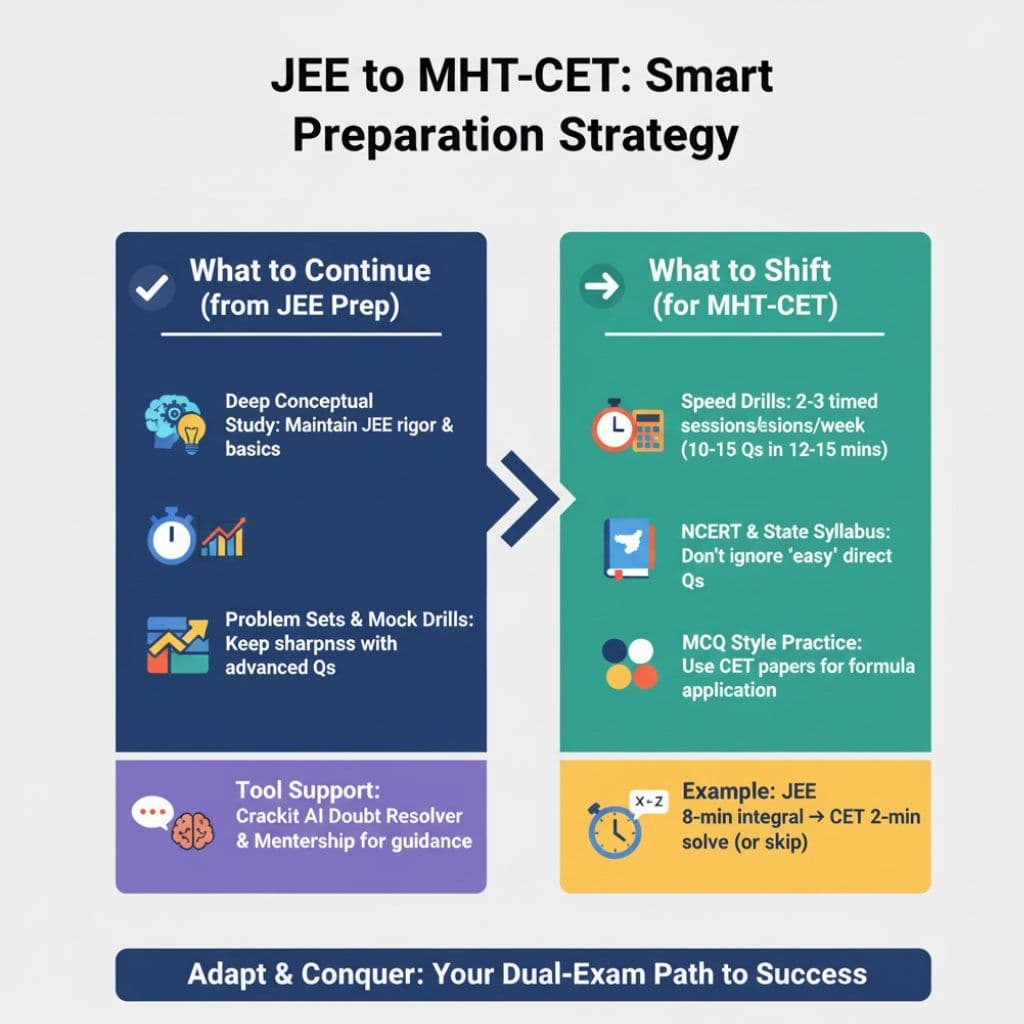
If you’re preparing for JEE, you’re already ahead of the curve for MHT-CET. But don’t fall into the trap of thinking “CET will be automatically easy.” The exam tests different skills. Here’s how to adapt.
What to Continue
- Deep Conceptual Study: JEE’s problem-solving rigor makes your basics solid. Keep revising those high-level concepts.
- Problem Sets & Mock Drills: Continue with advanced questions to maintain sharpness—you’ll find CET questions simpler in comparison.
What to Shift
- Speed Drills: Dedicate at least 2–3 sessions per week to CET-style timed practice (10–15 questions in 12–15 minutes).
- NCERT & State Syllabus: Some CET questions are direct lifts from textbooks. Don’t ignore them, even if they feel “too easy” compared to JEE.
- MCQ Style Practice: CET leans on the application of formulas and factual recall. Mix in previous CET papers or targeted MCQ books.
- Tool Support:
- Use CrackIt AI Doubt Resolver whenever you’re stuck—it keeps momentum instead of wasting hours.
- If you feel stuck or need structure, try CrackIt Mentorship. Personalized guidance avoids “generic study” mistakes.
Example: A JEE aspirant might spend 8 minutes on a difficult integral. In CET, that same student should learn to solve it in under 2 minutes—or skip it if it doesn’t click.
Study Materials & Resources
Choosing the right materials matters more than hoarding too many. For JEE + MHT-CET dual prep, balance depth with speed-oriented resources.
What to Keep / Adjust
- Keep JEE Books: Stick with your existing JEE prep books for strong fundamentals (e.g., HC Verma for Physics, JD Lee for Chemistry).
- Prioritize NCERT + State Board Texts: CET papers often include straightforward fact-based questions from NCERT lines—don’t ignore these.
- CET-Focused Books: Add a resource specifically written for MHT-CET (Arihant, Target Publications). They cover the question style you won’t find in JEE materials.
Online Platforms & Tools
- Use CET-style mocks to master pacing. Try CrackIt MHT-CET Mock Test series to simulate real exam conditions.
- Monitor your score trajectory with CrackIt Predictor. It helps you see if your performance is aligned with cutoffs.
- Resolve doubts instantly with CrackIt AI Doubt Resolver. It’s like having a tutor on demand.
Internal Resources to Explore
- Top Colleges for MHT-CET (Govt & Private in Maharashtra) — knowing where you want admission keeps motivation high.
- CrackIt Mentorship — for a personalized roadmap if balancing JEE and CET feels overwhelming.
Example Weekly Plan:
- Mon–Thu: Continue JEE problem sets (depth)
- Fri–Sat: Do CET MCQ practice (speed)
- Sun: Take 1 full-length CET mock test and analyze results using Predictor
Common Mistakes Students Make in the Transition
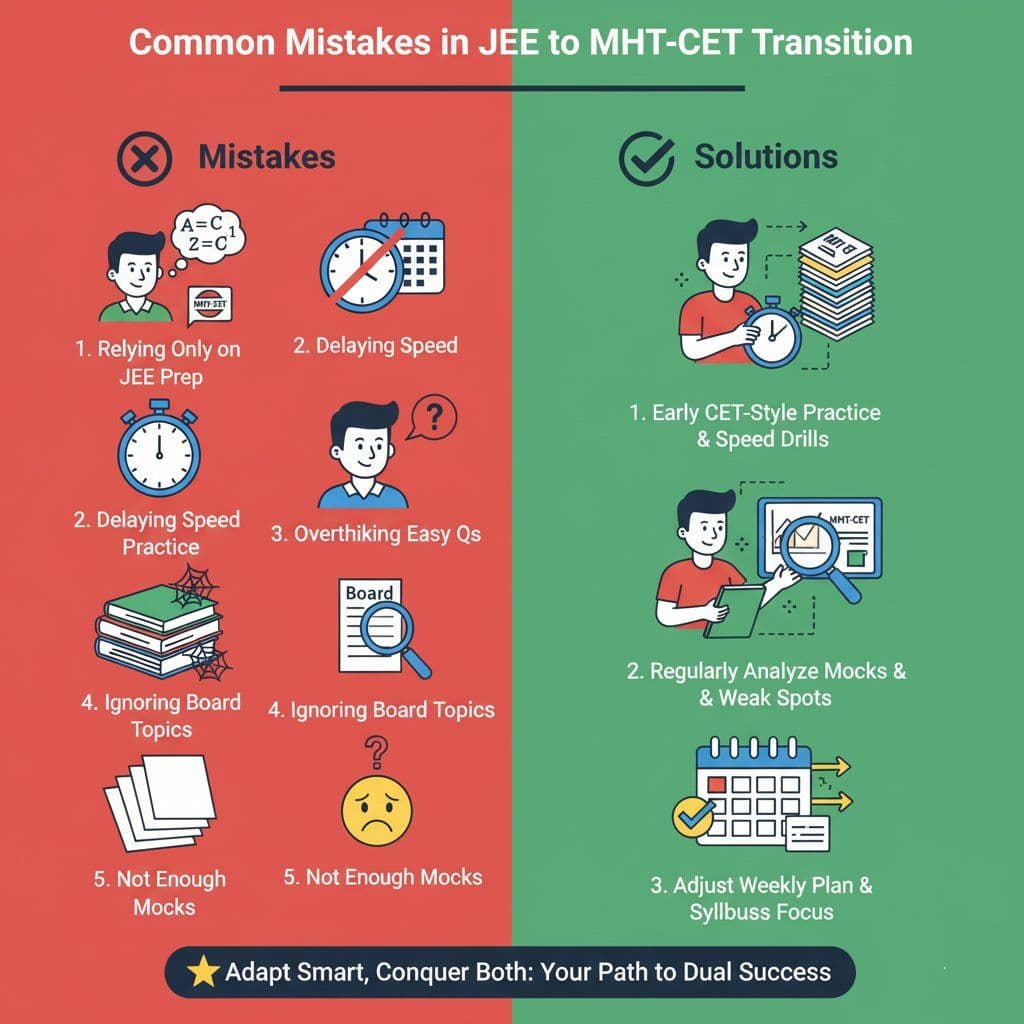
- Relying entirely on JEE-style prep and ignoring CET peculiarities
- Delaying speed practice until last month
- Overthinking questions in CET that are meant to be solved quickly
- Ignoring weak spots in the board syllabus topics
- Not taking enough mocks or review
Avoid these traps by scheduling early CET-style practice, regularly analyzing mocks, and adjusting your weekly plan.
Smart Tools & Mentorship for Dual Preparation
You don’t have to go it alone. Tools can speed up your feedback loop and stop small errors from cascading.
- CrackIt Mentorship can help you personalize your study plan, maintain accountability, and correct your trajectory.
- CrackIt AI Doubt Resolver helps resolve mistakes quickly—rather than letting them repeat.
- CrackIt Predictor gives you a sense of where your score stands relative to CET cutoffs.
Use these at regular intervals (say once a week or after 2 mocks) to adjust your strategy.
Case Study: JEE Candidate Who Cracked MHT-CET
Let me walk you through “Riya’s story” (hypothetical but grounded in real trends) to show how strategy shift works.
- Riya was preparing mainly for JEE. Six months out, she added weekly CET drills, used mocks regularly, and focused on board syllabus topics she had skipped.
- She used mentorship calls to identify her weakest topics and scheduled micro-sessions for those.
- In the final month, she practiced every day in a timed mode, tracked performance, and tailored guessing strategies.
- She ended up scoring high in both JEE and CET and got into a top engineering college in Maharashtra.
Key lessons: early adaptation, regular feedback loops (via mocks & tools), and strategic resource use.
Conclusion: Adjust Smartly, Stay Agile
JEE and MHT-CET both demand excellence, but the kind of excellence differs. Your mission is to balance depth and speed, pick your battles wisely, and constantly adapt.
If you start shifting early—blend your JEE strength with CET-style adjustments—your final months will feel more confident than frantic. Use tools like CrackIt’s Mentor, AI Doubt Resolver, and Predictor to keep feedback tight and course correct fast.
You’ve got the base. Now you just need the right adjustments.
FAQs on JEE to MHT-CET Strategy Changes for Each Exam
Q1. Can JEE preparation alone help me clear MHT-CET?
Yes—for many core topics, JEE study gives you a strong foundation. But JEE alone is not enough. You need extra work on speed, board syllabus alignment, and mock tests specific to CET. Without that, you may lose marks not for lack of knowledge, but for failing to adapt.
Q2. Is MHT-CET easier than JEE?
They differ. MHT-CET is easier in the sense that there’s no negative marking, many questions are more direct, and the syllabus leans towards to board curriculum. But the competition is fierce, and the time pressure is tight. So “easier” is only relative.
Q3. How quickly can I adapt from JEE prep to MHT-CET style?
If you begin 3–4 months before the CET, that gives enough runway. In that window, gradually increase CET drills, mock tests, and start shifting strategy. A late 1-month switch is possible, but harder.
Q4. What are the best resources if I’m already doing JEE?
- Use your JEE books for advanced practice, but add CET-style guides and state syllabus books.
- Practice on mock tests like those in the CrackIt MHT-CET mock test series.
- Anytime you hit a stumbling block, use CrackIt AI Doubt Resolver for fast clarification.
- If you feel directionless, seek a plan via CrackIt Mentorship.
- Use CrackIt Predictor to monitor where your scores place you for admission.
Q5. Do I need separate coaching for MHT-CET if I’m already coaching for JEE?
Not always. If your coaching covers both types (or allows you to practice CET problems), you might manage without separate classes. But if your coaching is strictly JEE-oriented, you’ll need supplementary CET practice—especially mocks and speed drills.
Categories
Join the Discussion
0 comments