Table of Contents
Scored Low in BITSAT Session 1? Here Is Your Complete Session 2 Improvement Plan [2026]
Pratham Jiwnani
5/1/2026
![Scored Low in BITSAT Session 1? Here Is Your Complete Session 2 Improvement Plan [2026]](/_next/image?url=https%3A%2F%2Fcdn.sanity.io%2Fimages%2Fp3j1jh9k%2Fproduction%2F24992fa51137777a8b20e8b4bca43e4981275dd3-1254x1254.png&w=3840&q=75&dpl=dpl_9MrmTLQ15fVcn73axnHN74SFMuNg)
The best BITSAT Session 2 preparation strategy starts with an honest analysis of your Session 1 score. Students scoring 180–220 should focus on concept revision with one mock every 3 days. Those at 220–260 need speed drills and sectional tests. Students above 260 should run full-length mocks every alternate day and target bonus questions. With a structured 30-day plan, improving by 40–60 points between sessions is realistic.
You Checked Your Score. Now What?
You opened your BITSAT Session 1 result and the number staring back at you wasn't the one you planned for. Maybe it's a 215 when you needed 290. Maybe it's a 255 and you're not sure if that even matters anymore. Either way, you're sitting with the same question every BITSAT student asks at this moment: is it over — or can I actually fix this?
The answer is yes, you can fix it. But only if you stop guessing and start with an honest analysis of what went wrong. This guide walks you through a complete, data-backed BITSAT Session 2 preparation strategy — from reading your Session 1 score like a diagnostic report to building a 30-day plan that actually works.
Already know your score range? Jump directly to the Score → Problem → Strategy → Action Framework below. Or use our free BITSAT College Predictor to see which BITS campuses are realistic for your current score.
"A 200 in Session 1 is not a failure. It's a 30-day roadmap in disguise. Every wrong answer tells you exactly where your next 10 marks are hiding." — CrackIT Mentor
BITSAT 2026 — Quick Exam Overview
The BITSAT (Birla Institute of Technology and Science Admission Test) is a computer-based national entrance exam for admission to B.E., B.Pharm, and M.Sc. programmes at BITS Pilani, BITS Goa, and BITS Hyderabad. For a detailed breakdown of every topic covered, see our complete BITSAT 2026 Syllabus Guide.
| Feature | Detail |
|---|---|
| Mode | Online — Computer Based Test (CBT) |
| Duration | 3 hours (180 minutes) |
| Total Questions | 130 + up to 12 bonus questions |
| Marking Scheme | +3 correct / −1 incorrect / 0 unattempted |
| Maximum Score | 390 (main) + 36 (bonus) |
| Session 1 | May 2026 (Tentative) |
| Session 2 | June 2026 (Tentative) |
Section-wise breakdown:
| Section | Questions | Max Marks |
|---|---|---|
| Physics | 30 | 90 |
| Chemistry | 30 | 90 |
| Mathematics | 40 | 120 |
| English Proficiency | 15 | 45 |
| Logical Reasoning | 15 | 45 |
| Total | 130 | 390 |
Bonus Questions: If you complete all 130 questions before time runs out, BITSAT presents up to 12 additional questions worth +3 each. Answering them correctly can only help your score — they cannot reduce it. Targeting bonus questions is a real strategy once your accuracy consistently exceeds 85%.
For the full BITSAT 2026 exam pattern including section-wise time strategy, read our dedicated guide.
How to Analyze Your BITSAT Session 1 Score
Most students look at their total score and either feel relieved or devastated. Both reactions skip the most valuable step: treating your Session 1 result as a diagnostic tool, not a verdict.
Step 1 — Break Down Your Score by Subject
Map your marks against the maximum per section. Do not estimate — use your actual scorecard breakdown.
| Subject | Your Marks | Max Marks | Accuracy % | Status |
|---|---|---|---|---|
| Physics | ___ | 90 | ___ | Strong / Weak |
| Chemistry | ___ | 90 | ___ | Strong / Weak |
| Mathematics | ___ | 120 | ___ | Strong / Weak |
| English + LR | ___ | 90 | ___ | Strong / Weak |
Step 2 — Calculate Your Accuracy Rate
Accuracy Rate = (Correct Answers ÷ Attempted Questions) × 100
This single number explains more about your score than the total itself. A student with 70% accuracy over 100 attempts scores around 180. The same student at 85% accuracy on the same 100 attempts scores around 230 — a 50-point gain purely from accuracy improvement, zero new learning required.
Step 3 — Categorize Every Wrong Answer
Tag each mistake into one of three buckets:
Conceptual Error — You did not know the underlying concept. Fix: targeted revision of that chapter.
Calculation or Silly Error — You knew the concept but made a careless mistake. Fix: slow down, cross-check your working.
Time Pressure Error — You rushed because you were running out of time. Fix: timed sectional drills to build speed.
Most students discover that 40–50% of their errors are silly mistakes — completely fixable without any new studying. For a ready-made error log template and chapter-wise revision tracker, visit our BITSAT Preparation Resources page.
What Does Your Score Actually Mean? (With Cutoff Context)
Before building a Session 2 strategy, you need to know what your current score means for actual admission chances. Below are approximate BITS campus cutoffs based on 2024–25 trends:
| Campus | Engineering Cutoff Range (Approx) | Note |
|---|---|---|
| BITS Pilani | 330 –360+ | Highest; most competitive |
| BITS Goa | 300 –335 | Strong competition |
| BITS Hyderabad | 275 – 315 | Most accessible of the three |
Important: Cutoffs vary by programme. Computer Science at any campus is typically 15–25 marks above the general engineering cutoff. Always verify with the official BITS Admissions portal (bitsadmission.com). For a full programme-wise cutoff comparison across all three campuses, see our BITS Pilani vs Goa vs Hyderabad Cutoff Guide.
| Your Session 1 Score | Current Position | Realistic Session 2 Target |
|---|---|---|
| Below 180 | Needs major rebuild | 200–230 |
| 180 –220 | Below competitive range | 250 –270 |
| 220 –260 | Borderline competitive | 280–300 (BITS Hyderabad territory) |
| 260–300 | Competitive for Hyderabad/Goa | 310–330 (BITS Goa territory) |
| 300+ | Strong position | 340+ (targeting Pilani) |
Not sure which campus to target? Our BITSAT College Predictor 2026 maps your score to realistic campus and programme options instantly.
Score → Problem → Strategy → Action Framework {#framework}
Match your score range to your actual problem, then follow the specific strategy and daily actions. This is the most important section of this guide.
Score Range: 180–220
Root Problem: Concept gaps in 2+ subjects, low accuracy, and time pressure combining together.
Strategy: Concept-first revision before any mock attempts. Do not start mocks until Week 2.
Daily Actions:
- Revise 2 chapters per day using NCERT + formula notes
- Solve 40 concept-based questions (not timed) per day
- One sectional test every 3 days starting Week 2
Success Metric: Accuracy above 75% in sectional tests before Week 3.
Score Range: 220–260
Root Problem: Speed inconsistency, topic-level gaps, and over-attempting low-probability questions.
Strategy: Timed sectional practice combined with strict error log discipline.
Daily Actions:
- One timed sectional test per day
- Deep review of all errors within 24 hours — no exceptions
- Full-length mock every 2 days from Week 2 onwards
Success Metric: Consistent 270+ score across 5 consecutive full mocks before Session 2.
Score Range: 260+
Root Problem: Accuracy dropping under exam pressure, hesitation on bonus questions.
Strategy: Full-length mocks under strict exam conditions, polishing weak topics only.
Daily Actions:
- Full mock every alternate day throughout the prep window
- 30 minutes of weak topic revision daily (no more than this — do not disrupt what is working)
- Active bonus question strategy practice
Success Metric: 340+ on 3 consecutive mocks with 88%+ accuracy.
Complete BITSAT Session 2 Preparation Plan: 30 Days
Phase 1 — Days 1 to 8: Analysis + Concept Revision
Days 1–2 are entirely for analysis. Do your full Session 1 score breakdown using the framework above. Tag every wrong answer. Build your error document. Do not attempt any mocks during this phase.
Days 3–8: Revise your 3 weakest chapters per subject using NCERT and concept notes. No full mocks yet. The foundation needs to be solid before you start testing it. For a chapter-priority list based on BITSAT question frequency, see our BITSAT High-Weightage Topics Guide.
Phase 2 — Days 9 to 22: Practice + Mocks
Begin with sectional tests (30-question timed tests per subject) before jumping to full mocks. Start full-length BITSAT mocks from Day 12 onwards. Target 8–10 full mocks total during this phase.
Analyze every mock within 24 hours using the three-bucket categorization. Track your accuracy rate per subject in a table — it should trend upward week over week. You can access CrackIT's free BITSAT mock test series with detailed performance analytics built in.
Phase 3 — Days 23 to 30: Final Push
One full mock every alternate day. No more — overloading in the final week causes burnout and drops performance. Spend 30 minutes daily on formula revision. Simulate full exam conditions: same time slot, no distractions, no mid-exam pauses.
Lock in your question-attempt strategy: decide which section you will tackle first, and when you will skip and return to a question.
Data point: Based on CrackIT's internal performance data from 412 BITSAT aspirants in the 2024–25 batch — students who completed 10+ full-length mocks with same-day error analysis improved their scores by an average of 42 points between Session 1 and Session 2. Students who also maintained a written error log improved by an average of 58 points. (Source: CrackIT student performance tracking, 2024–25 BITSAT batch, n=412)
Subject-Wise Strategy for BITSAT Session 2
Mathematics (40 Questions — Highest Priority)
Mathematics has the most questions of any section and therefore the highest potential score impact. A 5% accuracy improvement in Maths alone adds 6 correct answers, worth 18 marks.
Highest-yield topics to prioritize: Coordinate Geometry, Calculus (limits, differentiation, integration), Probability, and Vectors & 3D Geometry. Most BITSAT Maths questions can be solved in 60–90 seconds with strong formula recall. Do not skip Trigonometry or Complex Numbers — these often appear in 3–4 question clusters. For a topic-wise practice plan, visit our BITSAT Mathematics Preparation Guide.
Physics (30 Questions)
Focus areas: Mechanics, Electrostatics, and Modern Physics (photoelectric effect, Bohr model). Many BITSAT Physics questions test formula application rather than deep conceptual reasoning, which means formula sheets are extremely high ROI. Optics and Waves are frequently tested and often underrevised — prioritize these if they are in your weak bucket.
Chemistry (30 Questions)
Organic Chemistry typically contributes 10–12 questions. Named reactions and mechanisms are direct scoring opportunities. Physical Chemistry (equilibrium, electrochemistry, thermodynamics) rewards calculation speed. Inorganic Chemistry — particularly p-block and d-block elements — can be revised thoroughly in 2–3 days and is high-accuracy territory for most students.
English + Logical Reasoning (30 Questions)
This section is consistently underestimated. 30 questions in approximately 18–20 minutes is very achievable, and most students can reach 85–90% accuracy here with just 3–4 days of focused practice. BITSAT reading comprehension passages are shorter than JEE Advanced. Logical reasoning topics (series, coding-decoding, syllogisms) can be drilled to near-100% accuracy quickly.
BITSAT scoring math: A student who attempts 100 questions at 90% accuracy scores 260 points (90×3 − 10×1 = 260). A student who attempts 120 questions at 75% accuracy scores 258 points (90×3 − 30×1 = 240). The difference is 20 points — in favor of accuracy, not volume. This is why improving accuracy is always the higher-priority fix.
BITSAT Mock Test Strategy After Session 1
Mock tests are only as valuable as the analysis that follows them. A student who attempts 20 mocks without reviewing errors will plateau. A student who attempts 8 mocks with thorough same-day analysis will improve consistently. Access structured BITSAT mock tests with section-wise analytics on CrackIT to track your accuracy trend automatically.
The 4-Step Mock Analysis Protocol:
Step 1 — Immediately after the mock: Record your total score, subject-wise marks, and attempted/correct ratio. Do not review questions yet. Let the experience settle.
Step 2 — Within 2 hours: Go through every wrong answer. Tag it as conceptual, silly, or time error. Write the correct approach in your notebook in your own words.
Step 3 — Next morning: Revise only the concepts behind your conceptual errors from yesterday's mock. This is targeted, not general.
Step 4 — Before your next mock: Spend 10 minutes reviewing your error log from all previous mocks. Look for patterns — repeated mistakes in the same topic are your highest priority.
The plateau trap: Students who attempt mocks in the morning, feel okay about their score, and move on without reviewing them. This is the single biggest reason BITSAT scores stop improving between Session 1 and Session 2.
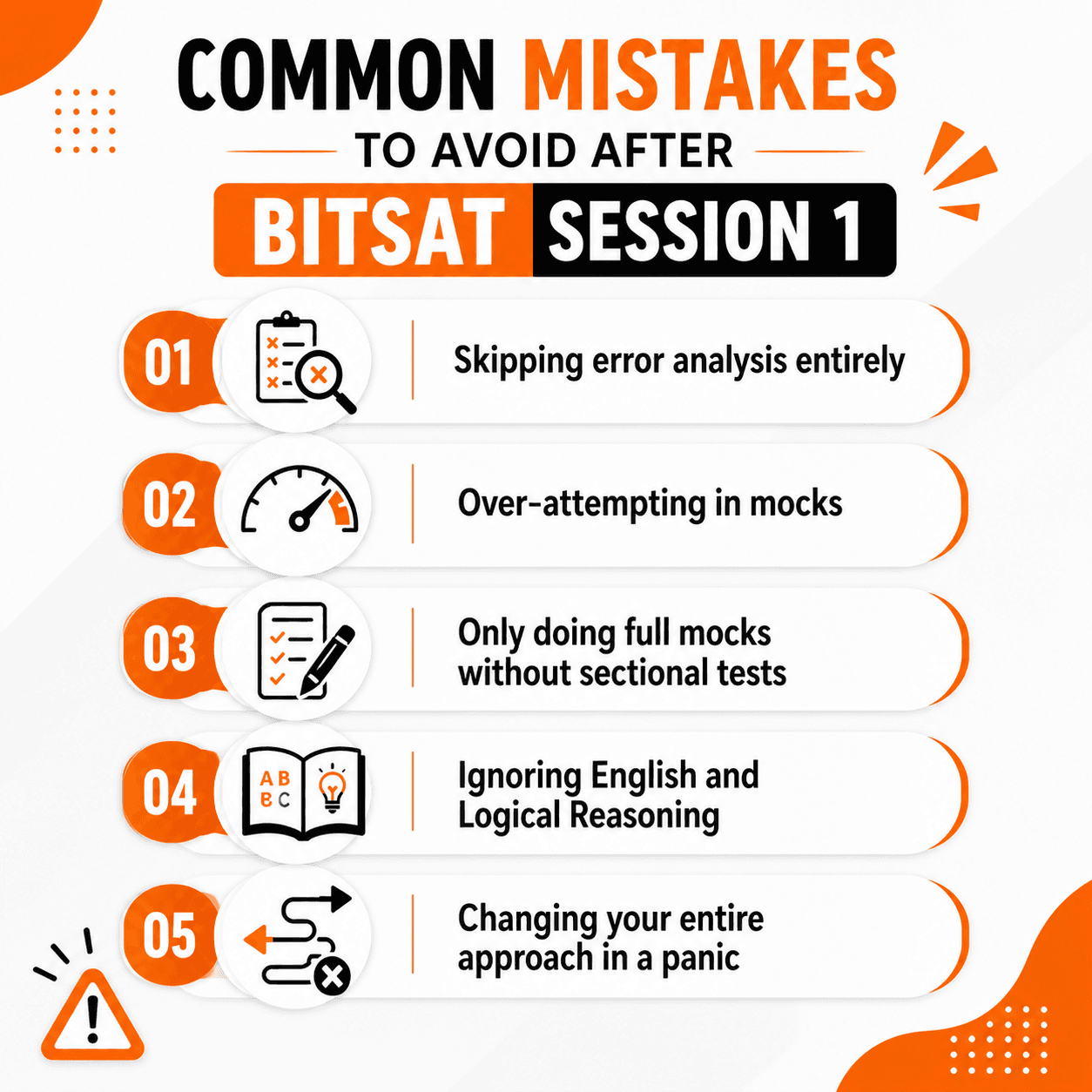
Common Mistakes to Avoid After BITSAT Session 1
Skipping error analysis entirely — reading your score without understanding why you got questions wrong is not preparation, it is procrastination.
Over-attempting in mocks — 75% accuracy over 100 questions consistently outperforms 60% accuracy over 130 questions. Know when to skip.
Only doing full mocks without sectional tests — sectional tests are how you fix specific weaknesses. Full mocks only measure where you currently are.
Ignoring English and Logical Reasoning — 30 questions in 20 minutes at high accuracy is the best ROI section in the exam and the most neglected.
Changing your entire approach in a panic — if your methodology was sound but your execution was inconsistent, fix the execution. Starting over wastes the preparation you have already done.
Trying to prepare without a mentor or structured feedback loop — self-study works, but it is significantly slower without someone identifying your blind spots. See how CrackIT's BITSAT mentorship programme works.
Self-Study vs Mentorship for BITSAT Session 2 — Which One Actually Works?
This is the most honest question a student can ask after a disappointing Session 1 score. Both approaches can work. But they work for different types of students, at different score ranges, with very different timelines. Here is a direct comparison.
| Factor | Self-Study | Mentorship |
|---|---|---|
| Cost | Low (free to minimal) | Moderate (programme fee) |
| Flexibility | Full control of schedule | Structured weekly plan |
| Accountability | Self-driven only | Weekly check-ins + tracking |
| Blind spot detection | Difficult — you don't know what you don't know | Mentor identifies gaps you miss |
| Mock analysis quality | Depends on your self-awareness | Expert review of every test |
| Average score improvement | 20–35 points (CrackIT data, 2024–25) | 42–58 points (CrackIT data, 2024–25) |
| Best suited for | Scores 270+ with strong discipline | Scores below 270 or inconsistent performance |
| Risk | High — no course correction if strategy is wrong | Low — strategy adjusted in real time |
(Source: CrackIT internal student performance data, 2024–25 BITSAT batch, n=412)
When Self-Study Is the Right Choice
Self-study works well when your Session 1 score is already above 270 and your main issue is consistency rather than concept gaps. If you know exactly which topics are weak, you have the discipline to stick to a daily schedule without external accountability, and you are comfortable analyzing your own mock tests thoroughly — self-study can get you to your Session 2 target.
The students who succeed with pure self-study for BITSAT Session 2 typically share three traits: they already have a structured plan before they start, they analyze every mock the same day they attempt it, and they do not change their approach mid-preparation out of panic.
When Mentorship Closes the Gap Faster
If your Session 1 score is below 270, or if you tried self-study between sessions before and your score did not move meaningfully, mentorship is the faster route. The core reason is blind spot detection — a mentor who has seen hundreds of BITSAT students will identify in the first week what is actually holding your score back, rather than letting you discover it in Week 3 when time is running out.
Based on CrackIT's 2024–25 batch data, students under mentorship improved by an average of 16 more points than self-study students in the same score range and same 30-day preparation window. That gap narrows at higher score ranges (280+) and widens significantly at lower score ranges (below 220).
The Honest Answer: A Hybrid Approach Works Best
For most students targeting a 30–60 point improvement in 30 days, the most effective approach is not purely one or the other. Use self-study for daily revision and chapter practice. Use mentorship or structured feedback specifically for mock analysis, strategy adjustment, and accountability.
The CrackIT data is clear: The biggest predictor of improvement between Session 1 and Session 2 is not hours studied — it is quality of feedback on mistakes. Whether that feedback comes from a mentor or from your own rigorous self-analysis, the students who improve most are the ones who understand exactly why every wrong answer happened.
Not sure which approach fits your score and timeline? CrackIT's free 20-minute strategy call will map out the right path based on your specific Session 1 breakdown — no commitment required.
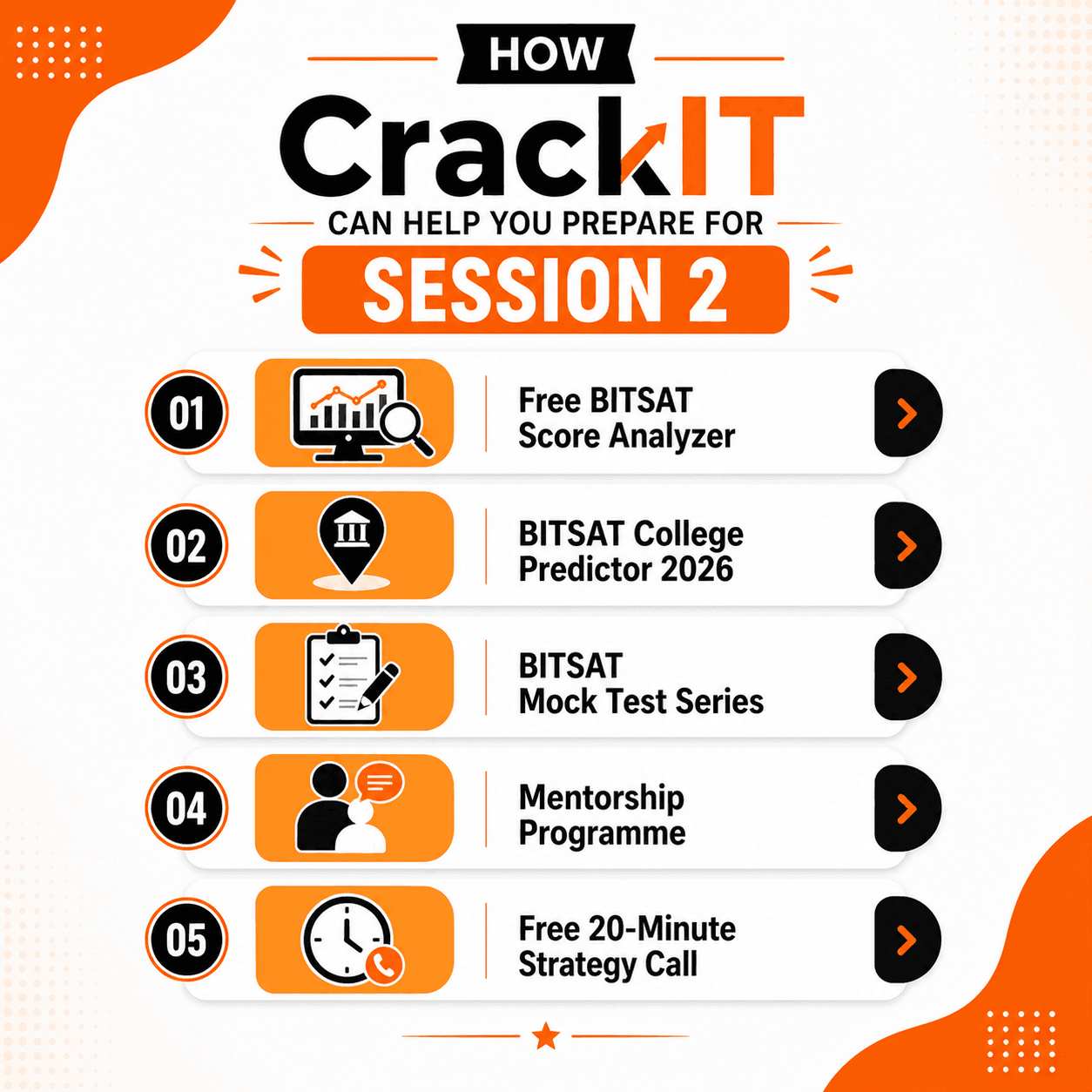
Free BITSAT Score Analyzer: Enter your Session 1 subject-wise marks and get a personalized Session 2 target and study priority list. No signup required. Takes 60 seconds.
BITSAT College Predictor 2026: See which BITS campuses and programmes are realistic for your current score, and exactly what score you need to unlock each option. Gives you a precise, motivating target for Session 2.
BITSAT Mock Test Series: Full-length and sectional mocks with built-in performance analytics. Track your accuracy rate, time-per-question, and subject-wise improvement across every test.
Mentorship Programme: Work with a BITS alumni mentor who has coached 400+ BITSAT aspirants. You get a personalized weekly plan, daily doubt resolution, and mock analysis support through the full Session 2 prep window.
Free 20-Minute Strategy Call — Share your Session 1 score and we will map out your personalized Session 2 plan live. Limited slots available before Session 2 exam dates. Book your free call at crackit.co.in
Frequently Asked Questions
1. Can I realistically improve my BITSAT score between Session 1 and Session 2?
Yes. Based on CrackIT's internal data from 412 students in the 2024–25 BITSAT batch, those who followed a structured mock and revision plan improved by an average of 42–58 points. An improvement of 30–80 points is achievable with consistent 4–6 hours of daily preparation over 30 days.
2. What is a good score in BITSAT Session 1?
A score above 260 is considered competitive, and 300+ puts you in a strong position for BITS Hyderabad and Goa. However, the definition of "good" depends entirely on your target campus and programme. Use our BITSAT College Predictor to match your exact score to realistic options.
3. Is BITSAT Session 2 harder than Session 1?
Historically, Session 2 difficulty is comparable to Session 1, though question sets differ. Cutoffs can vary slightly between sessions. BITS uses scores relative to your session cohort, so your performance against other Session 2 takers matters more than absolute difficulty.
4. How many mocks should I attempt before Session 2?
A minimum of 8–10 full-length mocks with same-day analysis. Quality matters more than quantity — 8 thoroughly analyzed mocks will outperform 20 mocks done for volume alone. Start with CrackIT's free BITSAT mock series to get performance analytics with every attempt.
5. Which subject gives the fastest score improvement?
For most students, Mathematics (40 questions) offers the highest improvement per hour because it rewards formula recall and speed, both of which improve quickly with targeted practice. If your Maths is already strong, English + Logical Reasoning offers the fastest accuracy ceiling at 30 questions in approximately 18 minutes.
6. Is self-study enough for BITSAT Session 2 or do I need a mentor?
It depends on your score range and self-awareness. Students above 270 with strong discipline typically do well with self-study. Students below 270, or those whose scores plateaued despite regular practice, see significantly faster improvement under mentorship. The average improvement gap between the two approaches in CrackIT's 2024–25 data was 16 points in the same 30-day window. See the full self-study vs mentorship comparison above for a detailed breakdown.
7. How do BITSAT bonus questions work?
If you complete all 130 questions before time expires, you receive up to 12 bonus questions. Correct answers add +3 each, and wrong answers do not reduce your score. Targeting bonus questions requires finishing the main paper with 10–15 minutes to spare, which is realistic once your question speed is consistently under 80 seconds per question.
8. Why is my BITSAT score not improving despite regular practice?
The most common cause is practicing without error analysis — attempting more mocks without reviewing mistakes creates a false sense of preparation. The second most common cause is overdrilling strong subjects while ignoring weak ones. Use the three-bucket error categorization system in this guide to identify your specific barrier. If the problem persists, speak to a CrackIT mentor who can identify blind spots you cannot see yourself.
Conclusion
Your BITSAT Session 1 score is not your final answer. It is your most detailed feedback report. Every wrong answer, every rushed section, every concept you guessed on — it is all data pointing directly to where your Session 2 marks are waiting.
The students who improve the most between sessions are not the ones who panic and attempt 30 mocks in 30 days. They are the ones who spend Day 1 on a thorough analysis, build a structured plan, and execute it consistently — mock by mock, error by error, subject by subject.
Start with the analysis. Follow the Score → Problem → Strategy → Action framework. Run the 30-day phased plan. Decide honestly whether self-study or mentorship fits your score range and timeline. And track your accuracy rate week over week, not just your total score.
Ready to build your personalized Session 2 plan? Use CrackIT's free BITSAT Score Analyzer, explore our BITSAT mock test series, or book a free strategy call with our mentors — and turn your Session 1 result into your Session 2 advantage.
Your BITSAT exam is closer than you think.
Don't just read about it — practice it. Free mock tests inside.
Categories
Join the Discussion
0 comments