Table of Contents
Why Maths Is the BITSAT Killer — and How to Beat the Clock with the Right BITSAT Maths Strategy
Pratham Jiwnani
5/18/2026
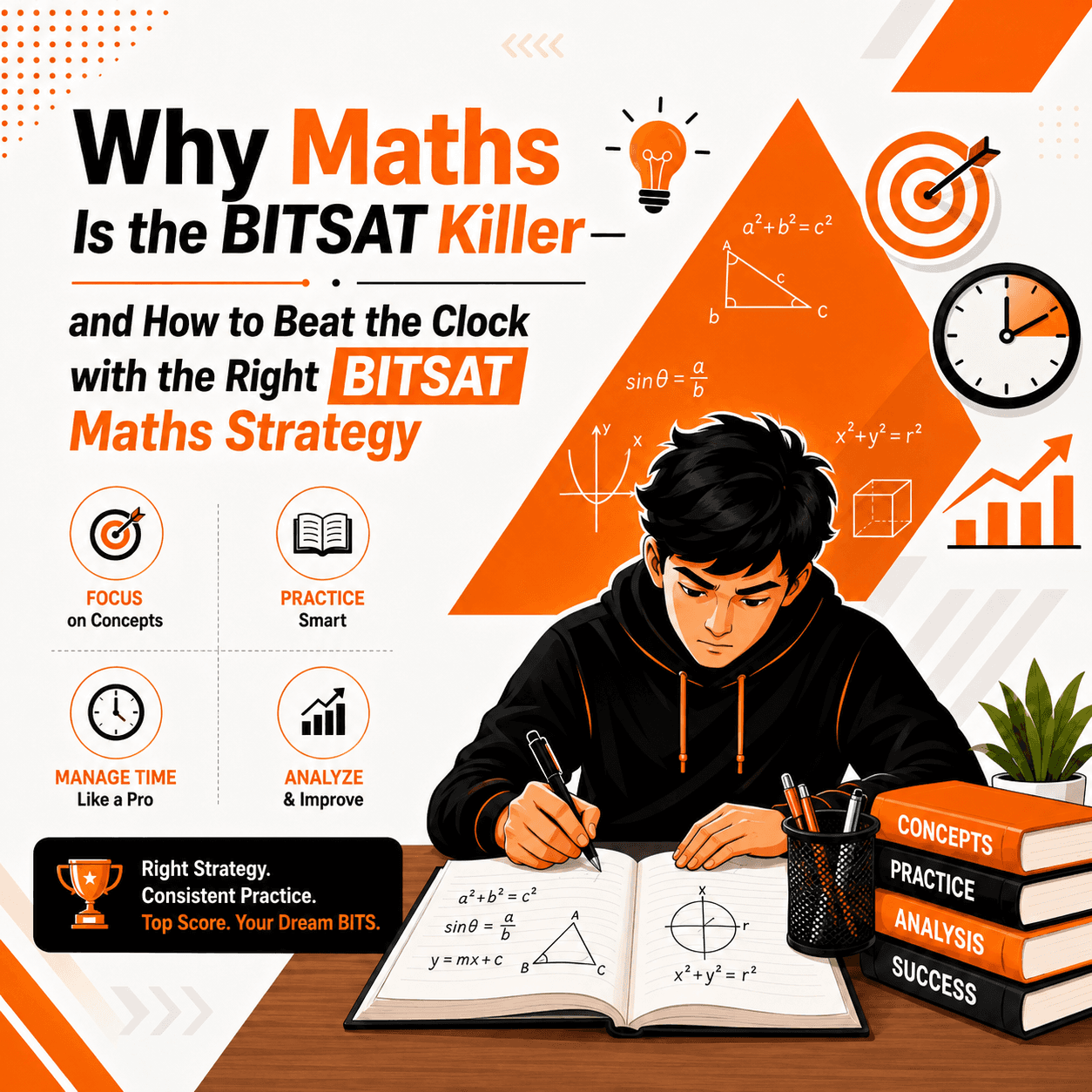
Every BITSAT aspirant eventually realizes one thing: Maths is rarely the hardest section conceptually, but it is almost always the most dangerous section strategically.
You may know formulas. You may solve questions correctly during practice. But inside the actual exam, Maths quietly drains your time, slows your momentum, and increases pressure across the paper. That is why students who score well in mocks still struggle to cross the 300 mark.
The difference usually comes down to one thing: execution.
The right BITSAT maths strategy is not about solving the toughest questions. It is about solving the right questions quickly, managing negative marking smartly, and maintaining speed without losing accuracy. If your goal is to improve speed, attempt more quality questions, and push toward a 300+ or even 330+ score, this guide will help you understand exactly how serious BITSAT aspirants approach Maths differently.
Understanding the BITSAT Exam Pattern First
Before building a strategy, you need to understand why BITSAT feels so different from other entrance exams.d too much time solving difficult Maths questions often lose marks in easier sections later. That is exactly why BITSAT maths time management becomes one of the biggest deciding factors in your final score.
2. BITSAT Rewards Speed More Than Deep Solving
One major mistake students make is treating BITSAT like JEE Main. That approach fails.
BITSAT is not designed for long problem-solving sessions. It rewards quick execution, fast calculations, smart skipping, and high attempt efficiency. Students who overthink questions usually lose valuable time. That is why improving BITSAT maths speed matters more than simply learning harder concepts.
3. Mental Fatigue Builds Faster Than Expected
The real issue is not one difficult question. It is solving 25 to 30 Maths questions continuously while the timer keeps moving. That leads to silly mistakes, sign errors, panic attempts, rushed guessing, and poor decision-making. Maths becomes dangerous when students stop managing energy and start reacting emotionally to the paper.
JEE Maths vs BITSAT Maths: Which Is Tougher?
One of the most common questions students ask is whether BITSAT Maths is harder than JEE Main. The honest answer is that JEE Main Maths is conceptually tougher, while BITSAT Maths is operationally tougher.
| Factor | JEE Main | BITSAT |
|---|---|---|
| Concept Difficulty | Higher | Moderate |
| Speed Requirement | Medium | Very High |
| Calculation Pressure | Higher | High |
| Time Per Question | More | Less |
| Negative Marking Pressure | Moderate | High |
Students shifting directly from JEE preparation often make one mistake: they solve too slowly. Understanding this difference early helps you adjust your preparation style before exam day.
Best BITSAT Maths Strategy for 300+ Score
The best strategy is not about maximizing attempts blindly. It is about maximizing efficient attempts. Top scorers usually follow a three-layer approach.
Phase 1: Build a Question Selection Mindset
Not every question deserves your time. Strong performers classify questions immediately into three categories.
Questions you solve instantly are those solvable within 45 to 60 seconds. These include matrices, determinants, direct formula application, basic coordinate geometry, and simple probability.
Questions you solve in the second round require moderate effort. These include algebra manipulation, moderate calculus, advanced probability, and conic sections.
Questions you skip immediately are time traps. These include long trigonometric simplification, messy integration, and calculation-heavy permutations.
This classification habit is the foundation of an effective BITSAT maths question solving strategy.
BITSAT Maths Time Management Strategy
A realistic time framework for the Maths section looks like this:
| Phase | Time Allocation | Goal |
|---|---|---|
| First Sweep | 25 - 30 Minutes | Solve easy and medium questions |
| Second Sweep | 15 - 20 Minutes | Return to moderate questions |
| Final Review | Remaining Time | Attempt only high-confidence questions |
The first sweep matters the most. Your goal should be fast momentum, confidence building, and low negative marking. Students who get stuck early usually lose control of the paper. Strong time management in BITSAT Maths is as much a psychological skill as it is a technical one.
How to Solve BITSAT Maths Faster
Improve Calculation Speed Daily
Most students lose time in calculations, not in concepts. Practice squares up to 30, cubes up to 20, percentage shortcuts, approximation methods, and fraction-decimal conversions. Even small improvements in calculation save significant time across 40 questions.
Keeping a dedicated BITSAT formula sheet handy during preparation and revising it regularly is one of the simplest habits that separates strong performers from average ones.
Reduce Unnecessary Rough Work
Students often write too much during solving. Train yourself to estimate faster, eliminate options mentally, simplify calculations early, and avoid full-length solving where shortcuts already exist. This is one of the easiest ways to improve your solving speed without changing how much you study.
Practice Under Timed Conditions
Untimed practice creates false confidence. Instead, solve 20 questions in 25 minutes, review mistakes immediately, and identify which chapters slow you down the most. Taking structured BITSAT mock tests regularly is how genuine speed develops. The performance data from each mock also helps you understand exactly where time is being lost.
High ROI Maths Chapters for BITSAT
Not all chapters offer the same scoring value. Prioritize based on how frequently they appear and how quickly they can be solved.
| Chapter | Priority Level |
|---|---|
| Matrices & Determinants | Very High |
| Coordinate Geometry | High |
| Algebra | Very High |
| Probability | High |
| Calculus Basics | High |
| Trigonometry | Moderate |
| Permutation & Combination | Moderate |
Students targeting higher scores should prioritize high-return chapters first and avoid spending equal time across all topics.
Score-Based BITSAT Strategy
Different score ranges require different preparation styles.
If your mock score is 180 to 220, focus on reducing negative marking, improving basic speed, strengthening English and Logical Reasoning, and selective Maths solving.
If your mock score is 220 to 280, focus on smarter attempt strategy, chapter prioritization, timed Maths practice, and mock analysis. This is where many students break into the 300 range.
If your mock score is 280 to 330+, your focus should shift toward advanced execution, minimizing silly mistakes, maintaining speed under pressure, and improving consistency. This is where BITSAT topper maths strategy becomes important.
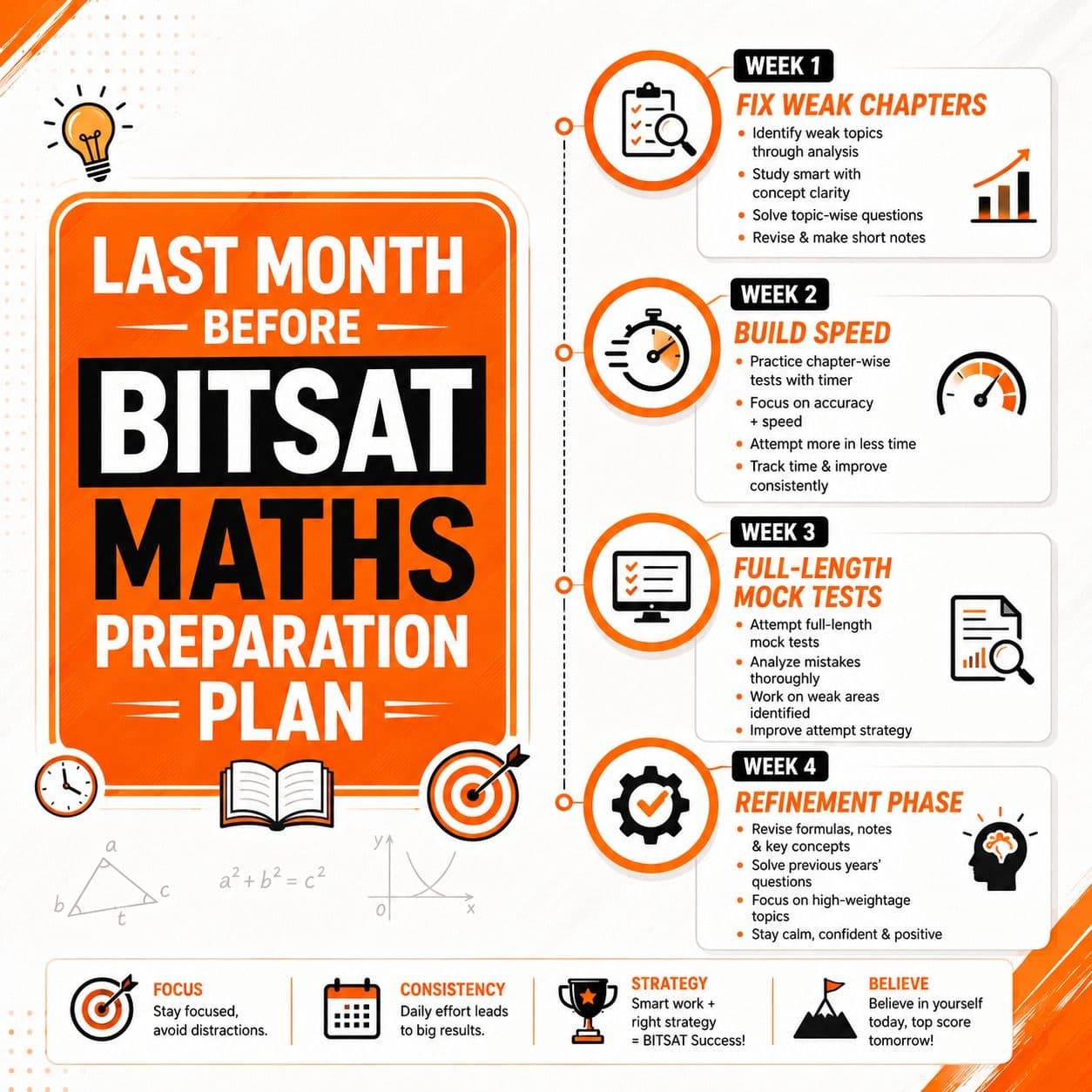
Last Month BITSAT Maths Preparation Plan
Week 1: Fix Weak Chapters
Prioritize algebra, probability, coordinate geometry, and calculus basics. Avoid jumping randomly between chapters. Focused revision of your weaker areas in the first week gives you the most improvement before the exam.
Week 2: Build Speed
Follow a daily routine of timed practice sets, calculation drills, formula revision, and error tracking. Speed only improves through deliberate repetition under time constraints.
Week 3: Full-Length Mock Tests
This is where your mock test strategy matters most. After every mock, identify slow chapters, review skipped questions, analyze negative marking patterns, and track time wasted per section. Mock analysis is often more valuable than simply taking additional mocks.
Week 4: Refinement Phase
Do not overload yourself with new topics in the final week. Focus only on revision, execution, speed stability, and confidence building. This is the smartest approach for last-month preparation, and it keeps you mentally sharp going into exam day.
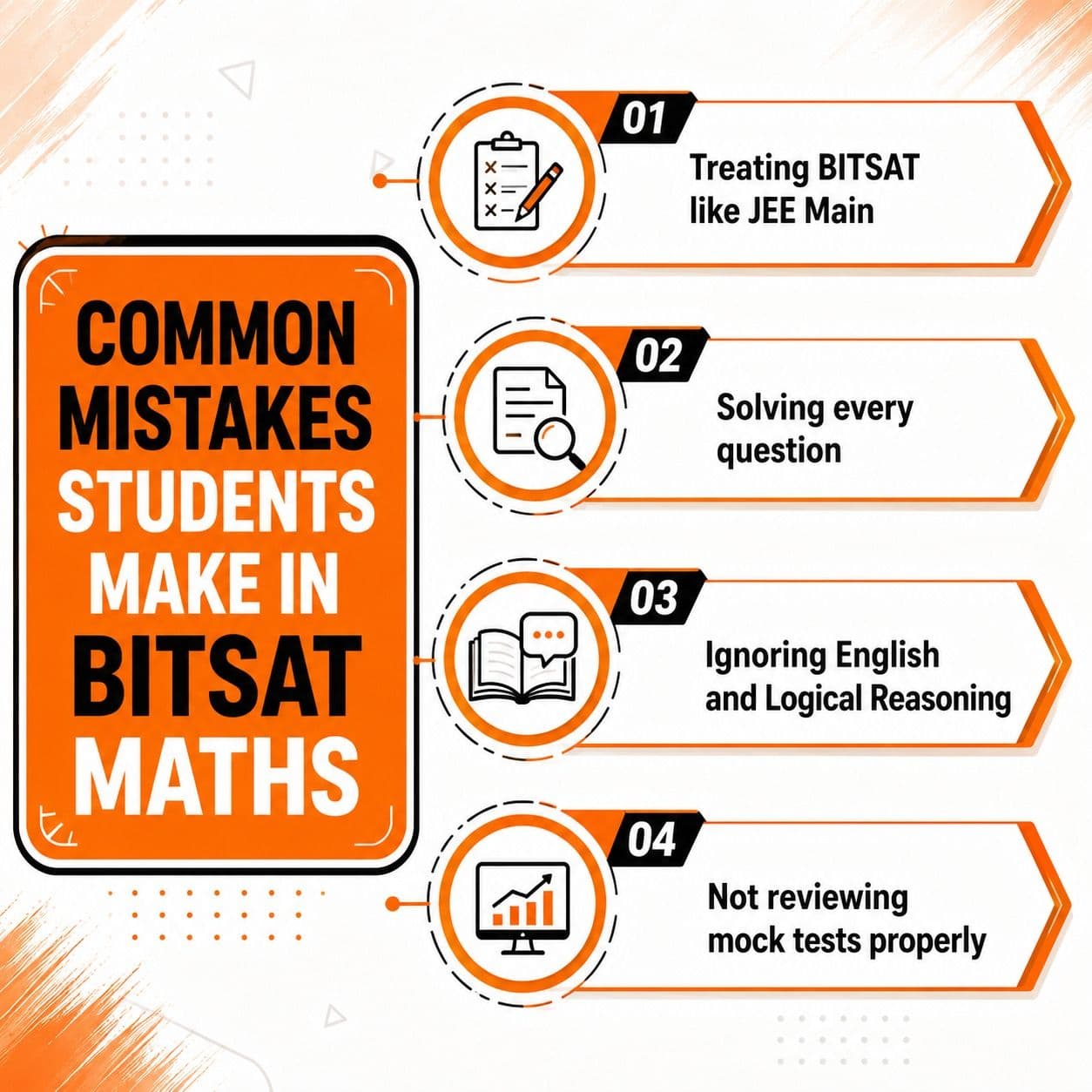
Treating BITSAT like JEE Main is perhaps the most common mistake. BITSAT rewards fast execution, not deep over-analysis. Carrying JEE habits into BITSAT preparation directly hurts your score.
Solving every question is another trap. Attempt obsession increases negative marking. Skipping strategically is not giving up — it is part of the plan.
Ignoring English and Logical Reasoning is a costly error. Many students try recovering everything through Maths. That backfires. These faster sections can lift your overall score more efficiently with far less effort.
Not reviewing mock tests properly is perhaps the single biggest mistake. Mocks without analysis rarely improve performance. Track repeated mistakes, slow chapters, panic attempts, and careless errors after each mock. The review session is where the real learning happens.
Smart Tools That Help Students Plan Better
Preparation becomes easier when decisions are based on data rather than assumptions.
College Predictors
After mock tests, students often wonder whether their score is enough, which branch they can realistically target, and whether another attempt is worth considering. Using a BITSAT college predictor helps you make smarter preparation decisions based on your current performance instead of guessing from random online opinions.
Mentorship and Strategy Guidance
Sometimes the problem is not concepts - it is execution. Getting guidance from students who have already cracked BITSAT can help you improve your attempt strategy, mock analysis approach, chapter prioritization, and exam temperament. The CrackIT mentorship program is built around exactly this kind of personalized, experience-based support. For many students, clarity from a mentor reduces stress more than additional study hours ever could.
If you want to understand what kind of results students are achieving with structured preparation and guidance, reading through student reviews gives you a grounded sense of what is possible.
Frequently Asked Questions
Why does BITSAT Maths consume the most time?
BITSAT Maths usually consumes the most time because many questions involve multi-step calculations, approximation, and faster decision-making compared to other sections.
How many Maths questions are there in BITSAT?
BITSAT typically includes 40 Mathematics questions within the standard 130-question paper pattern.
How can I improve speed in BITSAT Maths?
Practice timed question sets, improve calculation speed, reduce unnecessary rough work, and analyze mock test mistakes consistently.
What is the best BITSAT maths strategy?
The best BITSAT maths strategy combines selective solving, strong time management, faster calculations, and regular mock analysis.
Is BITSAT Maths harder than JEE Main Maths?
JEE Main Maths is tougher conceptually, while BITSAT Maths is more difficult from a speed and execution perspective.
Can I score 300+ with weak Maths?
Yes. Students can still score 300+ through strong Physics, Chemistry, English, and Logical Reasoning performance combined with smart selective attempts in Maths.
Conclusion
Maths becomes the BITSAT killer only when students approach it with the wrong mindset. This exam is not about solving the hardest questions in the room. It is about solving the right questions quickly while maintaining accuracy and calm decision-making.
The right BITSAT maths strategy combines speed, selection, mock analysis, and disciplined execution. Once students stop treating BITSAT like a traditional theory-heavy exam and start treating it like a speed-driven test, score improvement becomes far more realistic.
Stay consistent, trust your preparation, and keep refining your execution. A 300+ score is absolutely achievable with the right approach.
Categories
Join the Discussion
0 comments