Table of Contents
BITSAT Mock Test Analysis: What Your Score Is Actually Telling You (And What to Fix)
Pratham Jiwnani
5/22/2026

You're taking BITSAT mocks regularly, putting in long study hours — and your score refuses to move. The problem is almost never lack of effort. It's lack of BITSAT mock test analysis.
A mock test is not just a score report. It tells you whether your strategy is working, which chapters are silently costing you marks, and whether careless mistakes are undoing hours of revision. BITSAT has 130 questions across 5 sections in 180 minutes — that's 83 seconds per question. Every pattern hidden inside your mock result matters.
This guide will show you exactly how to read those patterns and fix them.
Key Takeaways
- Accuracy beats attempts every time under BITSAT's negative marking scheme
- Subject-wise breakdown reveals more than your total score ever will
- Most students stuck at 220–250 have an analysis problem, not a preparation problem
- English + Logical Reasoning is the fastest scoring opportunity most students ignore
What Is a Good BITSAT Mock Score?
Before fixing your score, you need to know where you stand.
| Mock Score | What It Signals | Recommended Action |
|---|---|---|
| Below 180 | Major conceptual gaps | Rebuild fundamentals; pause full mocks |
| 180 –220 | Basic prep, inconsistent | Fix concept gaps, reduce blind guessing |
| 220 –260 | Competitive zone | Improve accuracy and section timing |
| 260 – 300 | Strong preparation | Refine strategy, fix small leaks |
| 300+ | Excellent position | Maintain consistency, avoid burnout |
The key metric is trend, not a single number. A student moving 250 → 268 → 282 over three weeks is in a far stronger position than someone jumping randomly between 210 and 290.
How to Analyse a BITSAT Mock Test: Step-by-Step
Step 1: Check Accuracy, Not Just Attempts
Here is a calculation most students never do:
| Metric | Student A | Student B |
|---|---|---|
| Attempted | 125 | 105 |
| Correct | 82 | 90 |
| Wrong | 43 | 15 |
| Net Score | 203 | 255 |
Student B attempted 20 fewer questions and scored 52 marks more.
This is what BITSAT speed vs accuracy actually means. Blind attempts don't save time — they destroy your score through negative marking.
Step 2: Subject-Wise BITSAT Score Analysis
Your total score hides what's actually wrong. Break every mock into five separate reviews:
- Physics — Are you spending too long on formula-heavy questions?
- Chemistry — Are you dropping easy NCERT marks through carelessness?
- Mathematics — Is this section eating into your English + LR time?
- English Proficiency — Are you leaving this to the last 5 minutes?
- Logical Reasoning — Are you treating this as filler?
Ask after every mock: Which section had the worst accuracy? Which took the most time per mark? These two questions alone are worth more than any generic study plan.
English + LR together carry 35 questions. Most students can answer these in under 12 minutes at 85–90% accuracy, a higher scoring rate than any other section. Don't ignore it. See: BITSAT English Section: Syllabus and Strategy →
Step 3: Time Audit Per Section
Poor pacing is one of the top reasons students ask "why is my BITSAT score not improving?"
High scorers (300+) on CrackIT's platform follow this time distribution:
| Section | Ideal Time |
|---|---|
| Physics | 35 - 40 minutes |
| Chemistry | 30 - 35 minutes |
| Mathematics | 55 - 60 minutes |
| English + Logical Reasoning | 10 –15 minutes |
Compare your actual time to this after every mock. If you spent 75 minutes on Maths, that's your diagnosis not a mystery.
For a complete section-wise attempt strategy: BITSAT Time Management Strategy 2026 →
Step 4: Build an Error Log
Every wrong answer has a cause. Treating all mistakes as "careless" is a preparation mistake in itself.
| Mistake Type | What It Means | Fix |
|---|---|---|
| Concept Error | Incomplete topic understanding | Revise chapter before next mock |
| Calculation Error | Right method, wrong arithmetic | Slow down at the calculation step |
| Time Pressure Error | Panic attempt near section end | Fix section pacing |
| Guesswork Error | Blind attempt on unknown question | Skip and return; never guess randomly |
| Reading Error | Misread the question | Underline key terms while reading |
Track this in a notebook after every mock. Within two weeks, patterns will appear — and those patterns are your actual study plan.
Step 5: Write a 3-Point Post-Mock Action Plan
Every review session should end with three specific actions:
- One concept to revise (with chapter name and source)
- One timing habit to adjust (e.g., "cap Maths at 55 minutes from next mock")
- One question type to drill (e.g., "10 Electromagnetism problems before Saturday")
This turns a passive review into active improvement.
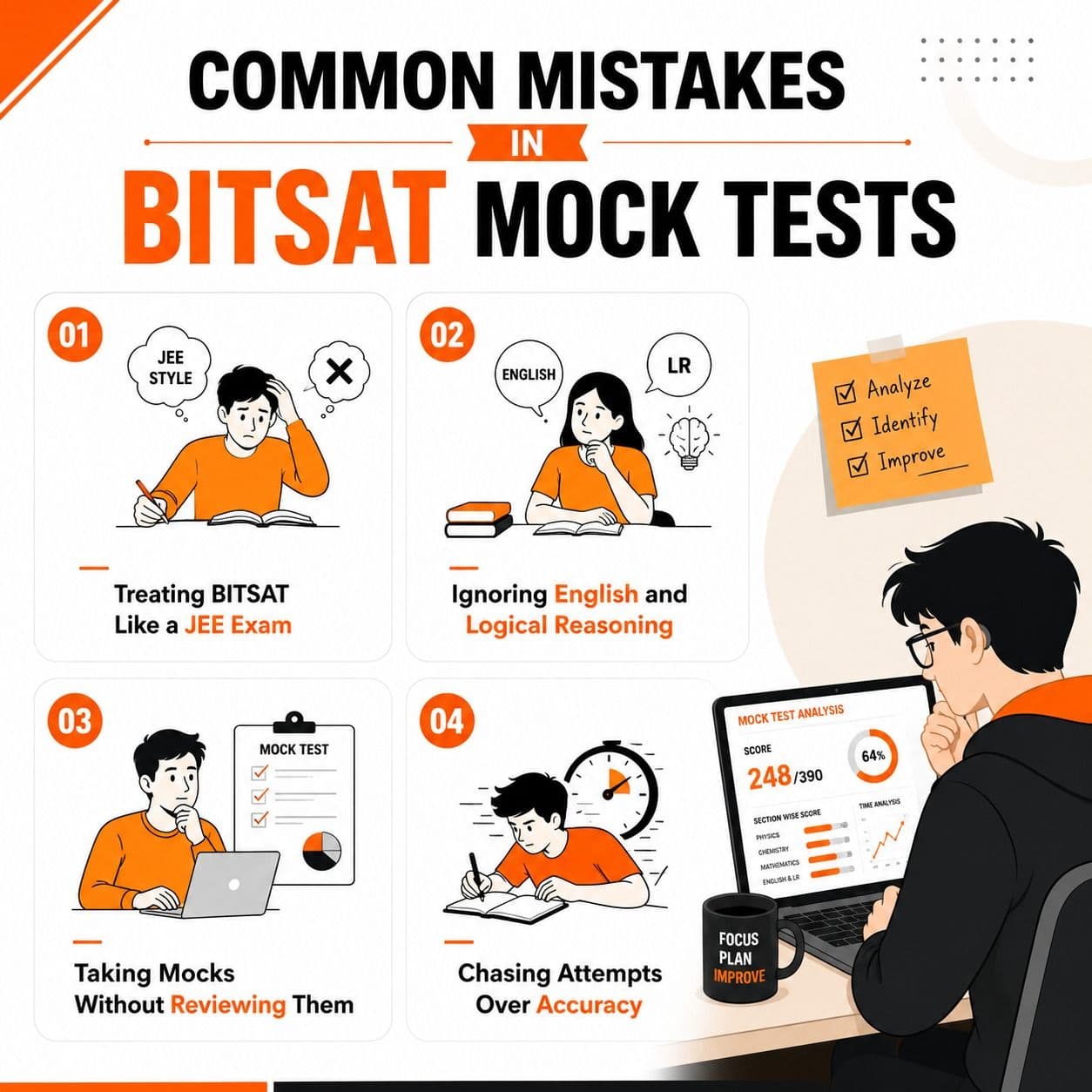
Common Mistakes in BITSAT Mock Tests
Treating BITSAT Like a JEE Exam
BITSAT rewards speed, accuracy, and decision-making across a broad syllabus. JEE-style deep solving on a single problem wastes your most valuable resource in this exam: time. If you're spending 7 minutes on one Maths question, your attempt strategy needs a reset.
Ignoring English and Logical Reasoning
These two sections are the most under-prepared and the most over-rewarding in BITSAT. 35 questions in under 12 minutes at high accuracy - that's genuinely the fastest path to 30 extra marks on your total.
Taking Mocks Without Reviewing Them
Taking a mock without reviewing it properly is like taking a diagnostic test and throwing away the results. The 20–30 minute window after a mock - ideally within 24 hours -is when learning from mistakes is fastest and most effective.
Chasing Attempts Over Accuracy
The Student A vs Student B table above says everything. A higher attempt count with low accuracy is a score-destruction strategy under BITSAT's marking scheme.
Score - Band Strategy: How to Improve BITSAT Mock Score
Below 200 — Rebuild First
Stop taking full mocks temporarily. Concept gaps are too large for mock repetition to fix.
- Focus on chapter-wise tests for Physics and Maths
- Target NCERT-level accuracy in Chemistry
- Return to full mocks after hitting 70%+ on chapter tests
200 - 250 — The Plateau Zone
This is where most students are stuck. Usually a mix of concept gaps and accuracy discipline issues.
- Identify the 3 weakest chapters across subjects using your error log
- Target 80%+ accuracy before focusing on speed
- Build and stick to a consistent section timing plan
For a full subject-wise plan: 4-Month BITSAT Preparation Roadmap
250 - 300 — Optimisation Mode
The foundation is solid. Now it's about consistency and execution.
- Maximise English + LR — fast marks, high yield
- Reduce careless errors by slowing down on calculations deliberately
- Analyse time data after every mock to find inefficient question choices
Don't experiment. Don't overwork.
- 3 mocks per week, full review of wrong answers only
- Avoid reckless over-attempting
- Know your college options: Use the CrackIT BITSAT College Predictor
How Many Mock Tests for BITSAT 2026?
| Stage | Recommended Frequency |
|---|---|
| 3+ months before exam | 1 full mock per week |
| 6 – 12 weeks before exam | 2 full mocks per week |
| Final 4 weeks | 3 - 4 full mocks per week |
15 - 20 properly analysed mocks will produce better results than 40–50 mocks taken without review.
Short on time? Read: Crack BITSAT in 20 Days — Strategy That Works
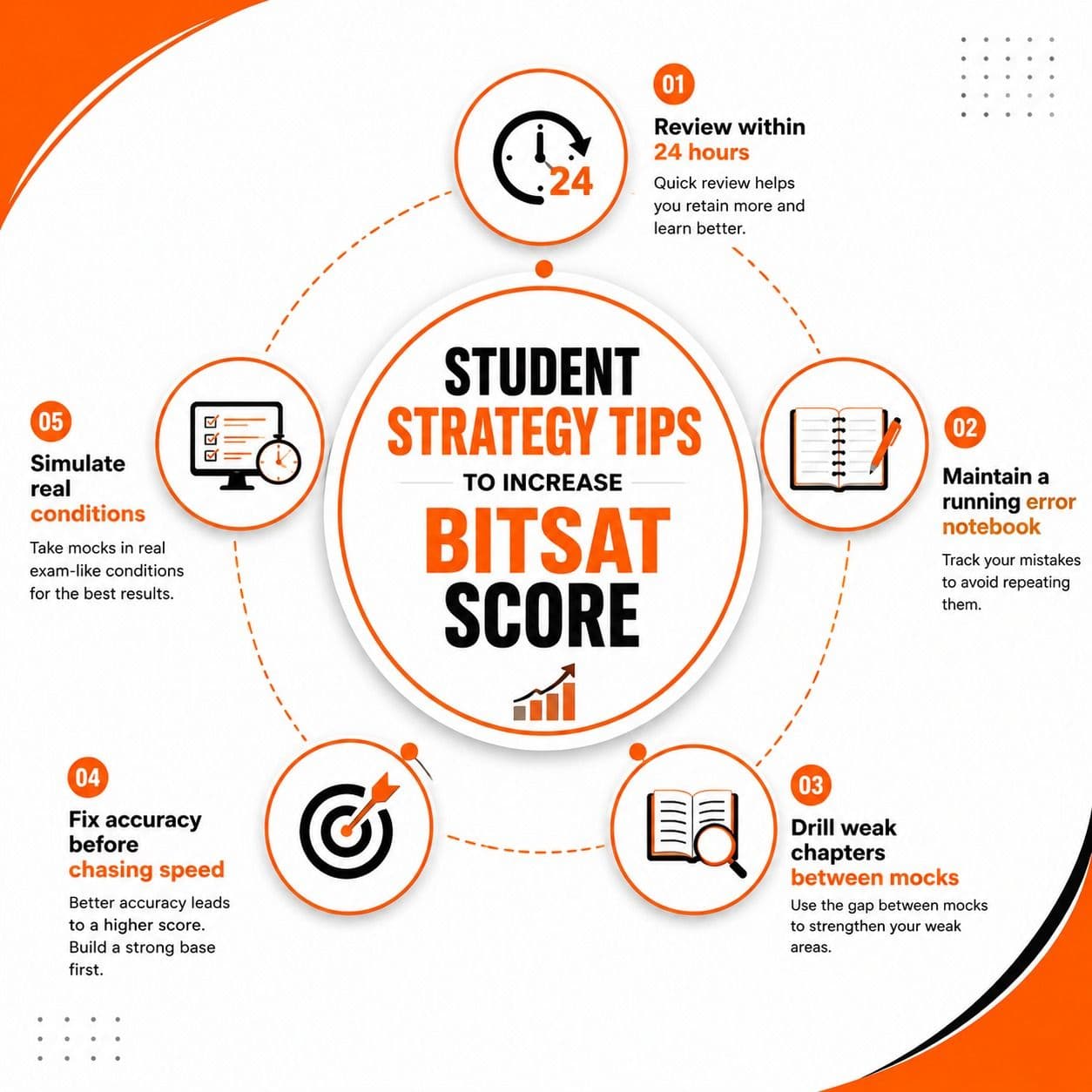
- Review within 24 hours. The memory of your reasoning is sharpest immediately after the mock.
- Maintain a running error notebook. Not a folder of screenshots — a written log with cause and fix for each mistake.
- Drill weak chapters between mocks. Mocks alone don't fix concept gaps; targeted chapter practice does.
- Fix accuracy before chasing speed. A student at 80% accuracy and 105 attempts scores more than one at 65% accuracy and 130 attempts.
- Simulate real conditions. Take mocks at the same time as your actual BITSAT slot, no phone, no pauses. Anxiety drops when the environment becomes familiar.
Ready to Analyze Smarter?
CrackIT's BITSAT Test Series is built by BITSians — 20 full-length mocks with per-question analytics, video solutions, and a personalised improvement plan after every test. Calibrated to the real BITSAT pattern, not a generic JEE question bank.
One CrackIT student who started at 189 reached 270+ in 6 weeks through structured mock analysis and 1-on-1 mentorship.
Start Your First BITSAT Mock on CrackIT
Conclusion
A BITSAT mock score is not just a number — it's a detailed report on your preparation. Proper BITSAT mock test analysis tells you whether your problem is accuracy, time management, weak concepts, or strategy.
The students who improve fastest are not the ones taking the most mocks. They're the ones extracting the most insight from each one.
Stop taking mocks blindly. Start analysing them deeply. Fix the right problem, and your score will move.
Scoring 260+ already? Find out which BITS campus and branch is realistic for you: Try the Free CrackIT College Predictor
Frequently Asked Questions (FAQs)
What is a good mock score in BITSAT?
A score above 250 is considered competitive for most BITS campuses. Scoring 300+ puts you in contention for top branches at BITS Pilani. Consistency across multiple mocks matters far more than one isolated high score.
How do I analyse a BITSAT mock test performance?
Review subject-wise accuracy, identify your weakest chapters, audit time spent per section, categorise wrong answers by mistake type, and write a 3-point correction plan before your next mock. Do this within 24 hours of every test.
Why is my BITSAT score not improving despite taking many mocks?
The most common cause is reviewing mocks without a structured system. Unresolved concept gaps and repeated uncategorised mistakes compound over time. Build an error log, fix the patterns it reveals, and improvement follows.
How many mock tests should I take for BITSAT 2026?
15–20 quality, fully analysed mocks is the recommended minimum for serious aspirants. In the final 4 weeks, 3–4 mocks per week is optimal. Analysed mocks always outperform unreviewed ones regardless of quantity.
How do I improve accuracy in BITSAT mocks?
Stop attempting questions you're unsure about. Set a personal rule: only attempt if you're 70%+ confident in the method. Maintain a mistake log and drill weak chapters between mocks. Track accuracy trend, not just score trend.
How to identify weak chapters for BITSAT?
After each mock, sort your wrong answers by chapter. Any chapter with 3 or more errors in two consecutive mocks is a confirmed weak area. Spend 2 focused days on that chapter before your next full mock.
Categories
Join the Discussion
0 comments