Table of Contents
IIITH UGEE 2026: Exam Pattern, Syllabus, Dates & Selection Process Explained
Pratham Jiwnani
2/8/2026
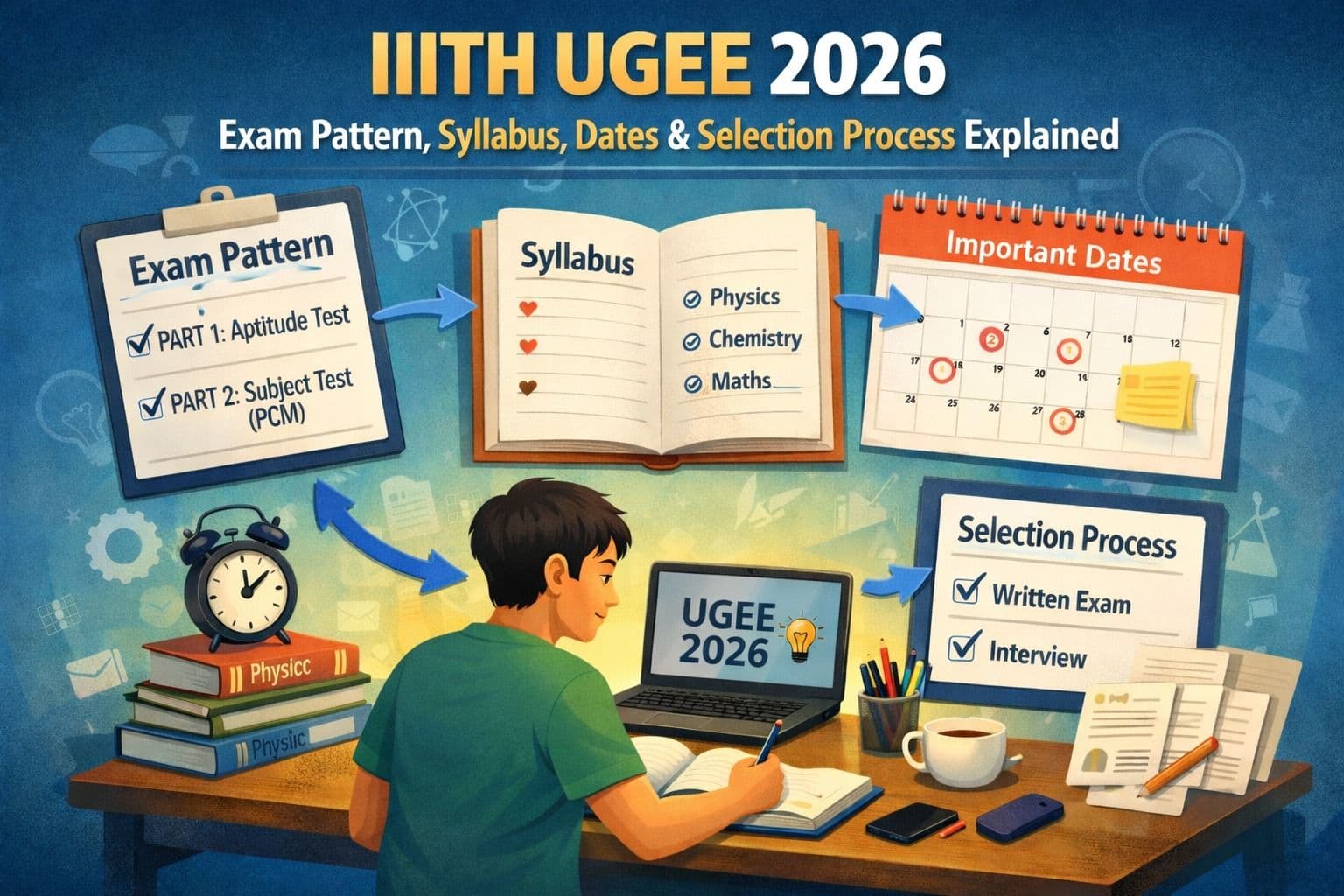
Preparing for IIIT Hyderabad through UGEE (Undergraduate Entrance Examination) is fundamentally different from preparing for JEE or other engineering entrance exams. UGEE is designed to identify students with deep conceptual understanding, analytical reasoning ability, and research aptitude, not just speed or memorization.
This guide explains the IIITH UGEE 2026 exam pattern and syllabus, SUPR and REAP structure, selection process, expected exam timeline, marking approach, and a practical preparation roadmap for serious aspirants.
If you are genuinely targeting IIIT Hyderabad through UGEE, strategy not just effort makes the difference.
IIITH UGEE 2026 includes two sections SUPR (Subject Proficiency Test) and REAP (Research Aptitude Evaluation) followed by an interview. The exam prioritizes conceptual understanding and analytical reasoning over speed, requiring preparation beyond standard JEE methods.
IIITH UGEE is a research-focused entrance exam for dual-degree programs at IIIT Hyderabad. It has two written sections that test subject fundamentals and analytical reasoning, followed by an interview. Candidates must qualify the subject section before reasoning scores are considered for shortlisting.
Quick Snapshot - IIITH UGEE 2026
| Exam Name | IIITH UGEE 2026 |
|---|---|
| Sections | Two - SUPR and REAP |
| Mode | Computer Based Test |
| Focus | Concept, Reasoning & Aptitude |
| Selection Stages | Written Test + Interview |
| Programs | Dual Degree (BTech + MS by Research) |
What Is IIITH UGEE 2026?
IIITH UGEE (Undergraduate Entrance Examination) is a research-focused admission channel for IIIT Hyderabad’s dual-degree programs. Unlike conventional entrance exams, UGEE is structured to assess whether a student can:
- Think analytically
- Apply concepts deeply
- Solve unfamiliar, non-routine problems
- Demonstrate logical and research-oriented thinking
- Clearly explain reasoning
This is why UGEE includes a dedicated Research Aptitude Evaluation (REAP) section, which most engineering entrance exams do not test.
In simple terms, UGEE evaluates both subject proficiency and analytical reasoning ability, followed by an interview to assess intellectual maturity.
Programs Offered Through UGEE
UGEE is primarily used for admission into research-oriented dual-degree tracks such as:
- BTech in Computer Science + MS by Research
- BTech in Electronics & Communication + MS by Research
The exact list of programs and seat intake is officially announced each year in the UGEE admission brochure.
IIITH UGEE 2026 Exam Pattern and Syllabus - Complete Breakdown
UGEE 2026 Paper Pattern
The exam consists of two sections conducted in a single sitting.
| Section | Purpose | Nature |
|---|---|---|
| SUPR | Subject Proficiency Test | Tests PCM fundamentals conceptually |
| REAP | Research Aptitude Evaluation | Tests reasoning, analysis, and logical thinking |
Exam Mode and Structure
| Parameter | Details |
|---|---|
| Mode | Computer Based Test |
| Total Duration | ~2.5–3 hours |
| Sections | SUPR + REAP |
| Question Type | Objective |
| Evaluation | Section-based evaluation |
| Interview After Test | Yes |
IIITH UGEE 2026 Marking Scheme
The UGEE marking scheme is section-dependent and officially confirmed only in the yearly UGEE brochure. Based on consistent past patterns:
- SUPR: Marks awarded for correct answers; usually no negative marking
- REAP: Higher analytical emphasis; negative marking is typically applied
Because REAP carries higher analytical weight, accuracy matters more than guessing.
Candidates should always verify the official marking scheme from the current UGEE admission brochure.
UGEE 2026 SUPR and REAP Syllabus
The UGEE syllabus is unique. Unlike most exams, it does not publish a strict micro-topic list. The syllabus scope covers Class 11–12 fundamentals plus reasoning skills.
SUPR Syllabus (Subject Proficiency)
| Subject | Core Areas |
|---|---|
| Mathematics | Calculus, Algebra, Coordinate Geometry, Probability, Functions |
| Physics | Mechanics, Electricity & Magnetism, Waves, Thermodynamics, Modern Physics |
| Chemistry | Physical chemistry fundamentals, Organic basics, Inorganic principles |
Preparation for SUPR requires strong conceptual depth, not surface memorization. The test rewards understanding - not formula recall.
REAP Syllabus
The REAP section does not follow a chapter-wise syllabus. Instead, it tests reasoning aptitude and analytical skills.
| Skill Area | What It Tests |
|---|---|
| Logical Reasoning | Deduction, patterns, sequences |
| Analytical Thinking | Multi-step reasoning |
| Mathematical Reasoning | Structured logical thinking |
| Data Interpretation | Pattern extraction |
| Problem Solving | Non-routine approaches |
There is no fixed textbook for REAP. Preparation is largely practice-driven.
IIITH UGEE 2026 Selection Process Explained
How UGEE Selection Works
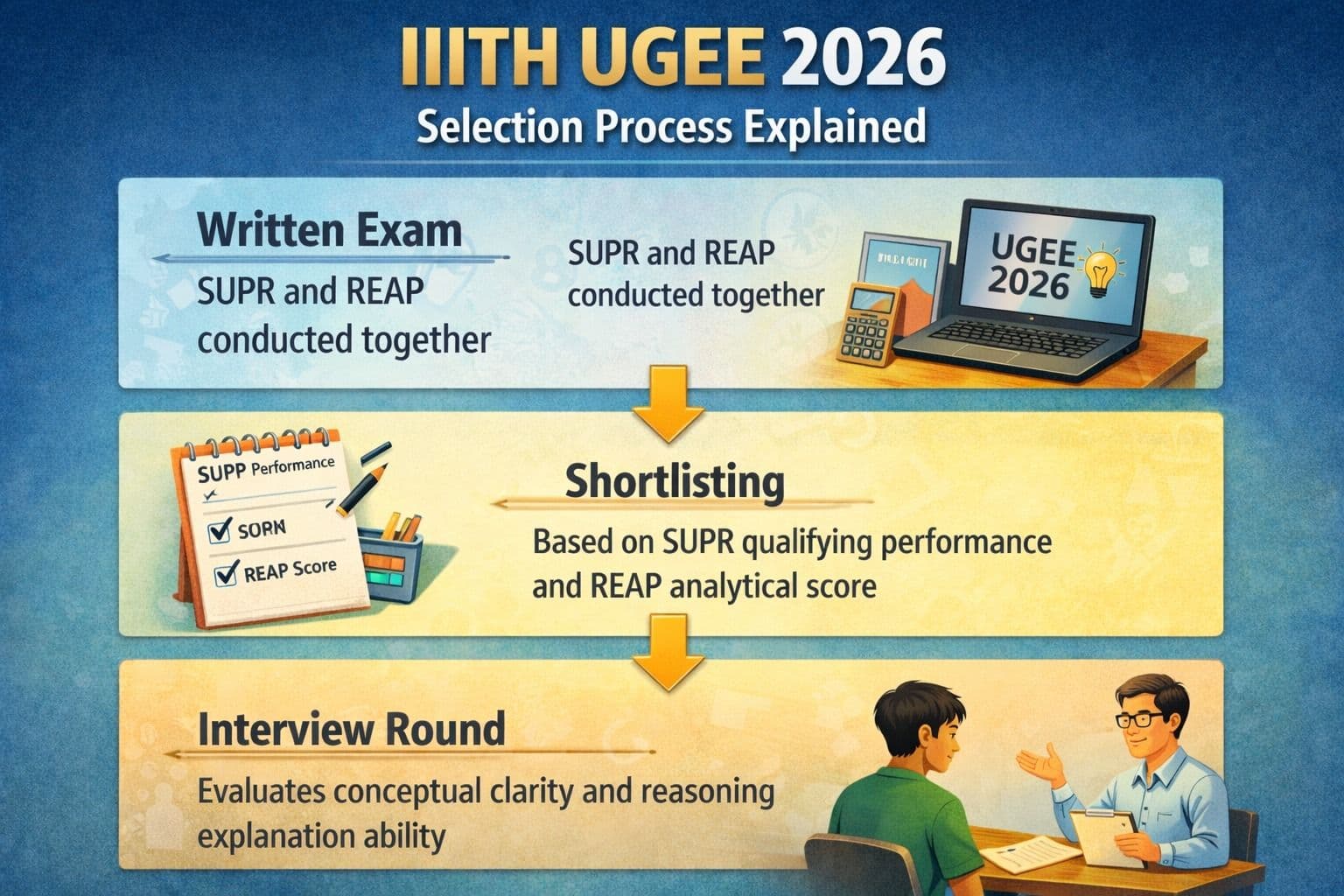
UGEE selection has three stages:
- Written Exam – SUPR and REAP conducted together
- Shortlisting – Based on SUPR qualifying performance and REAP analytical score
- Interview Round – Evaluates conceptual clarity and reasoning explanation ability
A candidate must qualify SUPR before their REAP performance is evaluated for shortlisting.
Shortlisting Factors
- SUPR qualifying performance
- REAP analytical performance
- Overall aptitude profile
- Cutoffs vary each year based on difficulty and competition
UGEE 2026 Interview Process
Shortlisted candidates are invited for an interview that evaluates:
- Conceptual clarity
- Reasoning explanation ability
- Approach to unfamiliar problems
- Mathematical maturity
- Curiosity and research mindset
Interview performance plays an important role in the final selection.
IIITH UGEE 2026 Exam Dates
Students often search for the UGEE exam timeline. Based on typical annual cycles:
| Event | Expected Window |
|---|---|
| Application Start | January–February 2026 |
| Application Close | March 2026 |
| UGEE Exam | April 2026 |
| Result | May 2026 |
| Interviews | June 2026 |
Always verify the official UGEE portal for confirmed dates when released.
UGEE vs JEE - Key Mindset Difference
| Factor | UGEE | JEE |
|---|---|---|
| Speed | Moderate | High |
| Reasoning | Very High | Moderate |
| Concept Transfer | High | Medium |
| Pattern | Analytical & mixed | Formula-driven |
| Interview | Yes | No |
While JEE preparation helps in SUPR due to overlapping PCM fundamentals, UGEE requires additional reasoning and analytical practice, especially for REAP and interview readiness.
How to Prepare for IIITH UGEE 2026
Successful preparation for UGEE requires two parallel tracks - SUPR and REAP.
SUPR Preparation Strategy
- Strengthen PCM fundamentals
- Practice application-based problems
- Maintain an error log
- Revise theory with problem solving
- Focus on concept understanding, not memorization
REAP Preparation Strategy
- Solve logical puzzles daily
- Practice multi-step reasoning sets
- Train pattern recognition
- Work on data interpretation
- Explain solutions verbally
Thinking clarity is more important than speed.
Weekly UGEE Preparation Plan (Sample)
| Day | Focus |
|---|---|
| Monday | SUPR Mathematics |
| Tuesday | SUPR Physics |
| Wednesday | REAP Reasoning |
| Thursday | SUPR Chemistry |
| Friday | Mixed Practice |
| Saturday | Mock Test |
| Sunday | Review & Weak Areas |
Common UGEE Preparation Mistakes
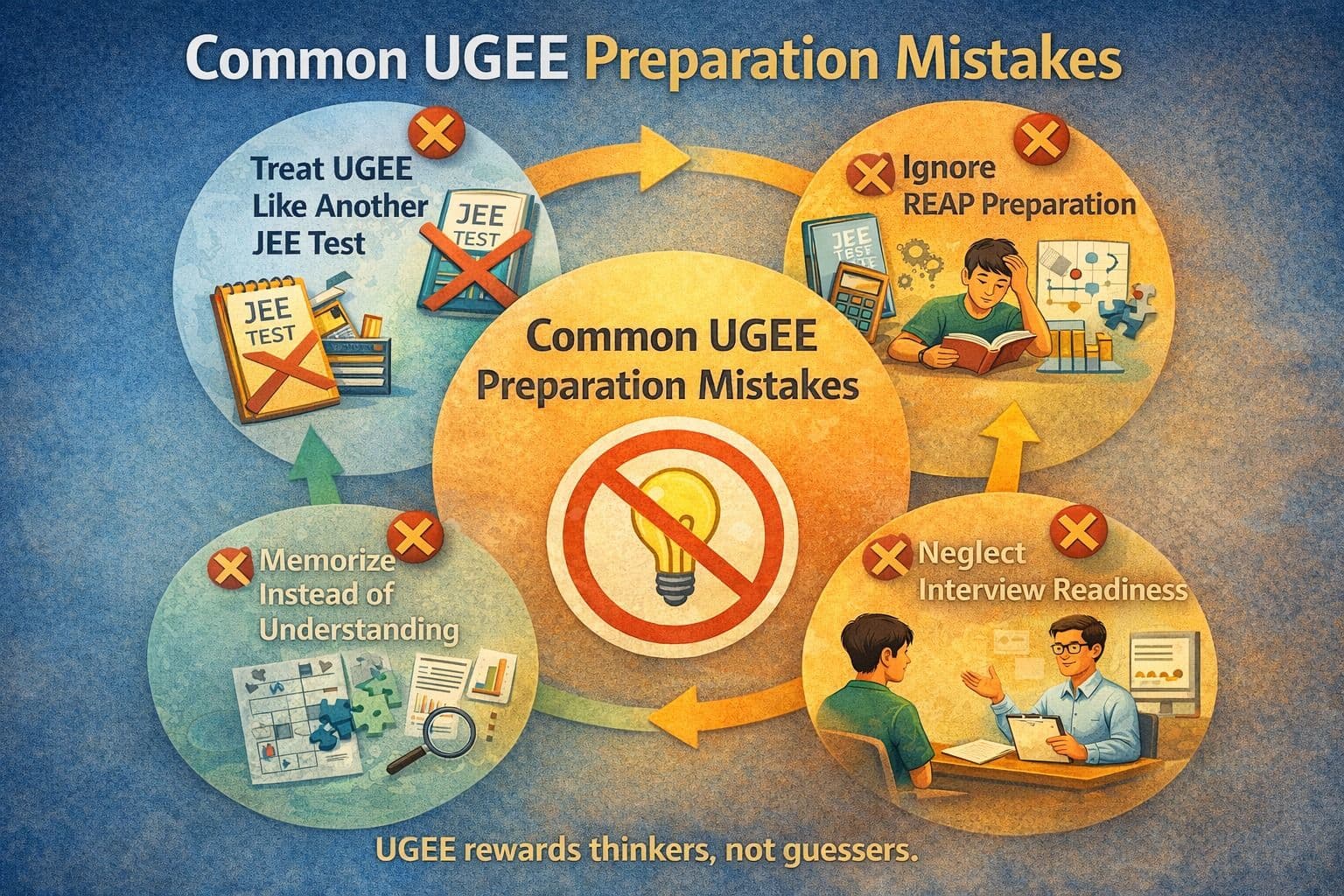
Students often underperform because they:
- Ignore REAP preparation
- Treat UGEE like another JEE test
- Memorize instead of understanding
- Avoid reasoning drills
- Neglect interview readiness
UGEE rewards thinkers, not guessers.
Conclusion
The IIITH UGEE 2026 exam pattern and syllabus is designed to identify deep thinkers and future researchers. SUPR evaluates subject fundamentals, REAP measures analytical reasoning, and the interview tests intellectual maturity. Students who prepare with concept clarity, reasoning discipline, and articulation practice gain a real advantage in the UGEE selection process. Prepare to think, not just solve.
- UGEE is a research-oriented entrance exam for IIIT Hyderabad dual-degree programs
- It evaluates conceptual understanding and analytical reasoning — not just speed
- The written test has two sections: SUPR (subject fundamentals) and REAP (reasoning ability)
- Both sections are taken in a single computer-based exam session
- Candidates must clear SUPR for shortlist consideration
- Shortlisted students go through an interview round
- Strong concept clarity and reasoning practice are more important than JEE-style preparation
FAQs
What is the exam pattern of IIITH UGEE 2026?
IIITH UGEE consists of two sections - SUPR (Subject Proficiency Test) and REAP (Research Aptitude Evaluation). SUPR tests PCM fundamentals while REAP evaluates logical reasoning and analytical thinking. Both are followed by an interview round.
What is the syllabus for IIITH UGEE 2026?
The UGEE syllabus includes Class 11–12 PCM fundamentals for SUPR. The REAP section focuses on reasoning, analytical ability, pattern recognition, and problem solving.
Is there negative marking in IIITH UGEE?
Negative marking usually applies in REAP, while SUPR often has no negative marking. Check the official UGEE brochure for exact details.
How does the UGEE selection process work?
Selection includes a written test, shortlisting based on performance, and an interview. Candidates must qualify SUPR before REAP is considered.
Is JEE preparation enough for UGEE?
JEE preparation helps in SUPR, but UGEE also requires reasoning and interview readiness, making focused preparation essential.
Categories
Join the Discussion
0 comments